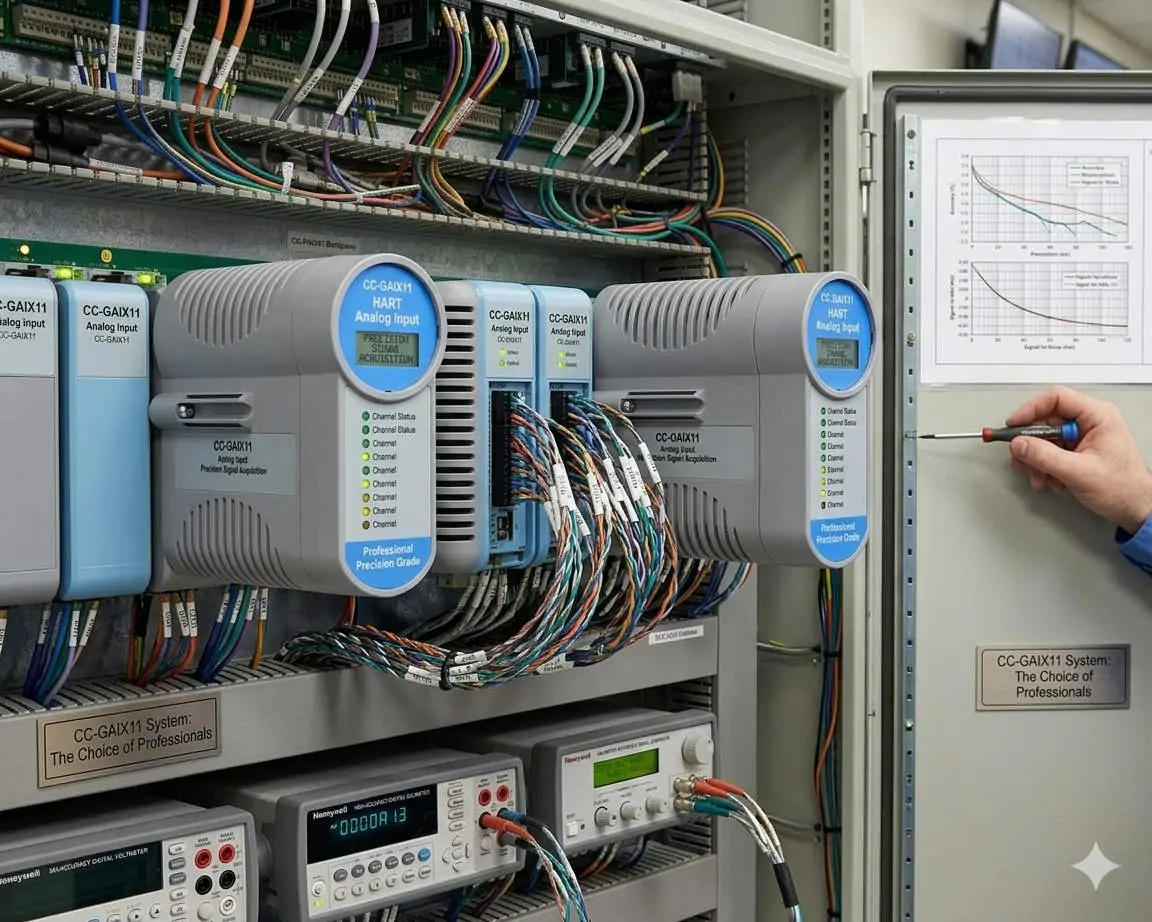
Maximizing Signal Integrity with the CC-GAIX11 Analog Input Module
The CC-GAIX11 analog input module delivers high-precision signal acquisition for complex industrial environments. Signal integrity is critical in multi-channel systems where accuracy defines success. Cross-talk between channels often leads to measurement drift and unstable process control. By mitigating these interferences, the module ensures reliable data for petrochemical and pharmaceutical sectors. At Oiltech Controls, we believe high-quality acquisition is the foundation of safe plant operation.
The Importance of Inter-Channel Isolation Voltage
Isolation levels between channels directly influence the severity of cross-talk. High isolation voltage reduces capacitive coupling between adjacent inputs. In dense DCS cabinets, insufficient isolation distorts sensitive 4–20 mA signals. As a result, noisy channels can trigger inaccurate control loops or unnecessary shutdowns. Therefore, choosing modules with superior isolation is vital for maintaining high-density I/O performance.
Input Impedance and Advanced Signal Conditioning
High input impedance minimizes loading effects on your field instruments. It effectively reduces unintended signal paths between different channels. When combined with internal filtering, this impedance helps suppress cross-channel interference. In flow or pressure measurements, poor impedance matching introduces cumulative errors. These subtle inaccuracies degrade overall plant efficiency during long-term continuous manufacturing.
Sampling Architecture: Dedicated ADC vs. Multiplexing
The internal sampling design significantly affects how a module handles interference. Multiplexed ADCs share signal paths, making them more susceptible to ghost signals. In contrast, designs using a dedicated ADC per channel offer much better isolation. For fast-changing processes like batch reactors, dedicated architecture prevents misleading operator data. This ensures that every control action stays based on true, isolated field variables.
Best Practices for Cable Routing and Shielding
- Maintain Separation: Keep analog signal cables 15 cm away from power lines.
- Use Shielded Pairs: Deploy shielded twisted-pair cables for all critical analog loops.
- Single-Point Grounding: Ground the shield only at the control cabinet side.
- Avoid Sharp Bends: Ensure cable routing minimizes mechanical stress on internal conductors.
Field Insights from Oiltech Controls
In our experience, simple installation fixes often solve complex noise issues. We once reduced noise by 60% in a chemical plant just by rerouting cables. Improper grounding remains a frequent cause of unstable readings during commissioning. Therefore, always implement a single-point grounding system compliant with IEC 60364 standards. For genuine Honeywell hardware and expert advice, visit Oiltech Controls Limited to secure your DCS components.
Application Scenarios for CC-GAIX11
- Refinery DCS Retrofits: Replacing legacy I/O to improve signal clarity in high-EMI zones.
- Pharma Batch Control: Ensuring zero cross-talk during rapid temperature and pressure sampling.
- Flow Meter Integration: Maintaining 0.1% accuracy over long-distance field wiring runs.
Frequently Asked Questions (FAQ)
1. How can I tell if cross-talk is affecting my DCS?
Look for correlated fluctuations across unrelated channels. If one noisy signal changes the value of another, cross-talk is likely the culprit.
2. Is the CC-GAIX11 backward compatible with older systems?
It generally maintains mechanical compatibility within its DCS family. However, you must verify power consumption and signal type support before installation.
3. Do I need external signal isolators with this module?
For channels exposed to extreme EMI or long-distance transmission, external galvanic isolators provide an extra layer of protection.