


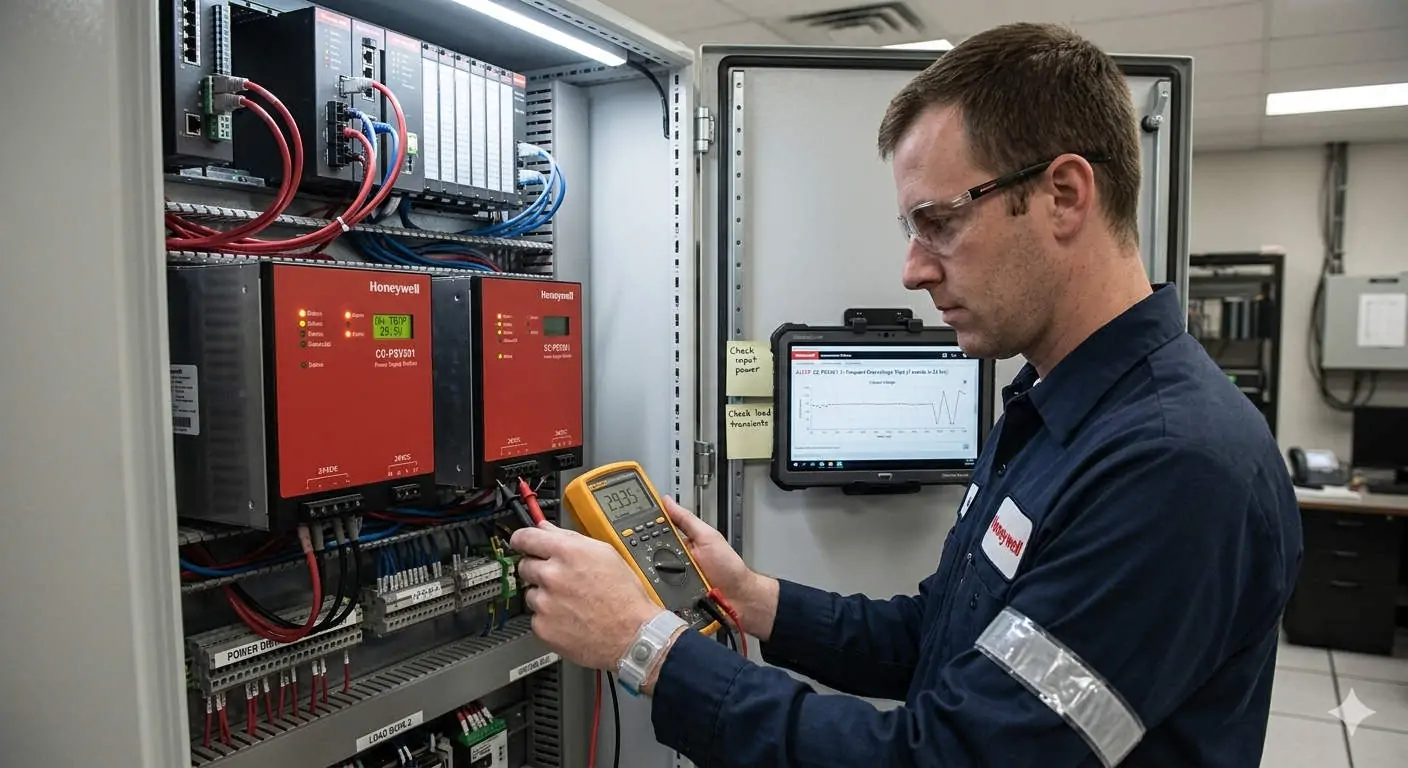
Troubleshooting Frequent Overvoltage Trips in Honeywell CC-PSV201 Modules
The CC-PSV201 module safeguards critical DCS components from abnormal voltage conditions. It ensures the stable operation of field instruments and I/O channels. In petrochemical and refining industries, power quality fluctuations occur frequently. Therefore, understanding overvoltage triggers is essential for process continuity. Frequent trips lead to unplanned shutdowns and costly production losses. At Oiltech Controls, we help you identify root causes to protect your sensitive hardware.
Understanding Overvoltage Thresholds and Protection Logic
The CC-PSV201 features a fixed protection threshold to prevent electronics damage. Frequent triggering usually indicates an unstable upstream power supply. For instance, generator fluctuations or poor UPS regulation often cause these spikes. Moreover, large inductive loads like motors can create transient surges. If the threshold is too tight, nuisance trips will occur. Conversely, a high threshold may stress module insulation over time.
Impact of Response Time on Voltage Transients
Fast response times in the millisecond range are critical for electronics protection. However, this high sensitivity makes the module react to short-duration spikes. In one refinery project, VFD switching noise caused repeated module trips. The PSV module performed correctly, but the system lacked proper EMI filtering. Consequently, faster response provides better protection but requires cleaner power conditioning. Engineers must address the electrical environment to prevent false overvoltage events.
Surge Immunity and EMC Compliance Standards
The CC-PSV201 complies with IEC 61000-4-5 standards for surge immunity. However, this compliance relies on proper system grounding and installation. Inadequate grounding often leads to repeated protection events in industrial plants. Shared grounding between power and signal circuits also compromises module immunity. Therefore, engineers must ensure low earth impedance to maintain equipment lifespan. Proper installation practices are just as important as the hardware specifications.
Installation and Maintenance Strategies for Reliability
- Analyze Power Quality: Use a power analyzer to check stability before replacing modules.
- Verify UPS Output: Ensure your UPS board is not failing and causing RMS variations.
- Improve Grounding: Implement single-point grounding for the entire control system.
- Separate Cable Runs: Segregate high-power cables from sensitive signal routing.
- Use Shielded Cables: Ensure proper termination to eliminate high-frequency switching noise.
The Importance of External Surge Protection
If your environment is prone to lightning or heavy surges, add external protection. Install Class II or III SPD devices upstream from the CC-PSV201. However, you must coordinate SPD ratings with the system voltage. Improper selection can conflict with the module’s internal logic. As a result, mismatched clamping voltages cause unnecessary trips. At Oiltech Controls, we recommend a layered defense strategy for maximum uptime.
Expert Insights from Oiltech Controls
From our field experience, replacing the module is rarely the final solution. Overvoltage alarms usually point to external issues like grounding or load switching. Focus on the electrical environment first to extend your DCS infrastructure lifecycle. For reliable Honeywell spares and technical support, visit the specialists at Oiltech Controls Limited to secure your facility. We provide the expertise needed to solve complex power quality challenges.
Application Scenarios and Solutions
- VFD Environments: Install EMI filters to prevent high-frequency noise from triggering PSV trips.
- Remote Stations: Use robust external SPDs to protect against lightning-induced surges.
- Pharma Batches: Stabilize UPS regulation to avoid overvoltage-related batch aborts.
Frequently Asked Questions (FAQ)
1. Does the CC-PSV201 need replacement if it trips often?
Rarely. If alarms persist across multiple modules, the issue is likely your power quality or grounding.
2. Is the CC-PSV201 compatible with older Honeywell systems?
Yes, but you must verify firmware and backplane compatibility via the Honeywell matrix.
3. What is the typical response time of this module?
The module typically reacts within milliseconds to protect sensitive I/O channels from transient spikes.


