Comparing SCADA and DCS: Choosing the Right Control System for Your Industry
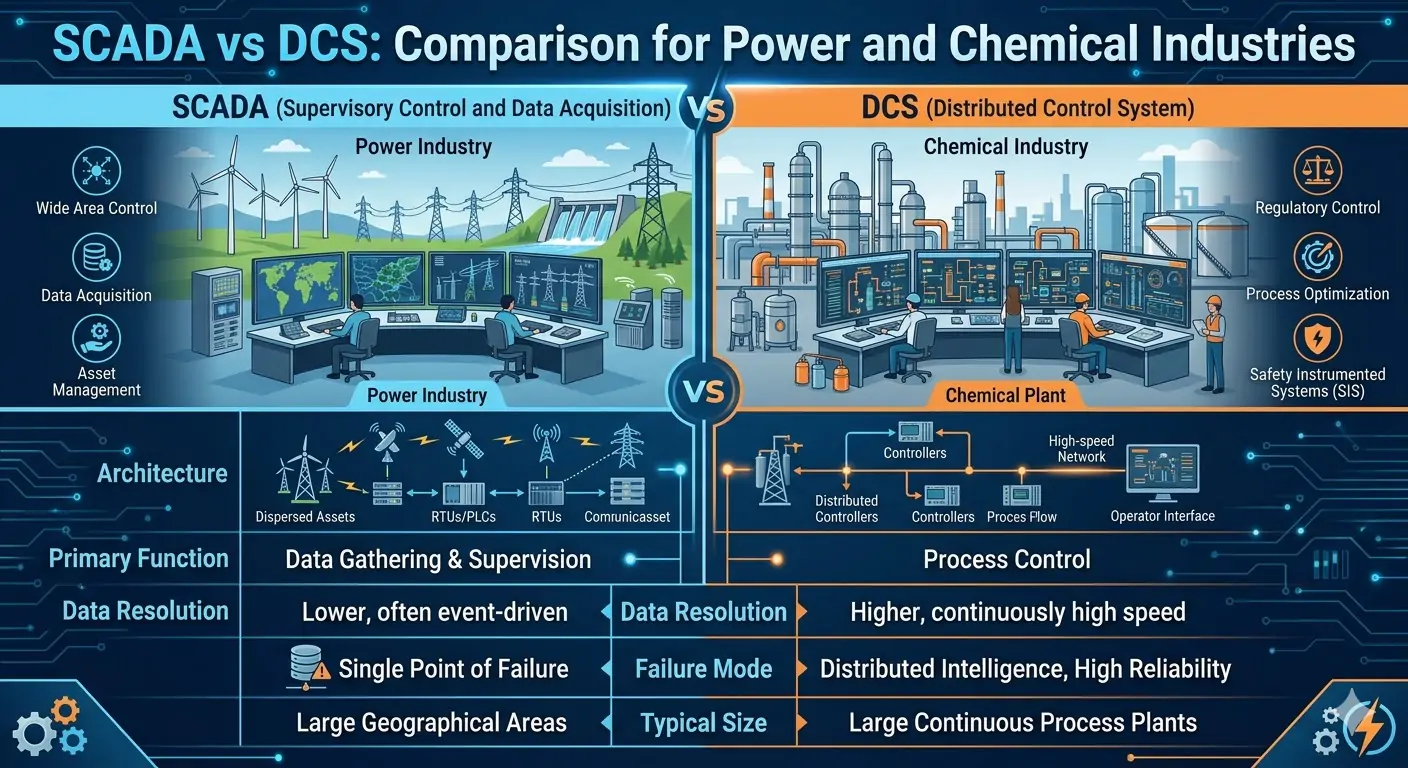
Industrial automation relies on two primary systems: SCADA and DCS. Each serves a distinct purpose based on process dynamics and risk profiles. Power industries often monitor geographically dispersed assets like substations using SCADA. In contrast, chemical plants require high-speed, continuous control provided by a DCS. Selecting the wrong architecture can lead to instability and safety risks. At Oiltech Controls, we emphasize aligning your system with your specific operational needs.
System Architecture and Latency Sensitivity Differences
SCADA systems typically operate with polling cycles lasting seconds or minutes. This delay is acceptable for power grids where voltage changes evolve slowly. However, chemical reactions happen in milliseconds. A DCS operates with high-speed scan cycles to prevent temperature runaways. It ensures deterministic control loops for maximum safety. As a result, using SCADA for closed-loop reactor control often causes dangerous oscillations.
Integrated Control Strategies for Chemical Production
SCADA acts primarily as a supervisory layer. It relies on external PLCs or RTUs to handle basic control logic. This setup works well for event-driven tasks like breaker switching. Conversely, a DCS integrates control at the system level natively. It supports complex PID loops and advanced process control (APC). This integration reduces engineering overhead and minimizes human error. Therefore, continuous production environments benefit from the seamless consistency of a DCS platform.
Redundancy and Reliability in Harsh Environments
SCADA redundancy usually exists at the server or communication level. This is sufficient for power systems where brief data loss is tolerable. However, a DCS provides controller-level redundancy and fault-tolerant I/O. Processes that cannot stop without economic loss require this “hot standby” capability. Moreover, DCS platforms better support IEC 61511 functional safety requirements. This makes them the standard choice for petrochemical and refinery installations globally.
Network Design and Signal Integrity Challenges
Long-distance SCADA lines are prone to lightning and electromagnetic interference. Engineers should always deploy fiber optic isolation in these remote substations. In chemical plants, DCS networks must avoid single points of failure. We recommend using ring topologies or redundant Ethernet like PRP/HSR. Furthermore, DCS I/O cabinets require clean grounding to prevent analog signal drift. Proper grounding ensures accurate measurements for critical flow and pressure readings.
Maintenance Strategy and Field Experience
- SCADA Focus: Prioritize communication diagnostics such as packet loss and protocol errors.
- DCS Focus: Concentrate on loop tuning, controller health, and redundancy switching tests.
- Tuning Risks: Improper PID tuning often causes more shutdowns than actual hardware failures.
- Field Tip: Use isolated communication interfaces to handle ground potential differences in wide-area networks.
Expert Insights from Oiltech Controls
The choice between SCADA and DCS is about alignment, not just preference. Power systems prioritize visibility over vast distances. Meanwhile, chemical plants demand precision and absolute continuity. Attempting to save costs by replacing a DCS with SCADA often leads to higher long-term risks. For reliable hardware and expert system integration, visit the specialists at Oiltech Controls Limited to optimize your automation infrastructure.
Application Scenarios and Solutions
- Power Grid Management: Deploy SCADA for wide-area monitoring of transmission lines and RTUs.
- Petrochemical Refining: Use DCS for tightly coupled temperature and pressure control loops.
- Hybrid Plants: Integrate PLCs via OPC UA or Modbus into a central DCS for unified supervision.
Frequently Asked Questions (FAQ)
1. Can SCADA replace a DCS to save on initial costs?
We do not recommend this. SCADA lacks the deterministic performance and integrated safety required for high-risk chemical processes.
2. Is a DCS backward compatible with existing PLC infrastructure?
Most modern DCS platforms support Modbus and OPC UA. However, you must verify protocol mapping before procurement.
3. What is the biggest maintenance difference between the two?
SCADA maintenance focuses on network stability over distances. DCS maintenance focuses on the precision of control loops and hardware redundancy.