Optimizing Process Stability with the Honeywell CC-PAOH51 Analog Output Module
The Strategic Value of Output Continuity in Industrial Automation
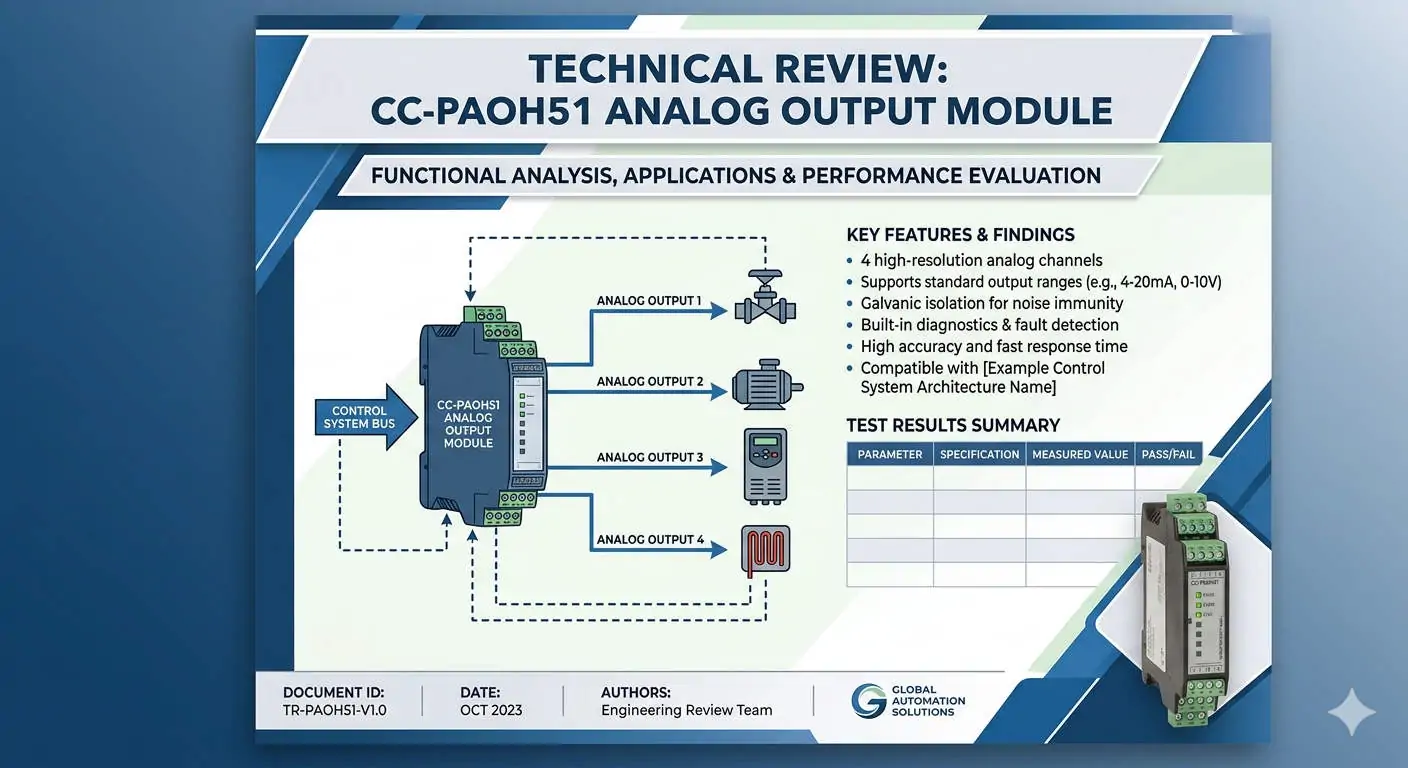
The Honeywell CC-PAOH51 analog output module plays a vital role in maintaining process continuity within modern DCS environments. In high-stakes industries like oil and gas or pharmaceuticals, output signals drive critical control valves and actuators. Unexpected resets during controller operations can lead to dangerous safety risks or significant financial losses. Therefore, the primary value of the CC-PAOH51 lies in its ability to preserve current output states during configuration downloads.
Technical Insights: Output Hold Behavior During System Downloads
Unlike standard modules that might force a zero-signal state, the CC-PAOH51 holds its last valid value during a controller download. This specialized engineering prevents sudden valve closures or pump trips during routine maintenance. However, engineers must verify that the Control Execution Environment (CEE) is correctly configured to support this “Hold Last Value” logic. Consequently, this feature minimizes process interruptions while allowing for necessary engineering changes.
Precision Control through Rapid Response and Update Times
Modern factory automation requires high-speed precision, and the CC-PAOH51 delivers update times in the millisecond range. This performance aligns perfectly with Honeywell Experion control cycles to ensure tight PID loop control. Faster update cycles reduce process oscillations and significantly improve final product quality. From a field perspective, the hardware often outperforms the control tuning, providing a robust foundation for even the most demanding flow control loops.
Ensuring Signal Integrity in Electrically Noisy Environments
Industrial plants often face heavy electrical noise from motors and VFDs. The CC-PAOH51 addresses this with superior channel-to-channel isolation and noise immunity. This isolation protects sensitive downstream equipment, such as I/P converters, from signal distortion and voltage spikes. Furthermore, the module complies with IEC 61000 EMC standards, making it an ideal choice for petrochemical facilities where electromagnetic interference is a constant challenge.
Best Practices for Installation and Field Maintenance
Successful deployment of the CC-PAOH51 requires meticulous attention to field device coordination. Even though the module holds its output, some smart positioners might interpret a communication pause as a fault. Therefore, technicians should always cross-reference the module’s behavior with the fail-safe settings of the field instruments. Additionally, using single-point grounding and shielded cables remains essential to prevent output drift in harsh environments.
Expert Commentary from Oiltech Controls Limited
At Oiltech Controls Limited, we have observed that process stability is often won or lost during system updates. The CC-PAOH51 is a game-changer because it bridges the gap between digital configuration and physical reliability. While the hardware is exceptionally robust, we recommend performing a full simulation during the Factory Acceptance Test (FAT). Testing ensures that critical loops, such as reactor pressure, remain stable under all download scenarios.
For more technical guidance and genuine Honeywell Series C components, visit Oiltech Controls Limited to explore our comprehensive automation solutions.
Technical Essentials for Engineers
- ✓ Configuration Audit: Always confirm “Hold Last Value” settings before initiating a partial or full download.
- ✓ Hardware Protection: Utilize channel isolation to extend the lifespan of your control valve actuators.
- ✓ System Migration: Test compatibility carefully when replacing legacy Series A or B modules with Series C hardware.
- ✓ Environmental Shielding: Route signal cables away from high-power trays to maintain 4-20mA accuracy.
Frequently Asked Questions (FAQ)
Q1: Does the CC-PAOH51 require external power for the output hold feature?
The module draws its operational power from the Series C I/O link. While it holds the last value during a software download, a total loss of system power will typically result in the output moving to its hardware-defined fail-safe state.
Q2: Can I use this module for high-speed turbine control applications?
Yes. Due to its millisecond-range update times and high signal integrity, it is suitable for fast-acting loops. However, ensure your CEE scan rate is set fast enough to match the hardware’s capability.
Q3: What happens if a channel fails while others are still operating?
The channel-to-channel isolation ensures that a fault on one loop does not migrate to others. This electrical “firewall” is one of the primary reasons engineers choose the CC-PAOH51 for critical infrastructure.
Recommended Solution Scenarios
- Chemical Reactor Management: Use the CC-PAOH51 to ensure temperature control valves stay in position during routine DCS logic updates.
- Oil Pipeline Pumping: Maintain steady pressure setpoints during system diagnostics to avoid surge conditions or hammer effects.