


Maximizing Process Precision with the Honeywell CC-TAOX61 Analog Output Module
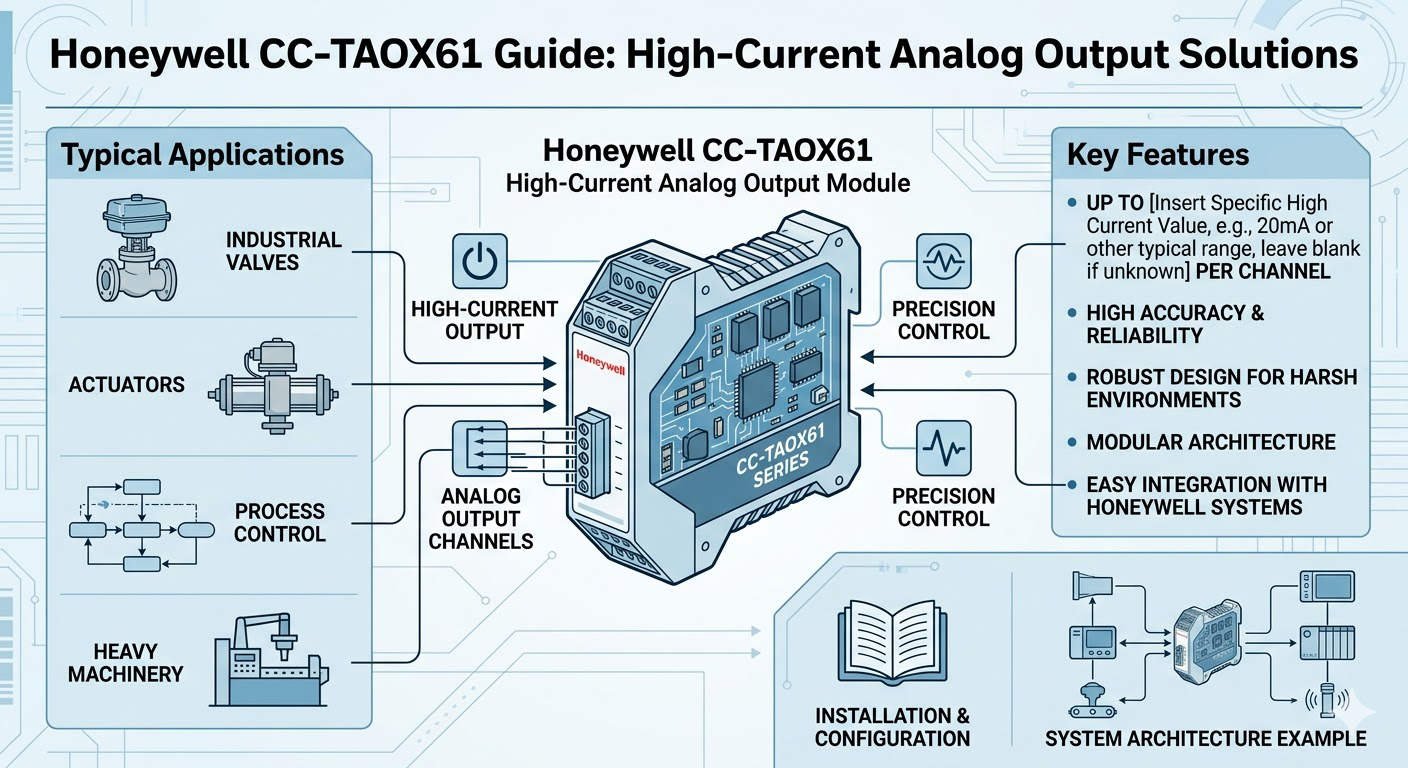
The Honeywell CC-TAOX61 (Part Number: 51307077-175) serves as a cornerstone for high-demand industrial control. This specialized analog output module integrates seamlessly into the Experion PKS architecture. It manages heavy-duty field devices that standard 4–20 mA signals cannot drive effectively. At Oiltech Controls, we see this module as a vital asset for modern DCS environments.
Superior Drive Capacity for Heavy Industrial Loads
Standard analog modules often struggle with high-impedance loads or large-scale actuators. However, the CC-TAOX61 provides enhanced current drive capabilities for robust performance. It ensures that large valve positioners receive the power they need for immediate response. Precise actuation is critical in oil, gas, and petrochemical sectors. Consequently, this module eliminates the lag times often found in weaker signaling systems.
Ensuring Signal Integrity in Electrically Noisy Environments
Refineries and manufacturing plants generate significant electromagnetic interference (EMI). Heavy motors and variable frequency drives (VFDs) often distort sensitive control signals. Fortunately, the CC-TAOX61 features industrial-grade filtering to maintain output stability. This noise immunity prevents control loop oscillations and reduces mechanical wear. Stable signals translate directly into lower energy consumption and extended equipment life.
Seamless Integration with Experion PKS Architecture
The CC-TAOX61 is purpose-built for the Honeywell C300 controller environment. It supports redundant I/O configurations to ensure maximum system availability. Therefore, mission-critical processes remain online even during a hardware fault. This module also aligns with Honeywell’s long-term lifecycle support strategy. Investing in this hardware minimizes the risk of future system obsolescence.
Best Practices for Installation and Cable Management
Proper physical installation determines the ultimate reliability of your control loop. Our engineers at Oiltech Controls recommend several key steps for field deployment:
- Separate analog output cables from high-voltage power lines by at least 30 cm.
- Utilize shielded twisted-pair wiring to minimize inductive coupling.
- Connect the cable shield to ground at only one end to prevent ground loops.
- Verify that the total loop resistance remains within the module’s rated specifications.
Thermal Management for High-Current Operations
High-current modules naturally generate more internal heat than standard signaling devices. You must ensure adequate ventilation within the system cabinet. Avoid placing the CC-TAOX61 directly adjacent to high-wattage power supplies. In confined spaces, forced air cooling protects the module from thermal drift. Proper cooling extends the lifespan of the internal electronic components significantly.
Oiltech Controls Expert Perspective on Retrofit Projects
Upgrading legacy systems requires a careful assessment of existing field conditions. The CC-TAOX61 excels in modern C300 setups but requires specific firmware compatibility. We suggest a full-range loop test (0–100%) during the commissioning phase. This identifies potential saturation issues before the process goes live. For genuine Honeywell components and expert technical support, visit Oiltech Controls Limited to explore our comprehensive inventory.
Application Scenarios and Solutions
- Large Valve Actuation: Driving hydraulic or pneumatic positioners in high-pressure gas pipelines.
- Long-Distance Signaling: Maintaining signal strength over cable runs exceeding 300 meters.
- VFD Speed Control: Providing stable reference signals to large motor drives in heavy manufacturing.
- Redundant Process Loops: Implementing fail-safe control for critical chemical reactor cooling systems.
Frequently Asked Questions
1. Can the CC-TAOX61 replace a standard 4-20mA module?
Yes, it can drive standard loads, but it is optimized for high-current or high-resistance applications.
2. Does this module support redundant configurations?
Yes, it fully supports Honeywell’s redundant I/O architecture for increased process reliability.
3. What is the primary cause of signal fluctuation in these modules?
Fluctuations usually stem from improper shield grounding or close proximity to high-power cables.


%20serves%20as%20a%20cornerstone%20for%20high-demand%20industrial%20control.%20This%20specialized%20analog%20output%20module%20integrates%20seamlessly%20into%20the%20Experion%20PKS%20architecture.%20It%20manages%20heavy-duty%20field%20devices%20that%20standard%204–20%20mA%20signals%20cannot%20drive%20effectively.%20At%20Oiltech%20Controls,%20we%20see%20this%20%5B…%5D&media=https://www.oiltechcontrols.com/wp-content/uploads/2026/03/Honeywell-CC-TAOX61-Guide-High-Current-Analog-Output-Solutions_.jpg)