Optimizing Honeywell CC-PUIO01: Choosing Between Analog and Digital Input
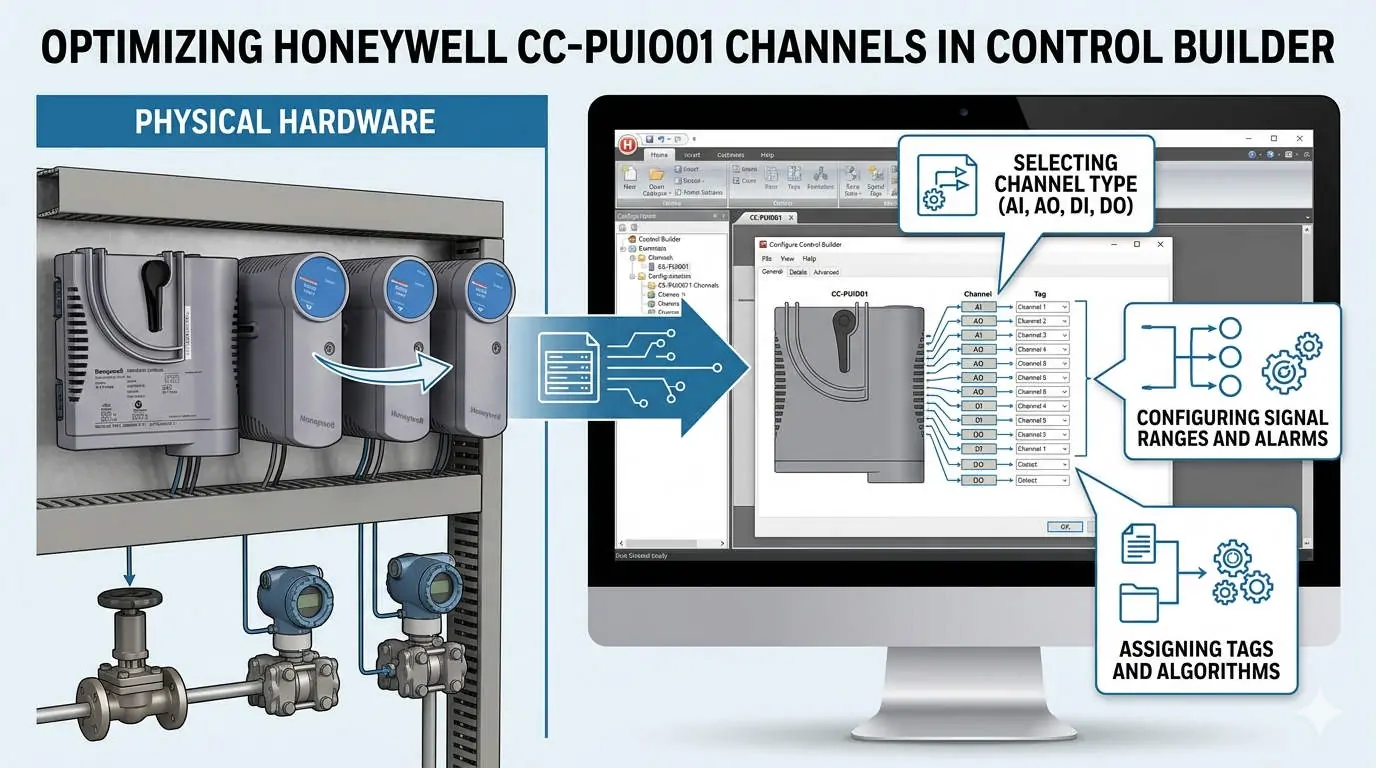
Configuring the CC-PUIO01 channel in Honeywell Control Builder involves more than a simple logical choice. This decision directly impacts signal fidelity, scan performance, and alarm reliability. For industries like oil and gas, selecting the correct channel type ensures accurate process monitoring. You must distinguish between continuous variables like pressure and deterministic state detection like valve positions. At Oiltech Controls, we believe that matching signal physics with system logic is the foundation of DCS stability.
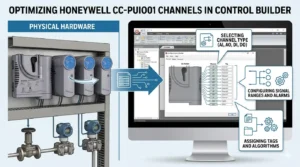
Signal Processing Differences: Continuous vs. Discrete
Analog Input (AI) channels perform complex A/D conversion, filtering, and scaling for high-resolution 4–20 mA data. However, this process introduces a conversion latency of typically tens of milliseconds. Digital Input (DI) channels utilize threshold detection with debounce logic for much faster response times. Consequently, DI is the superior choice for high-speed interlocks and trip systems. Misconfiguring a fast-changing signal as AI can cause late trip activations in critical equipment like compressors.
Managing Controller Load and Scan Time Performance
AI channels consume significantly more CPU power and network bandwidth due to continuous value updates. In contrast, DI channels are event-driven and place a lighter load on system resources. Using too many AI channels can increase controller scan time in high-density I/O cabinets. Therefore, engineers should follow ISA best practices by reserving AI for precision measurements. Use DI for status indicators, limit switches, and safety-related signals to optimize performance.
Noise Immunity and Signal Integrity in Harsh Environments
AI channels exhibit higher sensitivity to electrical noise, especially over long cable runs. In high-EMI environments, AI signals may drift or fluctuate without proper shielding. DI channels remain robust because they rely on defined voltage thresholds rather than precise currents. For example, a flow signal treated as DI would result in false state changes during noise spikes. However, correct AI configuration allows for filtering that protects the integrity of process trends.
Best Practices for Installation and Maintenance
- Shielding AI: Always use shielded twisted pair cables and ground them at one end only.
- Debounce Logic: Use debounce settings in Control Builder to filter mechanical contact bounce on DI.
- Secure Terminals: Ensure connections use spring clamps or locking connectors in high-vibration areas.
- Surge Protection: Install external surge protection for field signals exposed to lightning or outdoor elements.
- Grounding: Avoid grounding both ends of a cable to prevent destructive ground loops.
Strategic Engineering Insights from Oiltech Controls
Choosing between AI and DI is fundamentally about operational intent. At Oiltech Controls, we have seen projects fail because engineers forced analog signals into DI slots to save time. This shortcut leads to a total loss of process visibility and poor control performance. If you are upgrading your Honeywell Experion PKS environment, always validate your signal definitions first. For reliable hardware and expert system integration support, visit Oiltech Controls Limited to secure your facility.
Application Scenarios and Solutions
- Refinery Pump Monitoring: Use AI for bearing temperature trends and DI for the emergency stop button.
- Chemical Batch Control: Configure pressure transmitters as AI to maintain precise reaction environment data.
- Safety Interlocks: Always prioritize DI for valve limit switches to ensure the fastest possible safety response.
Frequently Asked Questions (FAQ)
1. How do I decide between AI and DI for a specific sensor?
If you need to measure a continuous range like 0–100%, use AI. If you only need to know “Open” or “Closed,” use DI.
2. Is the CC-PUIO01 compatible with legacy Honeywell Series C modules?
It integrates perfectly with C300 controllers but requires careful migration planning for legacy TPS I/O hardware.
3. Why is my AI signal fluctuating in the HMI?
This usually indicates electrical interference. Check your cable shielding and ensure the ground is only connected at the cabinet side.