Optimizing PLC Scan Cycles for High-Speed Packaging Precision
In high-speed packaging, the PLC scan cycle determines how fast your system reacts to critical sensor inputs. A poorly optimized cycle leads to missed products or inaccurate timing. In industries like pharmaceuticals and food processing, line speeds often exceed hundreds of units per minute. Therefore, a tuned scan cycle ensures precise synchronization between motion control and actuation. At Oiltech Controls, we emphasize that scan time is a performance constraint, not just a specification.

Technical Impact of Program Execution Speed
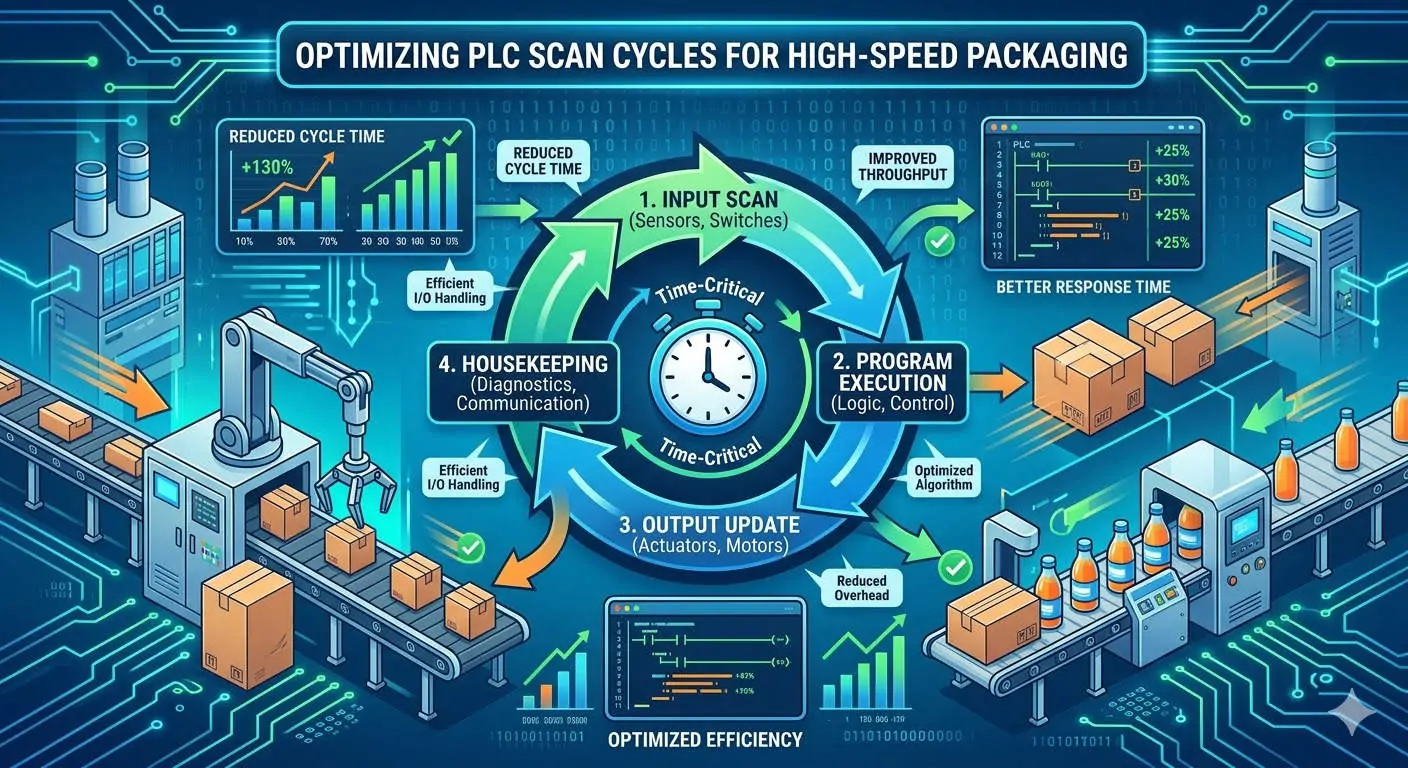
The PLC scan cycle consists of input sampling, logic execution, and output updates. A long cycle, exceeding 10ms, causes delayed responses to fast-moving products. This delay often results in mistimed sealing or failed rejections. Conversely, a short cycle of 1ms to 3ms allows for real-time responsiveness. This speed is critical for registration mark detection and high-speed counting. Reducing scan time can eliminate intermittent product misalignment in flow wrappers.
Enhancing Response via Interrupt Handling
Standard cyclic scanning is often insufficient for high-speed signals. High-speed inputs (HSI) or interrupt tasks allow the PLC to bypass the normal scan sequence. Without interrupt handling, the system may miss fast encoder pulses. This makes precise cut-to-length control unreliable in many factory automation scenarios. Engineers should use hardware-based high-speed counters for knife timing and registration sensors. This approach aligns with IEC 61131-3 standards for deterministic control behavior.
Managing Communication Loads and Task Priority
Modern PLCs handle SCADA and HMI communication simultaneously. These secondary tasks can increase scan cycle times unpredictably. Heavy network traffic over PROFINET or EtherNet/IP often introduces timing jitter. Poor task prioritization may delay critical control logic at the worst moments. On some machines, full data logging increases scan time by over 30%. Segregating communication into lower-priority tasks stabilizes machine performance. This ensures that the main control loop remains consistent and reliable.
Installation and Maintenance for Scan Stability
- Dedicated I/O: Avoid wiring high-speed sensors into standard digital input modules.
- Proper Shielding: Use shielded cables and proper grounding to prevent signal noise interference.
- Task Segmentation: Split programs into fast and slow tasks to prioritize time-critical logic.
- Code Efficiency: Minimize complex math and unnecessary loops within the main scan cycle.
- Surge Protection: Install external surge protection devices to maintain consistent CPU performance.
Expert Insights from Oiltech Controls
From our experience at Oiltech Controls, software structure is as important as hardware speed. A poorly structured program can double the scan time even on high-performance processors. We recommend using isolated power supplies for sensors to prevent electrical noise from affecting scan consistency. If your machine shows inconsistent actuation, it is time to audit your program architecture. For high-quality PLC components and technical guidance, visit Oiltech Controls Limited today.
Application Scenario: Flow Wrapper Precision
In a recent retrofit project, a flow wrapper suffered from 5% product waste due to misalignment. The original scan time was 12ms, which was too slow for the 300 packs/min speed. By moving the registration sensor logic to an interrupt task, the effective response time dropped to 1ms. This change eliminated waste and stabilized the servo synchronization. This demonstrates how software optimization can extend the life of existing industrial hardware.
Frequently Asked Questions (FAQ)
1. How do I know if my PLC scan cycle is too slow?
As a rule of thumb, your scan time should be less than 1/10th of your shortest control event. If you see inconsistent timing, your scan is likely too long.
2. Can SCADA communication affect my machine timing?
Yes, heavy communication tasks can steal CPU cycles. Without proper task management, this leads to jitter in the main control loop.
3. Is a faster CPU always the solution for timing issues?
Not always. Using high-speed counters and interrupt routines is often more effective than simply increasing raw processing power.