PLC Lightning Protection: Grounding and Signal Shielding Engineering Guide
PLC systems in oil and gas or chemical plants face constant threats from lightning and electromagnetic interference. Proper grounding and shielding prevent CPU faults and I/O mis-triggering. These strategies directly extend the lifecycle of your sensitive control hardware. At Oiltech Controls, we believe a disciplined grounding design is the highest ROI improvement for system reliability. A stable foundation ensures your factory automation remains operational during severe weather events.
The Importance of Grounding Resistance and Equipotential Bonding
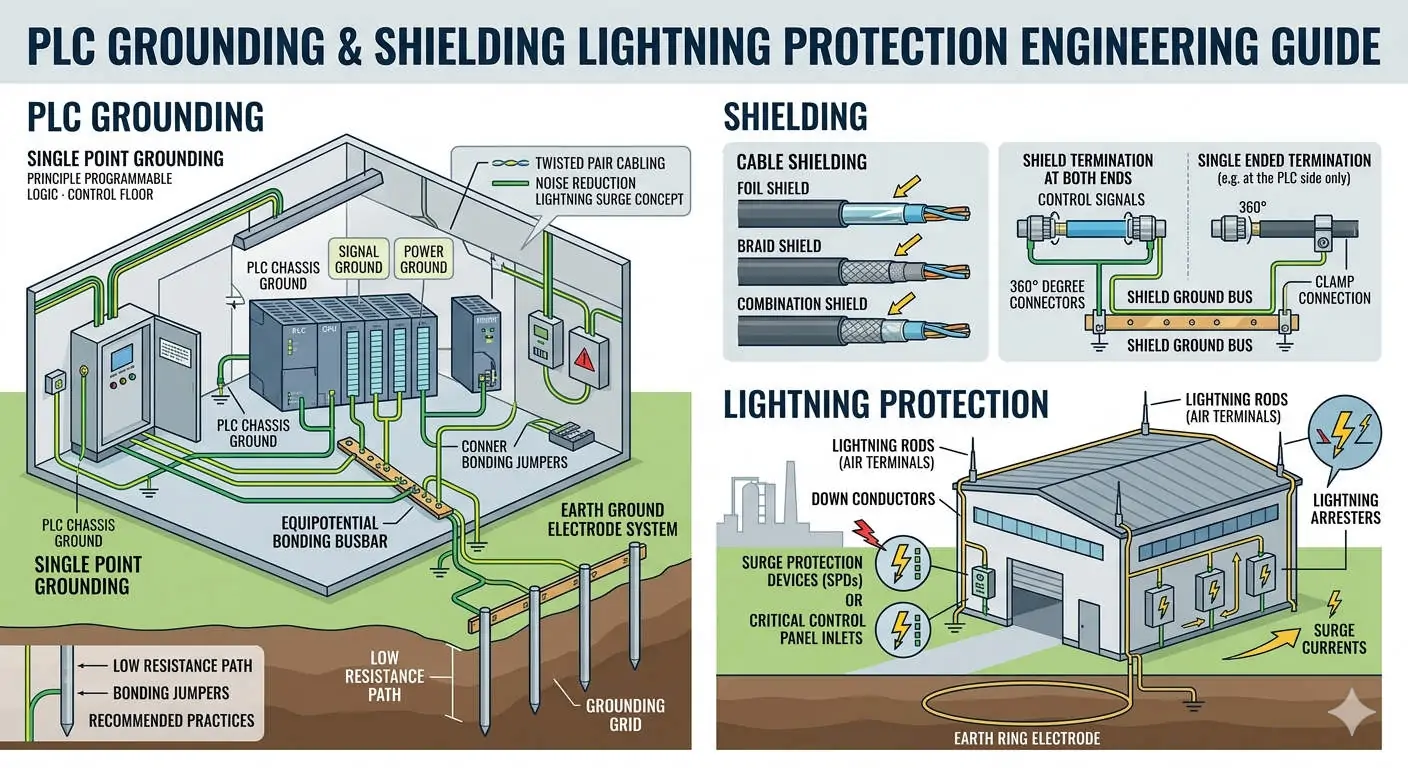
Ground resistance should typically remain below 4 Ω for standard industrial sites. However, petrochemical facilities often require a stricter limit of 1 Ω. High resistance prevents effective surge dissipation during lightning strikes. Furthermore, poor equipotential bonding creates ground loops. These loops cause analog signal drift, leading to 4–20 mA instability. In one refinery, inconsistent grounding caused massive AI fluctuations. Implementing a single-point grounding scheme solved the issue immediately.
Effective Signal Shielding and Termination Techniques
Shielding only works if you terminate the cable correctly. Typically, you should ground analog signal shields at a single end. High-frequency digital signals may require both-end grounding depending on EMC design. Incorrect termination can actually amplify interference instead of suppressing it. This leads to false DI triggering or Modbus communication errors. Therefore, always terminate shields at a dedicated grounding bar. Maintain shield continuity through junction boxes to prevent unintended current paths.
Coordinating Multi-Level Surge Protection Devices (SPD)
A robust defense requires coordinated SPD layers from the field to the control room. Class I, II, and III SPDs must work together to block high-energy surges. Without coordination, lightning can bypass protection and destroy PLC I/O modules. Repeated minor surges also shorten component life over time. Install Class I SPDs at main power entries and Class II in distribution panels. For critical I/O lines over 50 meters, always add signal-level SPDs.
Installation Best Practices for Control Cabinets
- Dedicated Ground Bars: Use a copper PE bar bonded to the plant grounding grid.
- Separate Ground Paths: Keep instrument ground separate from power ground until the final reference point.
- Cable Tray Separation: Route signal and power cables in separate trays with 30 cm spacing.
- Perpendicular Crossings: If cables must cross, ensure they do so at a 90-degree angle.
- SPD Lead Length: Keep grounding leads under 0.5 meters to maintain SPD effectiveness.
Field Troubleshooting and Author Insights
Most “mysterious” PLC faults are actually grounding or EMC problems. Mixing grounds inside a cabinet often couples noise from VFDs into analog inputs. I once saw a pharmaceutical plant with fluctuating temperature readings. Parallel routing of motor and signal cables caused a ±3°C error. Rerouting the cables restored accuracy instantly. For expert technical support and reliable hardware, visit the specialists at Oiltech Controls Limited to protect your system.
Application Scenarios for Enhanced Protection
- Outdoor Tank Farms: Use signal SPDs for all instruments located outside the main building.
- VFD-Heavy Environments: Implement high-frequency shielding to block noise from motor drives.
- Remote Pipelines: Focus on low-impedance grounding at remote terminal units (RTUs).
Frequently Asked Questions (FAQ)
1. How can I tell if my PLC grounding is failing?
Watch for unexplained I/O faults or communication port failures after thunderstorms occur. These often indicate poor surge protection.
2. Should I ground the shield at both ends for 4-20mA signals?
No, for low-frequency analog signals, single-end grounding prevents ground loops and signal noise.
3. Is 10 Ω ground resistance acceptable for a DCS system?
No, most DCS manufacturers like Honeywell specify a maximum of 1 Ω to 4 Ω for reliable operation.