


Why DCS Means Distributed Control and Centralized Management
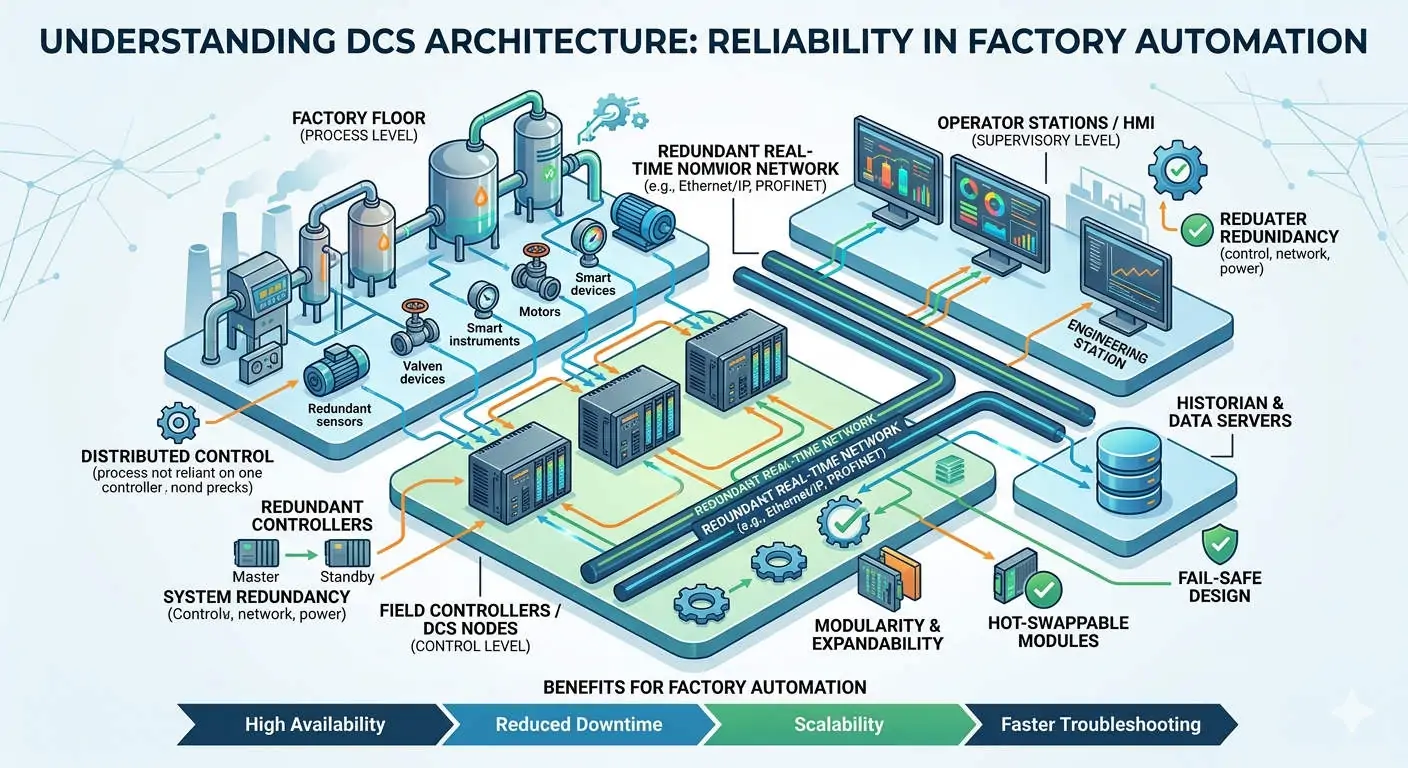
A Distributed Control System (DCS) solves a fundamental challenge in modern industrial plants. It maintains high reliability while managing complex operations. By distributing control across field controllers, the system minimizes single points of failure. Meanwhile, a unified operator interface centralizes supervision for better visibility. At Oiltech Controls, we believe this balance is vital for process continuity. This architecture ensures that one failed controller does not stop the entire plant.
Controller Redundancy and Process Response Time
DCS hardware typically uses redundant controllers with deterministic scan cycles. These cycles often range from 10 to 100 milliseconds. Fast response times keep critical loops like pressure and temperature stable. If a primary unit fails, the standby unit takes over immediately. However, improper synchronization can cause sudden output spikes during the switchover. Engineers should always verify this “bumpless transfer” during Factory Acceptance Testing (FAT).
Layered Network Architecture and Scalability
DCS relies on layered industrial networks to manage data flow effectively. It supports common protocols such as Modbus, Profibus, and Ethernet/IP. Network latency directly affects control loop stability and alarm response speed. Distributed nodes allow for easy expansion without redesigning the entire system. Nevertheless, not all third-party devices comply perfectly with protocol standards. We recommend using protocol analyzers to validate interoperability before full deployment.
Environmental Tolerance for Harsh Industrial Sites
DCS hardware survives extreme conditions in refineries and power plants. Most modules operate reliably between -20°C and +60°C. They also offer high resistance to electromagnetic interference (EMI). Higher environmental tolerance leads to fewer unexpected shutdowns. In coastal areas, salt mist corrosion remains a common threat. Therefore, adding conformal coating to modules can prevent long-term failure in high-humidity zones.
Grounding and Shielding Best Practices
- Single-Point Grounding: Use a single-point ground for all control cabinets.
- Shield Management: Ground shielded cables at only one end to prevent loops.
- Avoid Drift: Improper grounding often causes intermittent analog signal drift.
- Isolation: Ensure isolation between high-power cables and sensitive signal wires.
Cabinet Layout and Heat Management Strategies
DCS modules generate significant heat in dense I/O configurations. Maintain proper spacing between modules to ensure natural airflow. Install forced ventilation if ambient temperatures exceed 40°C. In one case, a pharmaceutical plant suffered frequent card failures. The root cause was poor cabinet airflow, not hardware defects. Always prioritize thermal design to extend the lifespan of your factory automation equipment.
Strategic Maintenance and Surge Protection
Many DCS power modules lack robust internal surge protection. Install external surge protectors (SPD) in areas prone to lightning. Use Uninterruptible Power Supplies (UPS) for clean, continuous power. Follow IEC 61000-4 standards for electromagnetic compatibility in your design. These steps protect sensitive control systems from transient voltage spikes. Consistent power quality is the backbone of reliable industrial automation.
Author Insights from Oiltech Controls
The real value of DCS lies in balancing resilience with operational clarity. Distribution protects the control layer, while centralization empowers the operator. If your hardware is obsolete, plan a phased upgrade immediately. For genuine DCS components and expert system integration, visit Oiltech Controls Limited to secure your facility. We help you transition from legacy systems to modern, high-performance architectures.
Frequently Asked Questions (FAQ)
1. How is a DCS different from a standard PLC?
A DCS centralizes the database and operations for thousands of loops. PLCs typically handle smaller, discrete logic tasks.
2. Can a DCS continue running if the HMI fails?
Yes, the distributed controllers handle the logic locally. The process remains safe even if the central monitor goes dark.
3. Is it hard to integrate new fieldbus devices into an old DCS?
It depends on the firmware version and available drivers. Gateways are often required to bridge different communication protocols.






%20solves%20a%20fundamental%20challenge%20in%20modern%20industrial%20plants.%20It%20maintains%20high%20reliability%20while%20managing%20complex%20operations.%20By%20distributing%20control%20across%20field%20controllers,%20the%20system%20minimizes%20single%20points%20of%20failure.%20Meanwhile,%20a%20unified%20operator%20interface%20centralizes%20supervision%20for%20better%20visibility.%20At%20Oiltech%20Controls,%20%5B…%5D&media=https://www.oiltechcontrols.com/wp-content/uploads/2026/04/Understanding-DCS-Architecture-Reliability-in-Factory-Automation.webp)