


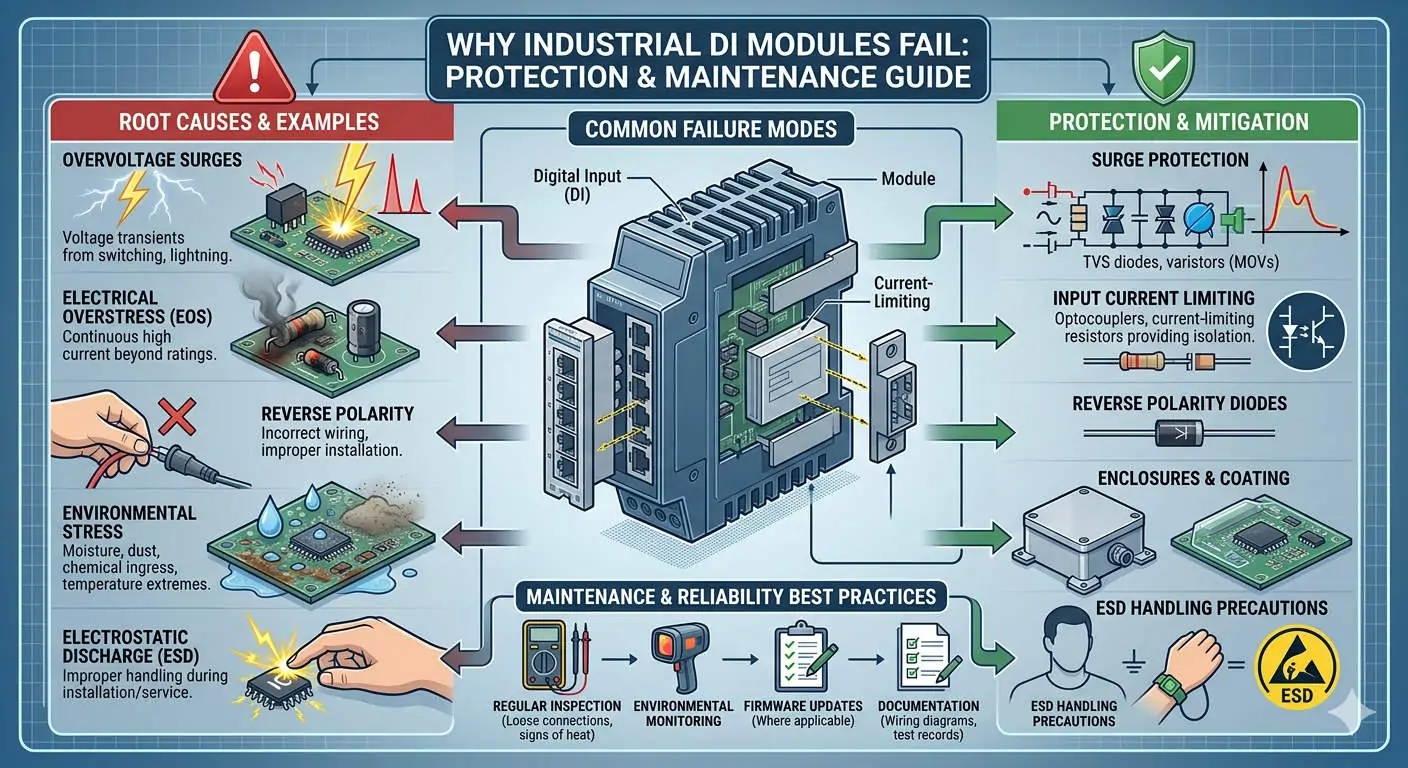
Why Industrial DI Modules Fail and How to Protect Your DCS Integrity
Digital Input (DI) modules act as the primary sensory interface for any DCS system. They capture field states and convert them into critical control logic for industrial automation. Frequent module failures lead to false trips and expensive production downtime. In petrochemical or pharmaceutical sectors, signal integrity is a matter of safety. A robust DI design must survive harsh electrical environments to maintain stable plant operations. At Oiltech Controls, we emphasize protecting these frontline interfaces from external stress.
Understanding Input Voltage Tolerance and Isolation Limits
Most industrial DI modules operate at a nominal 24 VDC rating. However, field voltages are rarely perfectly clean in a real factory automation setting. Inductive loads like large solenoids often generate spikes far above the standard window. If a module lacks sufficient galvanic isolation, transient surges will eventually destroy internal optocouplers. I have seen modules fail within months due to shared power supplies drifting up to 32 VDC. Always choose hardware with a high isolation rating to ensure long-term survivability.
Balancing Input Filtering with System Response Time
High-speed response times are attractive but often reduce a module’s filtering capability. In noisy industrial environments, insufficient filtering allows electrical noise to mimic valid signals. This creates “input chattering” that stresses internal components and leads to overheating. A slightly slower response time of 10–15 ms often improves the module’s lifespan. We recommend using debounce filtering to stabilize signals in heavy manufacturing zones. This trade-off significantly increases the reliability of your control systems.
The Necessity of Surge Immunity and EMC Compliance
Compliance with IEC 61000-4 standards is not just a checkbox for manufacturers. These certifications reflect the module’s ability to withstand repetitive switching transients and lightning surges. Modules installed near Variable Frequency Drives (VFDs) face constant high-frequency noise. Without proper EMC design, hardware failure becomes an inevitable outcome. Protecting your DCS requires hardware that meets these rigorous international surge immunity standards. Oiltech Controls consistently recommends high-spec modules for high-noise areas.
Proactive Installation and Maintenance Strategies
- External Surge Protection: Never rely solely on built-in module protection for outdoor cable runs.
- Physical Wiring Separation: Maintain at least 20 cm between signal cables and high-power lines.
- Shielding Best Practices: Use shielded cables and ground them at one end to avoid loops.
- Signal Verification: Always confirm if your field device is a Dry Contact or Wet Contact type.
- Clear Labeling: Prevent instant burnout by clearly marking voltage levels on all terminal blocks.
Strategic Buyer’s Guide for DI Module Replacement
Repeated channel dropouts usually indicate a design mismatch rather than a product defect. When upgrading, look for modules with isolation ratings of 2500 VAC or higher. Built-in diagnostics for input health can also prevent unplanned maintenance. Furthermore, ensure the new model is compatible with your legacy field devices’ logic thresholds. For reliable components and expert technical support, visit the specialists at Oiltech Controls Limited to secure your system.
Application Scenario: Chemical Plant Power Drift
A chemical plant recently experienced weekly DI card failures in their DCS. We discovered that shared 24V power supplies fluctuated during heavy motor starts. The voltage drift exceeded the module’s narrow tolerance window, causing optocoupler fatigue. After installing modules with wider voltage margins and external suppressors, failures stopped completely. This case highlights how system-level protection is more effective than simple hardware replacement. Proper engineering at the interface level saves thousands in potential downtime.
Frequently Asked Questions (FAQ)
1. Can I use a 24V DI module for a 48V field signal?
No, exceeding the rated voltage window will cause immediate and permanent damage to the input circuitry.
2. Why is single-point grounding better for signal shields?
Grounding both ends creates ground loops, which inject noise into the DI channel and cause signal oscillation.
3. Does a “flashing” input LED always mean the field device is faulty?
Not necessarily. It often indicates electrical noise or “chatter” resulting from poor filtering or loose wiring connections.




%20modules%20act%20as%20the%20primary%20sensory%20interface%20for%20any%20DCS%20system.%20They%20capture%20field%20states%20and%20convert%20them%20into%20critical%20control%20logic%20for%20industrial%20automation.%20Frequent%20module%20failures%20lead%20to%20false%20trips%20and%20expensive%20production%20downtime.%20In%20petrochemical%20or%20pharmaceutical%20%5B…%5D&media=https://www.oiltechcontrols.com/wp-content/uploads/2026/03/Why-Industrial-DI-Modules-Fail-Protection-and-Maintenance-Guide.webp)