


Troubleshooting Honeywell CC-PAIM01: Understanding “Compensation Error” Alarms
The Honeywell CC-PAIM01 Analog Input Module is a vital component for high-precision temperature acquisition. It performs cold junction compensation (CJC) and signal linearization for various thermocouples. However, a “Compensation Error” often confuses many field technicians. This specific alarm indicates a problem with the reference system, not a simple sensor break. At Oiltech Controls, we help engineers differentiate between field faults and module internal diagnostics.

The Critical Role of Cold Junction Compensation (CJC)
Accurate thermocouple measurement depends entirely on the reference junction compensation integrity. The CC-PAIM01 uses sensors to correct thermoelectric voltage readings based on ambient temperature. If this circuit drifts, the module cannot interpret the thermocouple data correctly. As a result, a “Compensation Error” usually flags an invalid reference temperature. This distinction is critical for maintaining product quality in petrochemical and pharmaceutical manufacturing.
Differentiating Between Sensor Failure and System Errors
Modern DCS hardware continuously evaluates input voltages against defined thermocouple ranges. An open thermocouple typically triggers a “Burnout” or “Upscale” alarm. In contrast, a compensation error indicates an inconsistency in the logic. Therefore, you should investigate the reference sensor before replacing the entire input module. This proactive approach improves troubleshooting efficiency and prevents unnecessary plant shutdowns.
Environmental Factors Affecting Temperature Acquisition
Compensation accuracy relies on stable ambient conditions inside the control cabinet. Excessive heat or poor ventilation can distort CJC readings significantly. Moreover, temperature gradients across terminal blocks lead to systematic measurement bias. These biases affect process control loops and can shorten equipment life. Proper thermal management ensures that your industrial automation system remains reliable over many years.
Maintenance Guidelines for Field Engineers
- Check Sensor Placement: Ensure the CJC sensor sits near the terminal blocks.
- Inspect Connections: Loose or oxidized terminals often cause intermittent compensation faults.
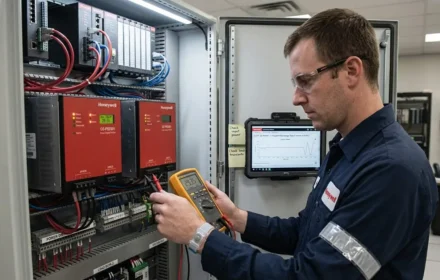
- Verify Continuity: Use a multimeter to measure thermocouple resistance before condemning the module.
- Swap Channels: Move the input to a different channel to isolate the fault location.
- Improve Shielding: Use shielded cables with single-point grounding to reject electromagnetic interference.
Author Insights from Oiltech Controls
From our experience at Oiltech Controls, about 40% of compensation errors stem from wiring issues. We often see engineers overlook the physical reference sensor during high-pressure commissioning. Correctly identifying this error prevents “ghost” chases that lead to wasted maintenance hours. For genuine Honeywell spare parts and technical guidance, visit the experts at Oiltech Controls Limited to secure your system.
Application Scenarios and Solutions
- Refinery Furnaces: High ambient heat requires external CJC sensors for better accuracy.
- Pharmaceutical Batches: Precise linearization ensures strict compliance with regulatory temperature standards.
- Remote Pumping Stations: Robust grounding protects low-level signals from noisy variable frequency drives.
Frequently Asked Questions (FAQ)
1. Does a “Compensation Error” mean my thermocouple is broken?
No, a broken sensor usually shows an open-circuit alarm. This error points to the reference system.
2. Can cabinet heat cause the CC-PAIM01 to fail?
Yes, high temperatures can cause CJC drift, leading to inaccurate readings and diagnostic alarms.
3. Is the CC-PAIM01 compatible with older Honeywell systems?
It integrates with Experion PKS, but you should verify firmware compatibility before installation.




%20and%20signal%20linearization%20for%20various%20thermocouples.%20However,%20a%20“Compensation%20Error”%20often%20confuses%20many%20field%20technicians.%20This%20specific%20alarm%20indicates%20a%20problem%20with%20the%20reference%20system,%20not%20a%20simple%20%5B…%5D&media=https://www.oiltechcontrols.com/wp-content/uploads/2026/04/Troubleshooting-CC-PAIM01-Alarms-in-Honeywell-DCS-Systems.webp)