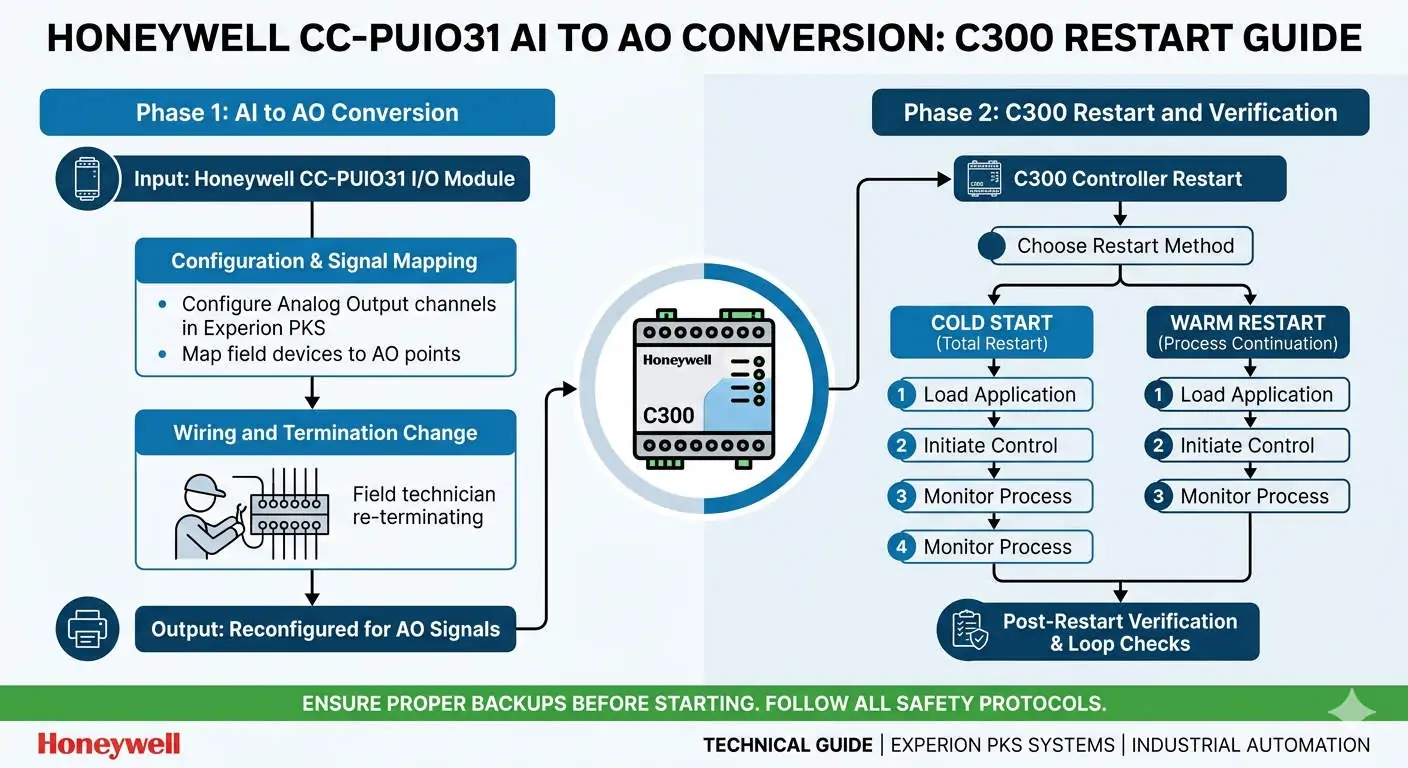
Does Converting AI to AO on Honeywell CC-PUIO31 Require a C300 Controller Restart?
The Strategic Value of Universal I/O in Modern Control Systems
The Honeywell CC-PUIO31 Universal I/O module revolutionizes how engineers approach industrial automation projects. Traditionally, changing a signal type required hardware replacement and extensive rewiring. However, this module allows users to define channel types like AI, AO, DI, or DO purely through software. In high-stakes sectors like oil and gas or pharmaceuticals, this flexibility minimizes delays during late-stage design changes. At Oiltech Controls Limited, we believe this adaptability is essential for maintaining project timelines when field requirements shift unexpectedly.
Understanding Universal Channel Architecture and Software Definition
Unlike fixed I/O cards, the CC-PUIO31 uses a software-defined architecture. Consequently, converting an Analog Input (AI) to an Analog Output (AO) is a configuration task rather than a mechanical one. While this eliminates the need for physical module swaps, it does require a module-level download. This process ensures the hardware correctly implements the new signal logic. Therefore, engineers must recognize that software flexibility does not mean a completely “hitless” transition for that specific channel group.
Controller Interaction and the C300 Dependency
One primary concern for plant operators is whether an I/O change will force a DCS (Distributed Control System) reboot. Fortunately, the CC-PUIO31 communicates with the C300 controller via redundant I/O links that support online changes. The system handles channel reconfigurations at the I/O module (IOM) level. As a result, the C300 controller continues running its core logic without interruption. You can update your I/O strategy without risking a total controller shutdown, which protects overall plant availability.
Managing Output Safety and Fail-Safe Behavior
The transition from AI to AO is critical because the channel moves from passive measurement to active control. During the reconfiguration download, the module briefly enters a reinitialization state. During this window, the output typically follows a configured fail-safe behavior, such as “last value” or zero. Moreover, improper planning could trigger unexpected valve movement or pump speed fluctuations. Engineers must verify downstream equipment safety before initiating the software download to prevent process upsets.
Field Installation and Maintenance Best Practices
Based on extensive field experience at Oiltech Controls Limited, we recommend a disciplined approach to I/O modifications. While the C300 does not restart, the specific CC-PUIO31 module will temporarily go offline. This interruption affects all 32 channels on that module. Therefore, you should always identify any critical loops sharing the hardware. In addition, always isolate the physical loop and ensure the AO will not drive an actuator into a dangerous position immediately after the download completes.
Author Insights: The Future of Remote I/O Flexibility
From our perspective at Oiltech Controls Limited, the move toward universal I/O is a game-changer for factory automation. It reduces the need for large spare parts inventories and simplifies the control systems lifecycle. However, this convenience demands stricter configuration management. We suggest that plants maintain rigorous change control logs to ensure that software-defined channels match the physical field wiring and loop drawings at all times.
For more technical guides and high-reliability Honeywell components, visit our dedicated resource center at Oiltech Controls Limited to optimize your plant’s performance.
Technical Execution Checklist
- ✓ Verify Criticality: Identify all loops on the shared CC-PUIO31 module before downloading.
- ✓ Loop Isolation: Manually override or bypass control loops to prevent sudden valve strokes.
- ✓ Wiring Audit: Confirm the 4-20 mA loop power and impedance meet AO specifications.
- ✓ Documentation: Update the Experion PKS database and field loop drawings simultaneously.
Frequently Asked Questions (FAQ)
Q1: Is there a limit to how many times I can reconfigure a CC-PUIO31 channel?
There is no physical limit to software reconfigurations. However, every change requires a module download that affects all channels on that specific card. Frequent changes in a live environment are not recommended without a scheduled maintenance window.
Q2: What happens if the software configuration does not match the field wiring?
If you configure a channel as an AO but keep AI wiring, you risk damaging the instrument or the I/O channel due to improper voltage application. Always perform a physical loop check before activating the new configuration.
Q3: Does the CC-PUIO31 support HART communication for both AI and AO?
Yes, the module supports HART pass-through for both inputs and outputs. This allows your Asset Management System (AMS) to continue monitoring device health regardless of whether the channel functions as an AI or an AO.
Application Scenario: Late-Stage Commissioning
In a recent chemical plant expansion, a final design audit revealed that three critical temperature inputs needed to be control outputs for a new dosing pump. Using the CC-PUIO31, the team completed the change in minutes via the engineering station. By avoiding new hardware procurement and panel rewiring, the project saved three weeks of potential delay and thousands in labor costs.