Schneider Quantum 140DAI75300 vs 140DAI74000: Understanding the Engineering Differences
The Critical Distinction in Discrete Input Modules
In the industrial automation sector, identifying the correct input module is vital for system uptime. The Schneider Quantum 140DAI75300 and 140DAI74000 are not identical replacements, despite sharing similar digital input functions. While the 140DAI75300 excels in high-reliability environments like petrochemical plants, the 140DAI74000 serves as a cost-effective alternative for general factory automation. Understanding these nuances prevents unexpected system failures during hardware migration.
Diagnostic Capabilities and Fault Visibility
One primary differentiator lies in the depth of internal diagnostics. The 140DAI75300 features advanced channel-level monitoring, including open wire detection and specific fault indicators. In contrast, the 140DAI74000 offers only basic status updates. Therefore, maintenance teams using the 75300 can troubleshoot remotely via DCS or SCADA systems. However, using the 74000 often requires physical field inspections, which significantly increases the Mean Time To Repair (MTTR).
Input Filtering and Signal Integrity in Noisy Environments
Signal noise poses a constant threat in large-scale control systems. The 140DAI75300 provides configurable input filtering to mitigate electromagnetic interference from long cable runs. Conversely, the 140DAI74000 typically utilizes fixed filtering parameters. In environments with heavy machinery or unstable power, the superior filtering of the 75300 prevents false triggering. Consequently, it protects the system from unnecessary process trips and production losses.
Electrical Robustness and Environmental Tolerance
Industrial disturbances such as voltage fluctuations can compromise digital inputs. The 140DAI75300 is engineered with higher tolerance for these electrical variances. For continuous process industries like pharmaceuticals, this robustness is non-negotiable. While the 140DAI74000 performs well in stable machine-level applications, it lacks the ruggedness required for mission-critical infrastructure where power quality may be inconsistent.
Software Compatibility and PLC Logic Considerations
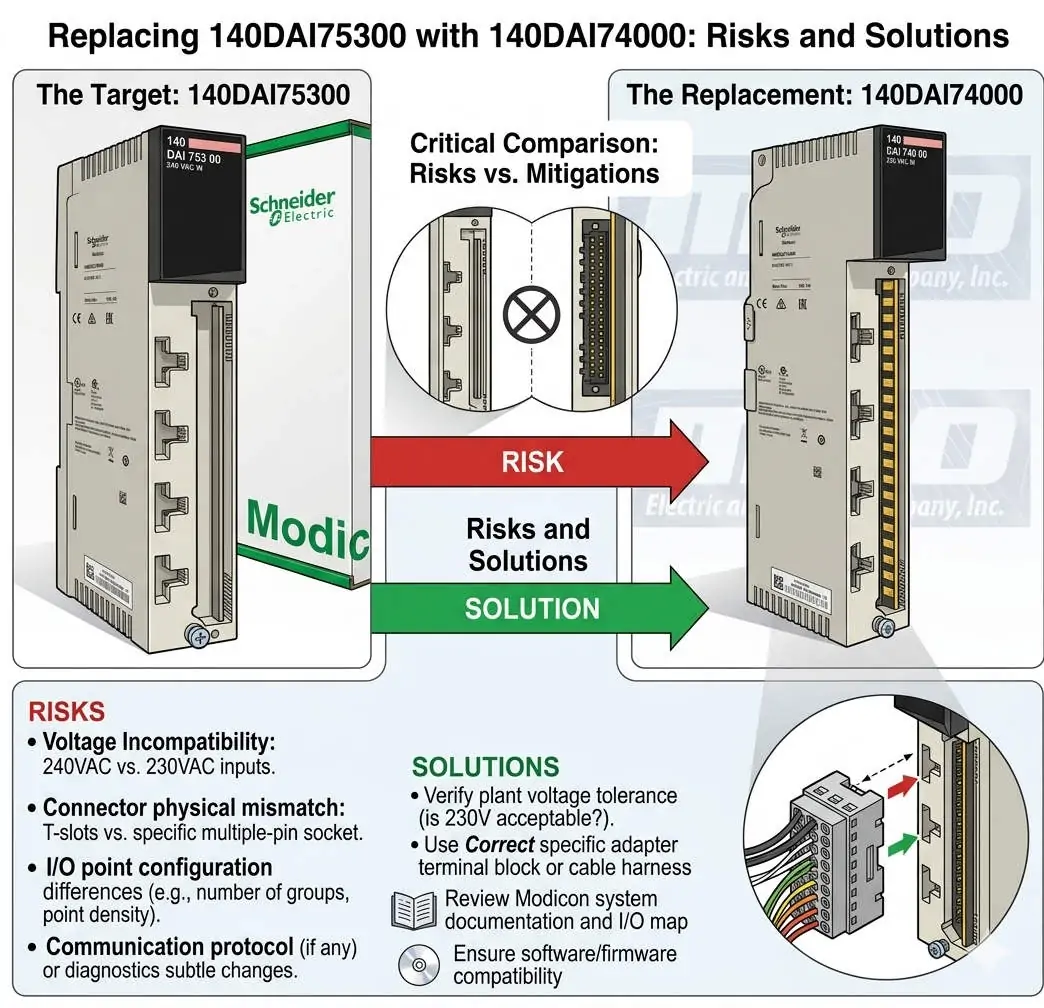
Replacing a 140DAI75300 with a 140DAI74000 requires more than just a physical swap. Engineers must review the PLC configuration within EcoStruxure Control Expert or Unity Pro. If the original program relies on diagnostic bits specific to the 75300, the system may fail to report critical errors after the downgrade. Moreover, software mapping must be adjusted to ensure the controller recognizes the new module’s limited data set.
Maintenance Best Practices for Quantum Modules
- ✓ Secure Terminals: Use ferrules and spring-clamp terminals to prevent vibration-induced faults.
- ✓ Surge Protection: Install external Surge Protection Devices (SPD) as neither module has high built-in immunity.
- ✓ Grounding Standards: Ensure your grounding resistance remains ≤ 4Ω to maintain signal stability.
- ✓ Logic Verification: Always audit diagnostic rungs in the PLC logic before downgrading hardware.
Expert Commentary from Oiltech Controls Limited
At Oiltech Controls Limited, we emphasize that hardware substitution is an engineering decision, not just a procurement one. We often observe that “functional equivalence” on a spreadsheet does not translate to “operational equivalence” in the field. If your facility operates 24/7, the 140DAI75300 is an investment in visibility and reliability. Downgrading to the 74000 may save initial costs but often leads to higher long-term expenses through increased troubleshooting hours.
For more technical insights or to source genuine Schneider Quantum components, visit Oiltech Controls Limited for expert support in industrial automation.
Frequently Asked Questions (FAQ)
Q1: Is there a risk of “silent failure” when using the 140DAI74000?
Yes. Because the 140DAI74000 lacks open-wire diagnostics, a broken cable may go undetected by the PLC. This is especially dangerous in safety-related monitoring where a “0” signal must be distinguished from a “faulty” signal.
Q2: Can I mix both modules in the same Quantum rack?
Technically, yes. The Quantum backplane supports different module types in the same rack. However, you must ensure your power supply module can handle the total current draw and that your software configuration accurately reflects each slot.
Q3: How does temperature affect these modules?
Both modules are designed for standard industrial ranges, but the 140DAI75300 generally handles thermal cycling better due to its higher-grade components. In high-heat environments, ensure proper cabinet ventilation to extend the lifespan of either module.
Application Scenario: Chemical Processing Plant
In a recent upgrade for a chemical dosing system, the client considered switching to 140DAI74000 to reduce costs. However, because their safety logic required real-time wire-break detection to prevent chemical overflows, we recommended staying with the 140DAI75300. This choice ensured that any physical wiring damage would trigger an immediate alarm, maintaining site safety and compliance.