Why Ground Loops Cause 50 Hz Interference on Honeywell CC-PAIL51 Modules
Understanding Low-Level Analog Input Vulnerability
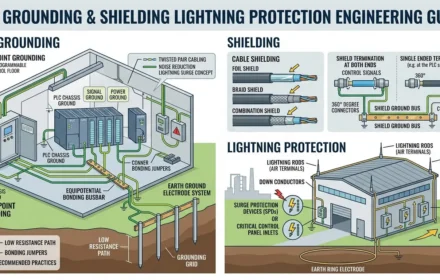
Plant engineers managing Honeywell Experion PKS C300 systems frequently rely on the CC-PAIL51 low-level analog input module to process thermocouple and RTD temperature signals. When process values exhibit periodic 50 Hz fluctuations or low-frequency drifts, maintenance teams often blame faulty I/O hardware immediately. At Oiltech Controls Limited, we emphasize that such disturbances typically originate from improper grounding topologies rather than internal card destruction.

Evaluating CMRR Limits and Ground Potential Differences
Industrial automation networks demand strict grounding discipline to protect sensitive measurement channels. Although the CC-PAIL51 module provides exceptional common-mode rejection ratios, heavy electrical equipment like variable frequency drives inject stray currents into protective earth conductors. When DC grounds and protective earth lines connect at multiple unauthorized points, circulating currents create small potential drops. Consequently, input circuits convert these common-mode voltages into significant measurement errors.
Systematic Grounding Diagnosis and Troubleshooting Rules
To differentiate between hardware failures and external ground loop interference across your distributed control systems, follow these structured engineering guidelines:
- ✅ Map Grounding Topologies: Draw out complete cabinet bonding paths before disconnecting any protective earth wires.
- ⚙️ Measure Potential Differences: Check voltage variations between DC references and panel grounds using diagnostic equipment.
- 🔧 Inspect Shield Termination: Verify that signal cable shields connect strictly according to approved engineering specifications.
Author’s Insight: Why High CMRR Does Not Prevent Ground Loops
At Oiltech Controls Limited, our hands-on commissioning experience across chemical and refining plants shows that high CMRR ratings cannot compensate for multi-point grounding errors. Because thermocouple signals operate in the millivolt range, minor voltage offsets translate into noticeable temperature errors. We strongly advise technicians to analyze complete grounding layouts and eliminate accidental ground loops before replacing expensive analog modules.
Frequently Asked Questions (FAQ)
Q: Does a 50 Hz fluctuation on a Honeywell CC-PAIL51 channel always mean the I/O card is broken?
A: No. Multiple channels fluctuating simultaneously usually point to ground loops, power reference instability, or electromagnetic interference rather than internal hardware faults.
Q: Can I connect the control system DC ground directly to the protective earth in multiple cabinets?
A: No. Connecting DC references to protective earth at multiple locations creates ground loops, allowing stray currents to contaminate sensitive low-level analog measurements.
Q: What is the most effective way to confirm whether interference stems from a ground loop?
A: Check for AC voltage potentials between the DC reference common and cabinet protective earth, and verify if signal fluctuations correlate with nearby motor or VFD operations.
Are you looking to troubleshoot complex distributed control system faults or source reliable Honeywell DCS spares? At Oiltech Controls Limited, we specialize in supplying high-performance industrial automation hardware and expert technical guidance for demanding process environments. Our team helps you eliminate persistent noise issues and maintain absolute plant reliability. Visit our website today to explore our extensive inventory and connect with our DCS hardware specialists.