


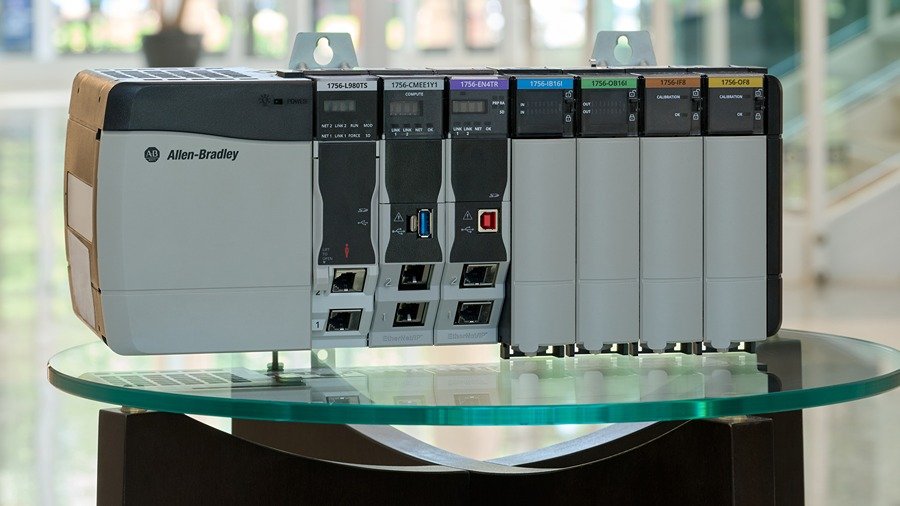
ControlLogix 5570 vs. 5580: A Comprehensive Guide for Industrial Automation
Rockwell Automation revolutionized the industry with the ControlLogix platform. However, engineers often must choose between the proven 5570 (L7) and the advanced 5580 (L8) series. Both families function as high-performance programmable automation controllers (PACs). Yet, the L8 series introduces critical architectural shifts. This guide analyzes these differences to aid your decision-making process.

Evolution of System Architecture
The ControlLogix 5570 (L7) series utilizes a single-core processing architecture. It successfully powers traditional discrete and process applications. Consequently, the controller handles logic and communications on the same processor resource.
In contrast, the ControlLogix 5580 (L8) represents a major leap in industrial automation. It features a modern, high-performance multi-core architecture. One core dedicates itself to logic execution. Meanwhile, other cores manage communications and system services. This separation ensures that heavy network traffic does not bog down the control logic.
Performance and Determinism in Factory Automation
Speed drives productivity in modern factory automation. The L7 series offers reliable deterministic control. However, single-core limitations affect it. High communication loads can impact the scan time in an L7 controller.
The L8 series solves this challenge effectively. It delivers significantly faster program execution. In fact, some instruction speeds increase by 5 to 20 times compared to the L7. The multi-core design guarantees that I/O updates remain consistent. Therefore, data-intensive applications run smoother on the L8 platform.
Advancements in Cybersecurity
Security remains a top priority for modern control systems. The L7 series relies heavily on external network defenses. It offers basic controller protections but lacks deep, built-in security features.
Conversely, Rockwell designed the L8 series with a “secure-by-design” philosophy. It supports advanced security standards.
- Firmware Integrity: The controller checks digital signatures on firmware.
- Role-Based Access: It offers granular control over user actions.
- Defense-in-Depth: The hardware aligns with CIP Security protocols.
These features make the L8 essential for critical infrastructure projects.
Connectivity and IT/OT Convergence
Connectivity defines the era of Industry 4.0. The L7 series utilizes separate communication modules for Ethernet connections. The processor itself lacks a built-in Ethernet port.
The L8 series changes this dynamic completely. It includes an embedded 1-gigabit Ethernet port. This port supports high-speed communications without extra hardware. Furthermore, the L8 handles higher connection counts. This capability supports the massive data flow required by IT/OT convergence strategies.
Memory Management and Scalability
Memory architecture differs significantly between the two generations. The L7 uses a fixed memory structure. This setup works for standard projects but limits expansion.
The L8 series provides a more flexible and larger memory capacity. It optimizes the storage of documentation and tag descriptions on the controller. As a result, engineers can store more data directly on the CPU. This scalability suits large, complex DCS (Distributed Control System) hybrid applications.
Oiltech Controls Author’s View
At Oiltech Controls Limited, we observe a clear shift in the industry. The L7 controller remains a workhorse. It is perfect for maintaining legacy systems where hardware consistency matters. We still supply L7 units for identical replacements to minimize downtime.
However, for new installations, the L8 is the superior technical choice. The integrated Gigabit port alone saves rack space and costs. Moreover, the multi-core CPU handles the demanding analytics of modern smart factories. We recommend the L8 for any application requiring high-speed motion control or extensive data logging.
Real-World Application Scenarios
Understanding where to apply each controller ensures project success.
Scenario A: High-Speed Packaging Line
- Requirement: Sub-millisecond scan times and synchronized motion.
- Solution: ControlLogix 5580 (L8). The dedicated motion core ensures precision without communication lag.
Scenario B: Municipal Water Treatment Plant
- Requirement: Steady process control with existing legacy I/O infrastructure.
- Solution: ControlLogix 5570 (L7). It integrates easily with older networks and provides sufficient processing power.
Frequently Asked Questions (FAQ)
Q1: Can I replace an L7 controller directly with an L8?
Yes, but you must check the firmware version. The L8 requires Studio 5000 Logix Designer version 28 or higher. You may also need to adjust network configurations due to the new embedded port.
Q2: Does the L8 series require a battery?
No, the L8 series uses an internal energy storage solution. It eliminates the need for maintaining lithium batteries. This feature reduces maintenance tasks compared to the older L7 series.
Q3: Is the L8 controller more expensive than the L7?
The hardware cost is comparable, but the L8 offers better value. The embedded Ethernet port saves the cost of buying a separate network module. Therefore, the total system cost is often lower with an L8.




%20and%20the%20advanced%205580%20(L8)%20series.%20Both%20families%20function%20as%20high-performance%20programmable%20automation%20controllers%20(PACs).%20Yet,%20the%20L8%20series%20introduces%20critical%20architectural%20shifts.%20This%20guide%20analyzes%20%5B…%5D&media=https://www.oiltechcontrols.com/wp-content/uploads/2025/12/ControlLogix-5570-vs-5580-A-Technical-Comparison-for-Industrial-Automation.jpg)