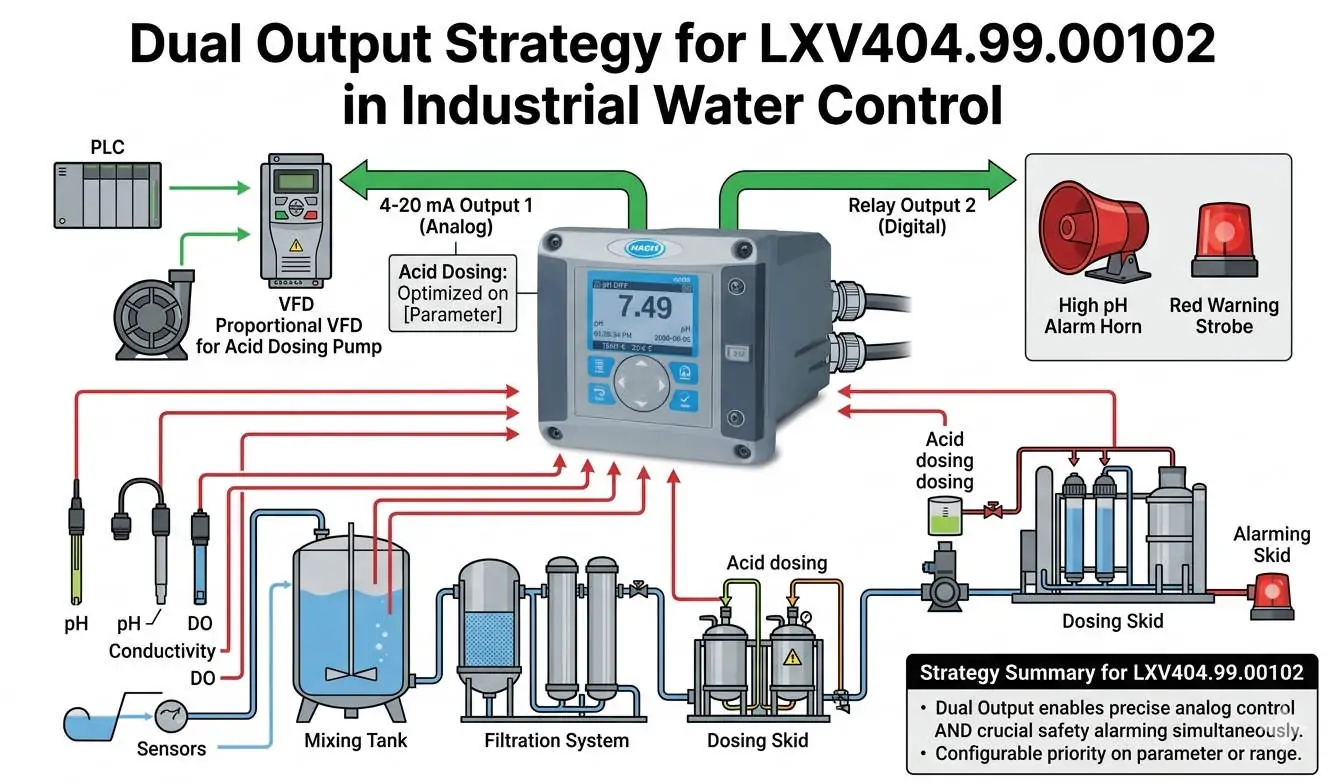
Optimizing Industrial Water Analysis with LXV404.99.00102: Dual Output Strategies
Bridging Legacy and Digital Infrastructure in Factory Automation
The LXV404.99.00102 module serves as a vital bridge between traditional analog controls and modern digital networks. It supports the simultaneous operation of 4–20 mA analog outputs and Modbus RS485 communication. As a result, plants can transmit real-time process data to PLC systems and SCADA platforms concurrently. This dual-output capability eliminates the need for expensive signal converters or splitters in complex industrial environments.

Strategic Value of Dual Communication Architecture
In modern industrial automation, redundancy defines system reliability. The 4–20 mA signal provides a deterministic, noise-resistant path for critical control loops, such as chemical dosing pumps. Meanwhile, the Modbus RS485 interface allows operators to access rich diagnostic data, calibration logs, and granular device alerts. Therefore, engineers can use analog signals for local control while utilizing digital data for high-level monitoring and predictive maintenance.
Ensuring Signal Stability and System Response
Analog outputs provide a continuous, fixed scan rate that remains immune to network traffic fluctuations. However, Modbus communication performance depends heavily on the master controller’s polling cycle. If a SCADA system requests data too frequently, it may increase the bus load and cause latency. In high-speed chemical processes, we recommend prioritizing the 4–20 mA loop for control and using Modbus strictly for data trending.
Electrical Isolation and Immunity to Interference
Harsh industrial environments often contain heavy EMI from pumps and VFDs. The LXV404 module features isolated 4–20 mA outputs to maintain signal integrity over long distances. To ensure stable digital communication, engineers must use 120Ω termination resistors at both ends of the RS485 line. Proper shielding is also essential. Most communication failures in the field stem from incorrect grounding rather than hardware defects.
Installation and Shielding for Optimal Performance
In hybrid setups, technicians should ground the RS485 shield at only one end to prevent ground loops. Moreover, keep signal cables at least 15 cm away from high-power motor lines. This separation prevents signal drift and noise spikes that could compromise data accuracy. Implementing these shielding strategies ensures that both analog and digital outputs remain precise and reliable under heavy load.
Addressing Connectivity Conflicts in Modbus Networks
When integrating the LXV404 into an existing RS485 network, you must ensure unique slave ID assignments. A mismatch in baud rate, parity, or stop bits represents the most frequent cause of commissioning delays. Therefore, verifying these parameters against the master device is the first step in any maintenance checklist. Correct configuration ensures seamless integration into modern SCADA and DCS platforms.
Expert Insights from Oiltech Controls Limited
At Oiltech Controls Limited, we observe a growing demand for hybrid communication in the water treatment sector. While digital networks are expanding, the reliability of a hardwired 4–20 mA loop remains unmatched for safety-critical tasks. We advise plants to maintain analog outputs as a “fail-safe” backup. This strategy ensures process continuity even if the digital network encounters a gateway failure or heavy latency.
For expert technical guidance and high-quality industrial modules, visit Oiltech Controls Limited to explore our comprehensive automation solutions.
Technical Essentials Checklist
- ✓ Termination: Install a 120Ω resistor to prevent RS485 signal reflection.
- ✓ Redundancy: Route 4–20 mA to the PLC and Modbus to the SCADA system.
- ✓ Protection: Add external surge suppressors for outdoor or lightning-prone installations.
- ✓ Cable Management: Separate signal wires from power cables to eliminate EMI.
Application Scenario: Pharmaceutical Water Purification
In a pharmaceutical water treatment facility, the LXV404 module sends a 4–20 mA signal to a PLC to control PH levels precisely. Simultaneously, it transmits temperature and diagnostic data via Modbus to a centralized SCADA for regulatory reporting. This setup ensures compliance with strict industry standards while maintaining continuous, real-time control over critical water quality parameters.
Frequently Asked Questions (FAQ)
Q1: Can the Modbus polling rate affect the accuracy of the 4–20 mA signal?
No. The analog and digital circuits are processed independently. However, a very high polling rate can slow down the module’s internal microprocessor slightly, which might marginally delay digital updates, but the analog output remains stable and real-time.
Q2: Why is my RS485 communication dropping intermittently?
This is often caused by common-mode voltage or ground loops. Ensure you are using a twisted-pair shielded cable and that the shield is grounded at the control cabinet side only. Also, check if a termination resistor is missing on a long cable run.
Q3: Is it possible to calibrate the device remotely via Modbus?
Yes, one of the primary advantages of using Modbus with the LXV404 is the ability to adjust parameters and trigger calibration cycles remotely. This reduces the need for technicians to access the physical device in hazardous or hard-to-reach areas.