


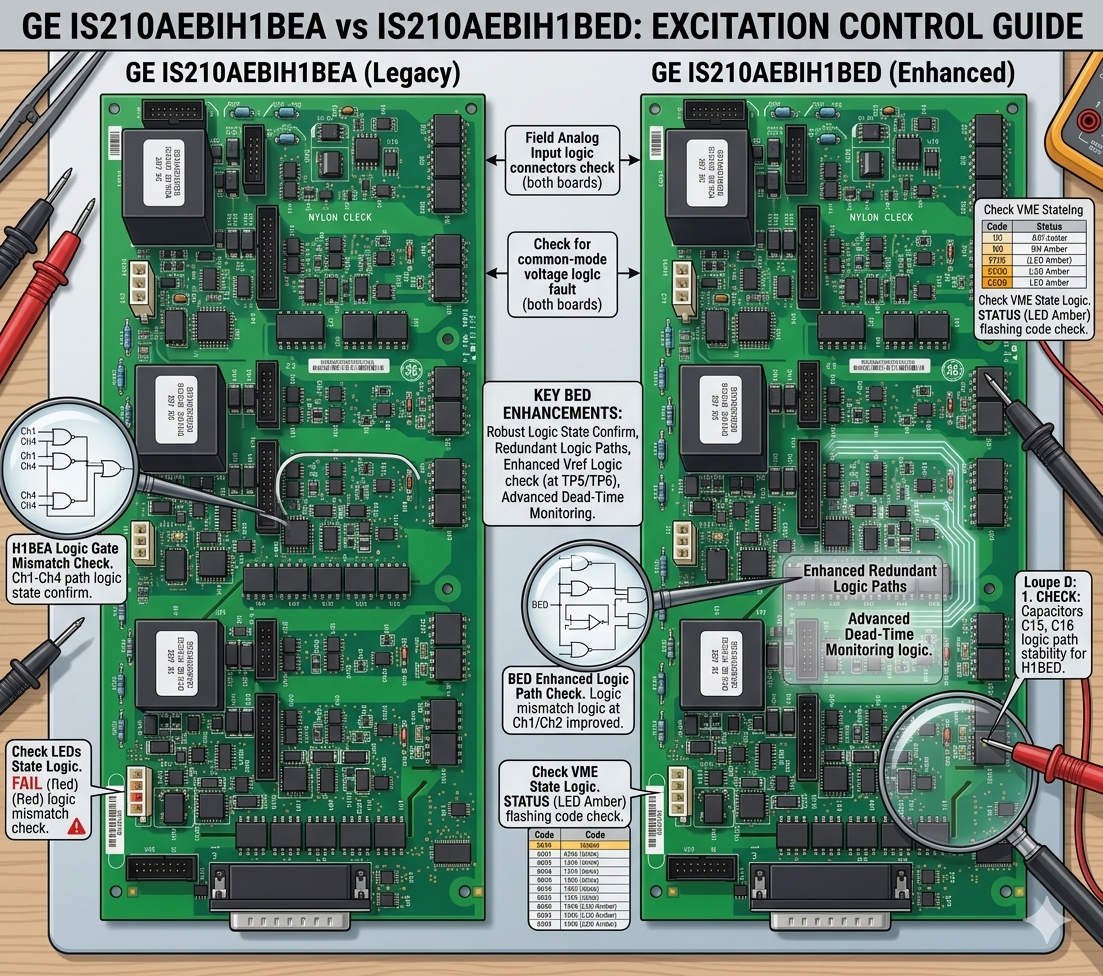
Understanding GE IS210AEBIH1BEA and IS210AEBIH1BED Bridge Interface Boards in Excitation Control Systems
The Critical Function of Bridge Interface Boards in Heavy Industry
The GE IS210AEBIH1BEA and IS210AEBIH1BED Bridge Interface Boards (BIB) serve as vital components within the EX2100 Excitation Control System. These boards actively monitor and isolate Silicon Controlled Rectifier (SCR) firing feedback signals inside the excitation bridge. In high-power turbine generator operations, unstable SCR triggering can trigger severe excitation instability or field overcurrent alarms. Therefore, the AEBI board minimizes these operational risks by supervising thyristor conduction timing and pulse integrity.
Maximizing Control Systems Stability Through SCR Trigger Monitoring
The primary duty of the AEBI board involves verifying that each SCR responds accurately to firing commands. The board continuously compares commanded firing pulses with actual bridge feedback signals to identify missing pulses or delayed conduction. Consequently, this precise supervision directly protects the stability of your generator excitation. In power generation plants, even a minor firing-angle deviation can cause unstable field current oscillations and severe reactive power fluctuations.
Galvanic Isolation Standards for Enhanced Controller Protection
The Bridge Interface Board provides robust galvanic isolation between low-level control electronics and high-energy SCR bridge circuits. This protection is essential in medium-voltage industrial automation environments where transient voltages can spike during switching events. As a result, the board shields the Mark VI or Mark VIe controller from catastrophic surge energy. Moreover, this separation eliminates nuisance trips caused by common-mode noise, extending the operational lifespan of your control hardware.
High-Speed Fault Detection to Prevent Secondary System Damage
The AEBI board utilizes high-speed trigger supervision logic tailored for dynamic factory automation architectures. Rapid detection of abnormal SCR behavior allows the EX2100 system to block faulty firing channels instantly. Therefore, the system can smoothly transfer control to backup bridge logic or initiate a controlled excitation reduction. This rapid intervention prevents localized current imbalances from destroying multiple thyristors within milliseconds, saving plants from costly emergency repairs.
Proactive Field Maintenance Strategies for Turbine Retrofits
Successful long-term operation requires strict adherence to fiber-optic and wiring maintenance standards. During maintenance outages, technicians must clean all optical connections with non-residue swabs to prevent signal attenuation. Furthermore, heavy vibration in compressor stations can loosen terminal hardware over time. Field teams should use locking terminal ferrules and conduct regular thermal imaging scans under full-load conditions to identify loose connections early.
Strategic Engineering Perspective from Oiltech Controls Limited
At Oiltech Controls Limited, we recognize that excitation reliability dictates overall plant uptime. Many operators mistakenly blame thyristor hardware when the root cause is actually a degrading interface layer or fiber contamination. As plants integrate advanced digital control systems, maintaining clean feedback loops becomes non-negotiable. We highly recommend auditing your cabinet surge suppression networks annually to support the high-speed isolation capabilities of your AEBI boards.
For genuine GE components and specialized technical advice on your excitation systems, visit Oiltech Controls Limited to explore our inventory and engineering solutions.
Essential Maintenance Checklist
- ✓ Fiber Calibration: Check optical trigger paths for excessive bending radiuses and dust accumulation.
- ✓ Thermal Auditing: Run infrared scans on terminal blocks during peak operations to detect micro-arcs.
- ✓ Grounding Verification: Test cabinet earth resistance annually according to IEEE excitation standards.
- ✓ Surge Suppression: Inspect external snubber networks to ensure maximum transient voltage clamping.
Frequently Asked Questions
Q1: What physical indicators suggest my excitation interface board requires immediate replacement?
Look for recurring, intermittent bridge imbalance diagnostics or sporadic SCR trigger-loss alarms during load swings. If your data logs show frequent micro-second synchronization mismatches that do not resolve after cleaning the fiber paths, the board hardware or onboard logic is likely degrading.
Q2: Can I swap an older AEBI revision with the H1BED variant during an emergency breakdown?
Never attempt a direct swap without verifying your firmware compatibility matrix first. While the H1BEA and H1BED variants appear identical mechanically, they often require specific jumper configurations and software I/O mapping changes. Mixing revisions blindly can cause severe trigger synchronization faults upon startup.
Q3: How does the AEBI board handle high electromagnetic interference from nearby heavy machinery?
The board utilizes specialized internal differential filtering circuits alongside its galvanic isolation barriers. This design allows it to reject high-frequency common-mode noise. However, you must pair the hardware with proper single-point shield termination at the cabinet boundary to ensure complete noise rejection.
Real-World Solution Scenario: Overcoming Nuisance Trips
A major petrochemical processing facility experienced frequent, unexplained excitation trips during compressor startup sequences. Engineers traced the issue to ground potential differences corrupting the feedback signals on an older interface module. By retrofitting the system with a certified IS210AEBIH1BED board and optimizing the cabinet bonding network, the plant successfully isolated the sensitive Mark VIe I/O modules from high-frequency switching noise, completely eliminating the nuisance shutdowns.





%20serve%20as%20vital%20components%20within%20the%20EX2100%20Excitation%20Control%20System.%20These%20boards%20actively%20monitor%20and%20isolate%20Silicon%20Controlled%20Rectifier%20(SCR)%20firing%20feedback%20signals%20inside%20%5B…%5D&media=https://www.oiltechcontrols.com/wp-content/uploads/2026/05/GE-IS210AEBIH1BEA-vs-H1BED-Excitation-Control-Guide.jpg)