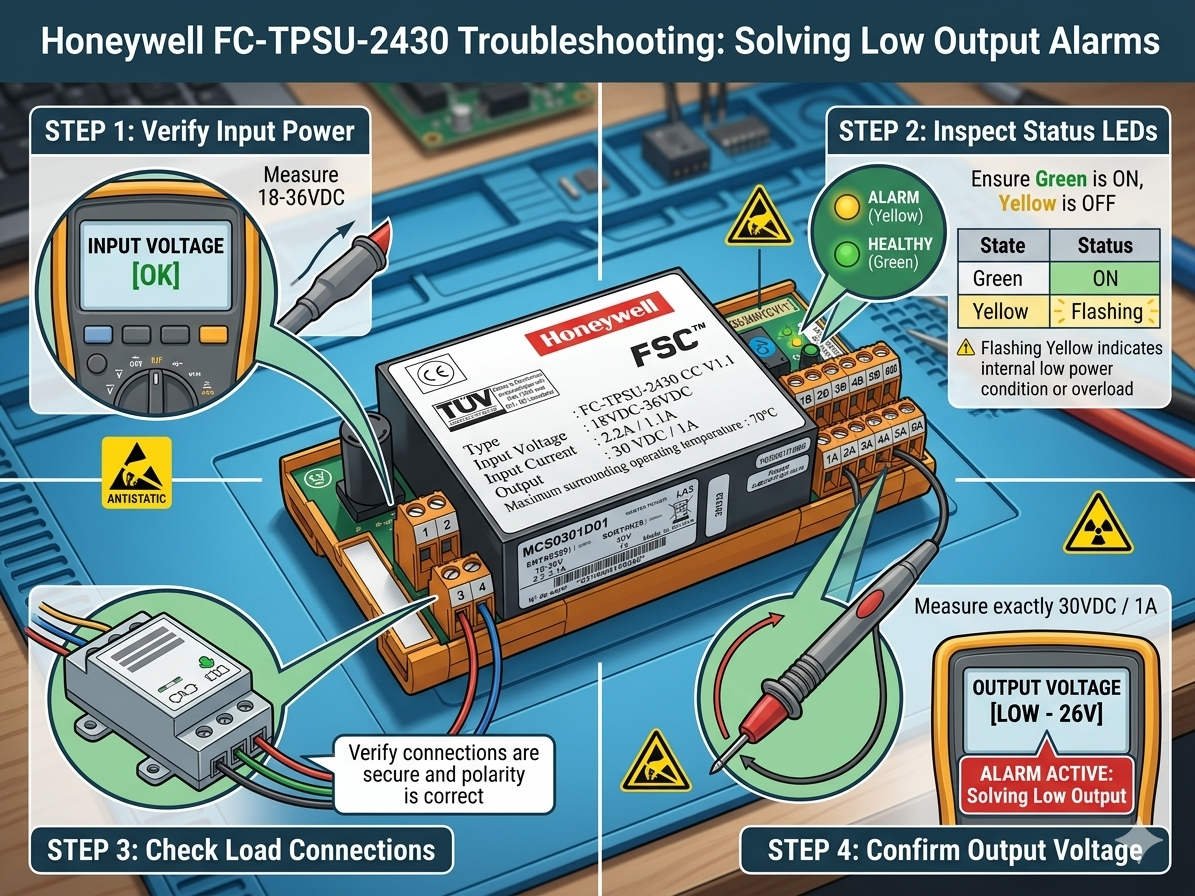
Troubleshooting Honeywell FC-TPSU-2430: Diagnosing Low Output and Undervoltage Alarms
The Critical Role of Power Stability in Honeywell Safety Systems
The Honeywell FC-TPSU-2430 power supply module serves as the backbone for Honeywell FSC and FC control systems. It delivers a regulated 24VDC to critical controllers, I/O modules, and safety loops. However, when the output drops below the 23V threshold, it triggers a severe system alarm. This undervoltage condition threatens signal integrity and relay actuation reliability. In high-stakes environments like chemical processing or oil and gas, even minor voltage deviations can cause false trips or dangerous shutdowns.

Understanding Technical Causes: Beyond Capacitor Aging
Output voltage stability is vital for maintaining logic states in digital inputs and accuracy in 4–20 mA loops. While many engineers immediately blame capacitor aging, other technical factors often play a role. As electrolytic capacitors degrade, they lose their ability to filter ripple effectively. Consequently, this leads to CPU instability or noisy analog readings. If an oscilloscope shows ripple exceeding 200mV, the internal filtering components likely require replacement to restore industrial automation performance.
Impact of Load Regulation and Current Demands
The FC-TPSU-2430 must handle transient loads, such as the startup of inductive solenoids or relays. Over time, system expansions often push these modules toward 90% of their maximum current capacity. When the load exceeds original design margins, momentary voltage sags below 23V become frequent. Therefore, engineers must audit current consumption whenever adding new I/O modules to the PLC or DCS cabinet to ensure adequate power headroom.
Thermal Stress and Maintenance Best Practices
Heat is the primary enemy of power module longevity. According to industry standards, every 10°C increase in ambient temperature halves the lifespan of electrolytic capacitors. In poorly ventilated cabinets, internal temperatures often exceed 55°C, accelerating hardware failure. Oiltech Controls Limited recommends maintaining a 20-30% physical gap between power units and other heat-generating devices. Proper airflow management ensures compliance with IEC 61439 thermal guidelines and extends equipment life.
Strategic Insights from Oiltech Controls Limited
In our experience at Oiltech Controls Limited, approximately 70% of low-output cases involve aged capacitors. However, the remaining 30% usually stem from loose terminals or oxidized wiring. Before replacing expensive hardware, technicians should measure voltage directly at the PSU terminals. If the voltage is stable at the source but low at the load, the issue lies in the distribution network. This systematic approach prevents unnecessary hardware costs and reduces downtime in factory automation environments.
For genuine Honeywell modules and expert technical consultation, please visit our website at Oiltech Controls Limited to explore our inventory and support services.
Maintenance and Verification Checklist
- ✓ Direct Measurement: Test output at the source vs. the distribution block to isolate wiring losses.
- ✓ Ripple Analysis: Use an oscilloscope to check for AC noise on the DC line.
- ✓ Thermal Scan: Use infrared thermography to identify hotspots or overheating capacitors.
- ✓ Load Audit: Verify that the current demand has not surpassed 80% of the PSU rating.
Frequently Asked Questions
Q1: Why does my undervoltage alarm only occur during plant startup?
This usually indicates an “inrush current” issue. When multiple field devices or relays power up simultaneously, they draw a peak current that temporarily exceeds the module’s regulation capacity. If the PSU is aged, its response time to these transients slows down, causing the voltage to dip below 23V.
Q2: Can I adjust the output voltage higher to compensate for aging?
While some modules have a potentiometer for fine-tuning, this is a temporary fix. If the internal capacitors are failing, increasing the voltage will not resolve the high ripple levels. This can eventually lead to communication errors or damage to sensitive analog cards. Replacement is the safer option.
Q3: What is the typical service life of an FC-TPSU-2430 in a 24/7 environment?
In a controlled environment (25°C), these modules can last 10 years. However, in typical industrial cabinets where temperatures reach 40°C-50°C, we recommend a proactive replacement every 5 to 7 years to avoid unpredictable safety system failures.
Application Scenario: Chemical Plant Power Management
In a recent pharmaceutical project, a Honeywell FSC system experienced intermittent “Analog Drift” alarms. The maintenance team initially suspected the field transmitters. However, following our diagnostic protocol, they discovered the FC-TPSU-2430 was outputting 22.8V with high ripple. By replacing the aged power module and improving cabinet ventilation, the plant restored full signal accuracy and eliminated the phantom alarms.