


Troubleshooting the FC-SDI-1624 Digital Input Module: Resolving Channel Mismatch Faults
The Critical Impact of Channel Inconsistency in Safety Systems
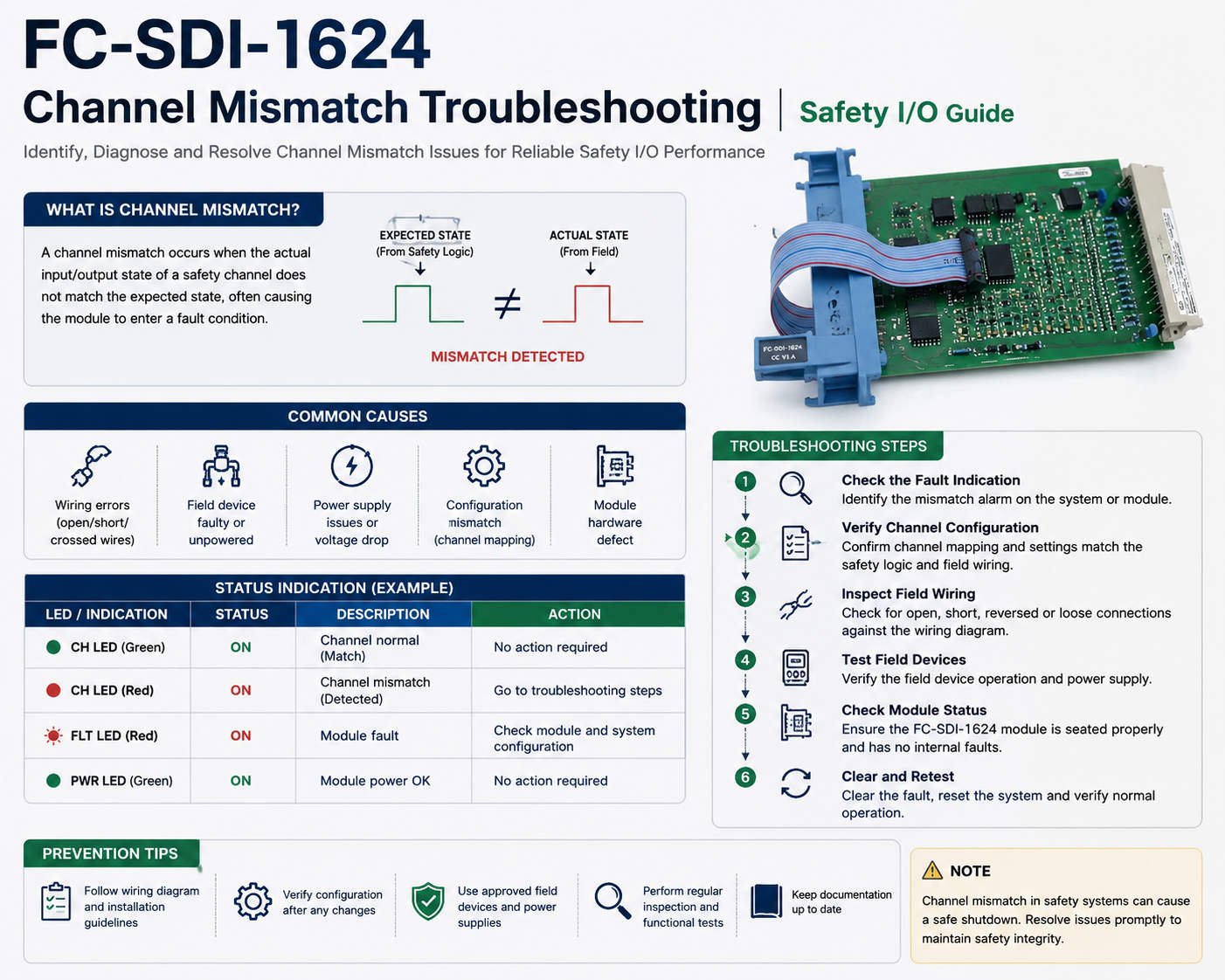
The FC-SDI-1624 digital input module plays a vital role in safety-instrumented systems (SIS). When a “Channel Mismatch” fault occurs, it signifies a discrepancy between redundant signal paths. In high-stakes environments like oil & gas or chemical processing, this issue threatens process integrity. Moreover, persistent faults may compromise SIL (Safety Integrity Level) compliance. Consequently, rapid resolution is essential to prevent unnecessary plant trips and ensure reliable factory automation.
Understanding Redundancy Architecture and Voting Logic
The FC-SDI-1624 utilizes dual-channel comparison logic to maintain high safety standards. A mismatch typically triggers when Channel A and Channel B report different states. Furthermore, timing skews that exceed pre-set tolerances can also cause alarms. In a DCS (Distributed Control System) environment, this affects 1oo2 or 2oo2 voting configurations. Therefore, an unresolved mismatch often forces the system into a fail-safe state, which reduces overall plant availability.
Managing Input Filtering and Signal Debounce Settings
Configurable filtering times, typically ranging from 3 ms to 50 ms, dictate how the module processes signal transitions. If the filter time is too short, the module becomes susceptible to electrical noise. Conversely, excessively long filter times may delay critical interlock responses. In high-speed industrial automation applications, improper debounce settings are a frequent root cause of intermittent mismatch errors. Adjusting these parameters carefully balances noise immunity with response speed.
Diagnostic Coverage and Line Monitoring Challenges
Beyond simple logic errors, the FC-SDI-1624 supports advanced line fault detection for open or short circuits. Mismatch alarms often stem from physical field wiring degradation rather than internal module failures. Factors such as moisture ingress or high contact resistance are common in corrosive offshore or outdoor installations. Regular inspection of the physical layer ensures that the control systems receive clean, consistent data from the field devices.
Practical Installation and Maintenance Strategies
Field data suggests that over 60% of mismatch faults arise from asymmetrical wiring. Engineers should ensure that redundant channels utilize identical cable lengths and routing paths. Furthermore, loose terminal connections on a single channel can introduce enough resistance to trigger an alarm. To mitigate interference, always use shielded twisted-pair cables and maintain single-point grounding. These steps significantly enhance factory automation reliability in high-EMI environments.
Expert Insights from Oiltech Controls Limited
At Oiltech Controls Limited, we observe that many operators replace modules prematurely. We believe that systematic root cause analysis saves significant time and money. Before swapping hardware, verify that your configuration—such as Normally Open (NO) vs. Normally Closed (NC) settings—is perfectly aligned across both channels. Our experience shows that configuration audits solve more “faults” than hardware replacements ever do.
For specialized technical support and a wide range of Honeywell safety components, visit Oiltech Controls Limited to optimize your safety system performance.
Technical Maintenance Checklist
- ✓ Wiring Symmetry: Confirm identical lengths and routing for both redundant channels.
- ✓ Terminal Torque: Inspect for loose connections that may cause intermittent resistance.
- ✓ Configuration Sync: Ensure filter times and logic types (NO/NC) match exactly in the controller.
- ✓ Grounding Audit: Verify shields are grounded at one end only to prevent ground loops.
Frequently Asked Questions
Q1: Why does my module show a mismatch even when the field switch is working?
This is often a timing issue. If the two redundant contacts of your field device do not close at the exact same millisecond, the module may perceive a mismatch. Increasing the “Allowed Skew” or “Filter Time” in the engineering software usually stabilizes this.
Q2: Can I clear a mismatch fault by simply rebooting the I/O module?
While a reset might temporarily clear the alarm, it will return if the underlying cause is physical. We recommend checking for moisture in the junction box or loose terminals, as these are the most common reasons for “soft” faults that reappear later.
Q3: Is it safe to run a process with a persistent mismatch alarm?
No, a mismatch indicates that your safety redundancy is compromised. Depending on your safety manual, a mismatch might mean the system is no longer performing at its rated SIL level. You should investigate and resolve the discrepancy immediately to maintain 100% protection.
Application Scenario: Chemical Batch Processing
In a recent chemical refinery project, a batch reactor experienced frequent trips due to FC-SDI-1624 mismatch faults. Upon inspection, the team found that one channel’s cable was routed near a high-power pump motor, inducing noise. By rerouting the cables and matching the filter settings, the facility achieved 99.9% uptime, proving that control systems require physical as well as logical precision.


.%20When%20a%20“Channel%20Mismatch”%20fault%20occurs,%20it%20signifies%20a%20discrepancy%20between%20redundant%20signal%20paths.%20In%20high-stakes%20environments%20like%20oil%20&%20gas%20or%20chemical%20%5B…%5D&media=https://www.oiltechcontrols.com/wp-content/uploads/2026/05/FC-SDI-1624-Channel-Mismatch-Troubleshooting.jpg)