


Why High-Speed Counter (HSC) Modules are Essential for Precision Industrial Automation
The Core Value of High-Speed Pulse Acquisition
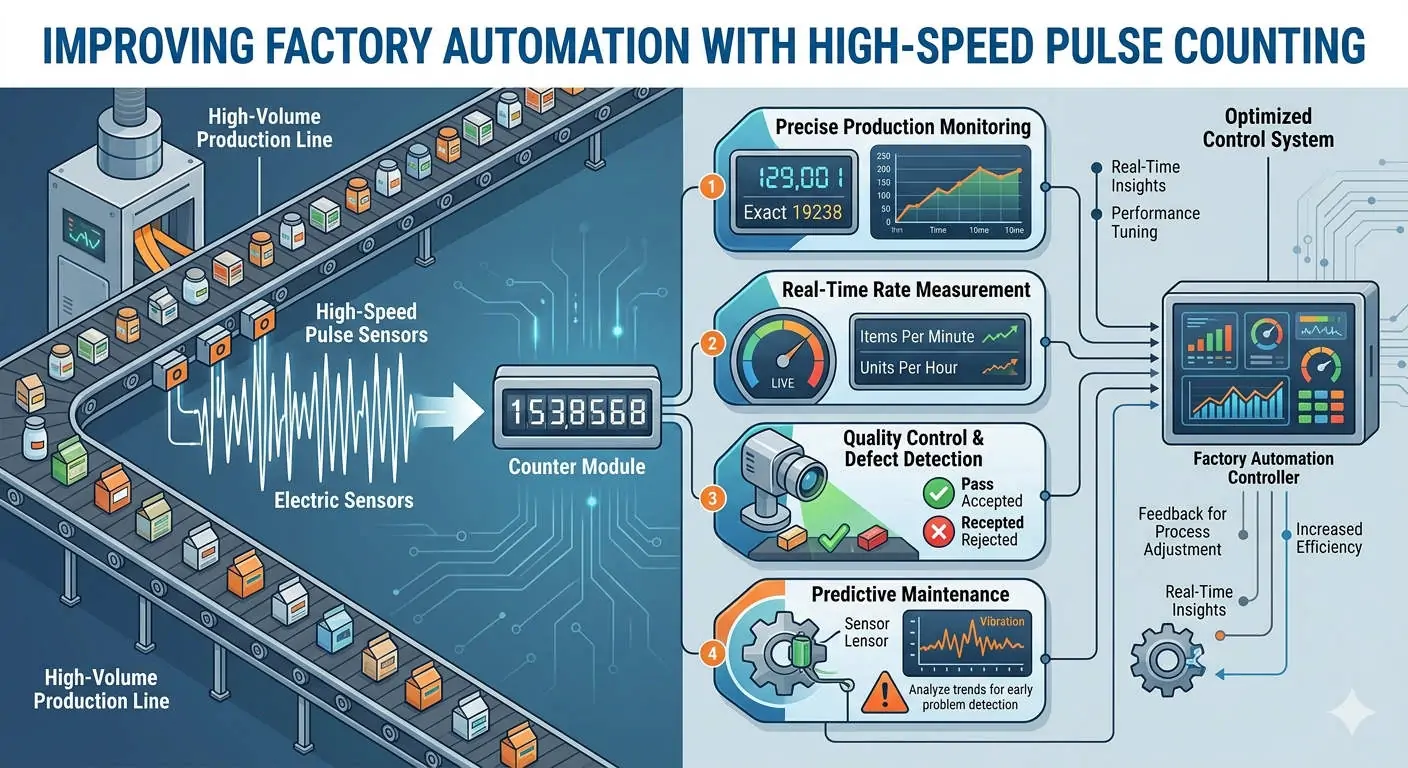
High-Speed Counter (HSC) modules capture rapid pulse signals that exceed standard PLC scan cycle capabilities. These modules utilize dedicated signal processing chips to ensure deterministic counting and timing accuracy. Consequently, they become indispensable in factory automation, packaging, and high-speed assembly lines. Reliable encoder feedback and real-time motion synchronization prevent cumulative positioning errors during production. Even a few microseconds of delay can lead to product defects or system desynchronization.
Technical Superiority in Response Time and Interrupt Handling
Standard PLC scan cycles usually range from 1ms to 10ms, which is too slow for kHz-level signals. Dedicated HSC hardware processes pulses asynchronously from the main CPU to achieve microsecond response times. This architecture prevents pulse loss for high-speed encoders operating above 100 kHz. Therefore, cutting machines and conveyor tracking systems maintain absolute length measurement accuracy. Furthermore, offloading these tasks reduces CPU interrupt strain and enhances overall control system stability.
Enhancing Signal Integrity and Noise Immunity
Independent processing chips integrate hardware-level filtering and debounce logic to protect data integrity. Many modules support RS-422 differential inputs to cancel out common-mode noise. As a result, systems maintain stable counts even in electrically noisy environments near variable frequency drives. Effective EMI suppression reduces false counts and prevents grounding issues in complex chemical plants. These features ultimately extend the operational lifespan of expensive sensors and high-resolution encoders.
Versatile Counting Modes and Industrial Protocol Support
Modern HSC modules support diverse counting modes, including quadrature, up/down, and pulse-direction formats. This versatility allows seamless integration with various incremental and bidirectional encoders. Moreover, engineers can retrofit these modules into legacy systems without replacing existing field devices. Compatibility with common industrial communication backplanes ensures that the HSC fits perfectly into modern DCS or PLC architectures. This flexibility simplifies the transition toward more advanced factory automation standards.
Maintenance Guide for High-Noise and High-Vibration Areas
Improper grounding remains a leading cause of unstable counts in petrochemical and heavy machinery environments. Engineers at Oiltech Controls Limited recommend using shielded twisted-pair cables for all encoder signals. You should ground the shield at only one end to prevent problematic ground loops. In high-vibration applications like stamping presses, spring-clamp terminals offer better reliability than standard screws. Additionally, always apply cable strain relief to prevent intermittent signal loss during heavy machine operation.
Insights from Oiltech Controls Limited
At Oiltech Controls Limited, we observe that many precision errors stem from underestimating signal frequency. As industrial lines move faster, the demand for dedicated hardware processing grows significantly. We believe that choosing an HSC module with built-in surge protection is no longer optional for outdoor installations. Relying solely on software interrupts for high-speed tasks often leads to jitter and unpredictable system behavior. Investing in robust HSC hardware is a proactive step toward a more maintainable automation infrastructure.
For expert guidance on selecting the right counter modules for your system, visit Oiltech Controls Limited to explore our technical solutions.
Technical Implementation Checklist
- ✓ Cable Separation: Maintain at least 20cm between signal and power lines.
- ✓ Terminal Integrity: Use locking connectors in high-vibration zones.
- ✓ Surge Defense: Install external SPDs if the module lacks internal isolation.
- ✓ Noise Management: Verify differential signal pairing to eliminate EMI.
Frequently Asked Questions (FAQ)
Q1: When should I move from a standard digital input to an HSC module?
If your pulse frequency exceeds 5 kHz or if you require sub-millisecond precision, a standard input will fail. Standard inputs depend on the PLC scan time, which causes missed pulses. An HSC module handles the counting independently, ensuring every pulse is recorded regardless of the CPU load.
Q2: How do I resolve inconsistent count totals in a noisy environment?
Inconsistency often results from EMI or ground loops. Ensure you are using shielded cables and check if your encoder supports differential (Line Driver) signals. Adding a hardware filter or adjusting the debounce time in the HSC configuration can also eliminate high-frequency noise spikes.
Q3: Can I use an HSC module with an absolute encoder?
Most standard HSC modules are designed for incremental encoders (A/B phase). If you are using an absolute encoder, you typically need a module that supports SSI or EnDat protocols. Always verify the interface compatibility between your encoder and the counter module before installation.
Solution Scenario: High-Speed Bottle Labeling
In a high-speed bottling plant, standard inputs failed to track bottle positions accurately at 500 units per minute. By installing an HSC module, the system achieved microsecond trigger accuracy for the labeling head. Consequently, the plant reduced labeling waste by 15% and eliminated cumulative positioning drift throughout the 24-hour production cycle.


%20Modules%20are%20Essential%20for%20Precision%20Industrial%20Automation%20The%20Core%20Value%20of%20High-Speed%20Pulse%20Acquisition%20High-Speed%20Counter%20(HSC)%20modules%20capture%20rapid%20pulse%20signals%20that%20exceed%20standard%20PLC%20scan%20cycle%20capabilities.%20These%20modules%20utilize%20dedicated%20signal%20processing%20chips%20to%20ensure%20deterministic%20counting%20and%20timing%20accuracy.%20Consequently,%20they%20become%20indispensable%20in%20factory%20automation,%20packaging,%20%5B…%5D&media=https://www.oiltechcontrols.com/wp-content/uploads/2026/04/Improving-Factory-Automation-with-High-Speed-Pulse-Counting.webp)