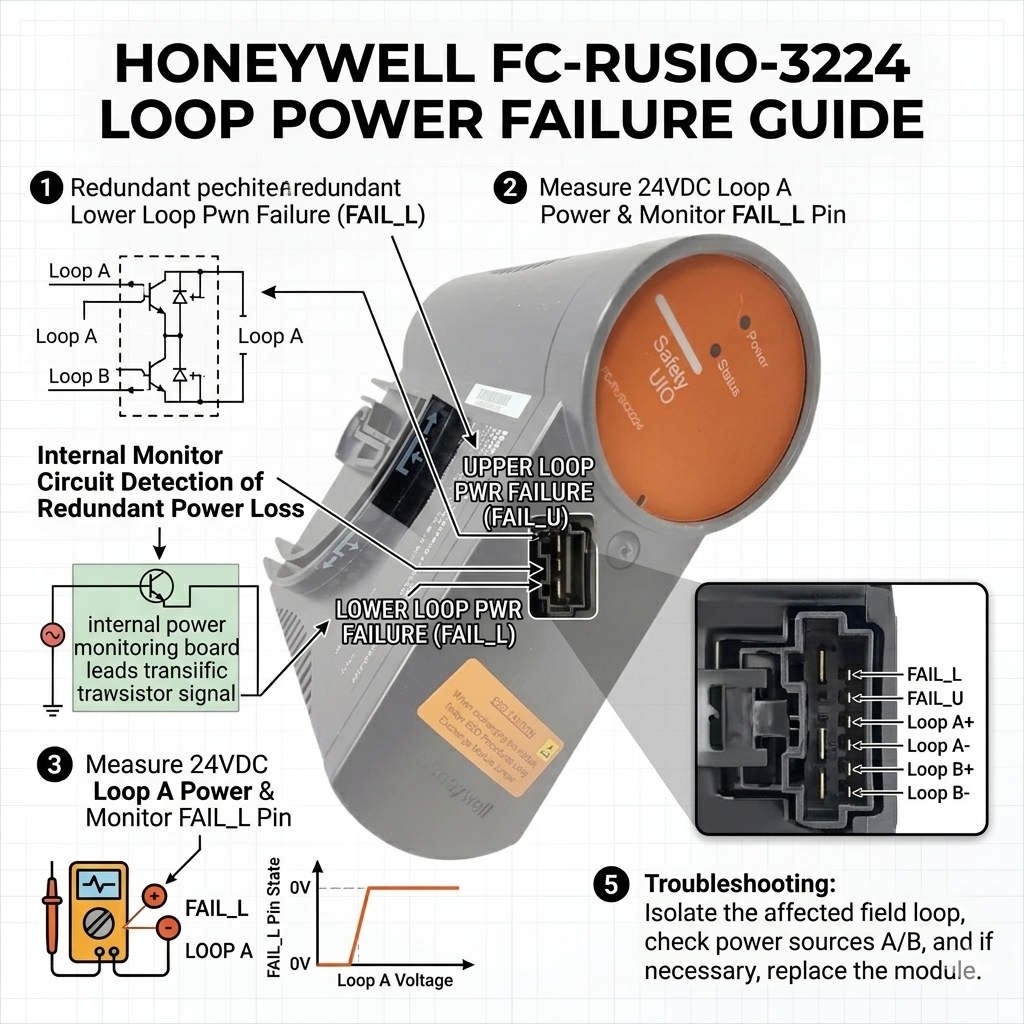
Managing Loop Power Failures in Honeywell FC-RUSIO-3224 Analog Input Channels
Critical Value of Reliable Signal Acquisition in Process Industries
In modern industrial automation, the Honeywell FC-RUSIO-3224 module plays a vital role in maintaining system integrity. When configured as an analog input, loop power loss presents a significant risk to measurement reliability. In sectors like oil and gas or chemical processing, 4–20 mA signals represent essential process variables. Therefore, engineers must implement robust strategies to handle power interruptions. Proper management prevents false alarms and ensures the safety of the entire control system.
Technical Insights into Signal Behavior and Fail-Safe Logic
When loop power fails, the analog input channel typically registers 0 mA or an underrange condition. Without specific configuration, the DCS (Distributed Control System) might interpret this as a valid low process value. Consequently, this could lead to undetected dangerous failures in a Safety Instrumented System (SIS). Best practices involve mapping these underrange signals to a “BAD PV” status. This ensures the controller logic triggers a predefined fail-safe action rather than continuing operations blindly.
Diagnostic Capabilities and Line Fault Detection (LFD)
The FC-RUSIO-3224 supports advanced line fault detection depending on the specific wiring topology used. This feature allows the system to differentiate between a genuine low process signal and a hardware open circuit. As a result, maintenance teams can significantly reduce troubleshooting time in large-scale factory automation environments. Moreover, professional technicians at Oiltech Controls Limited suggest that correct grounding is essential to avoid false diagnostic positives caused by electrical noise.
Optimizing Input Impedance and Loop Stability
The input impedance of the FC-RUSIO-3224 matches standard industrial requirements for 4–20 mA loops. This design ensures stable signal acquisition even when cable runs exceed 100 meters. However, mixing transmitters from different manufacturers requires careful loop budget calculations. If the total voltage drop exceeds the supply capacity, intermittent signal loss may occur under high-load conditions. Therefore, verifying the impedance match is a critical step during the engineering phase.
Guidelines for Installation and Maintenance
Engineers should never rely solely on hardware defaults for safety. In systems like Honeywell Experion PKS, you must configure underrange detection to trigger a “last good value hold” or a trip. Additionally, for SIL-rated loops (IEC 61508), consider adding external loop power monitoring relays. Using shielded twisted-pair cables is also mandatory. Oiltech Controls Limited recommends grounding the shield at only one side to prevent ground loops that disrupt analog accuracy.
Industry Trends and Expert Perspectives
At Oiltech Controls Limited, we observe that “Smart I/O” modules like the FC-RUSIO-3224 are transforming predictive maintenance. While the hardware is highly capable, its effectiveness depends entirely on the control strategy configuration. We suggest that operators prioritize alarm rationalization according to ISA 18.2 standards. This ensures that power loss is treated as a priority diagnostic event rather than a routine process deviation.
For more technical specifications or to procure genuine Honeywell modules, please visit our website at Oiltech Controls Limited for expert assistance and industrial components.
Technical Implementation Checklist
- ✅ Verify Software Release: Check compatibility with your current Experion PKS firmware version.
- ⚙️ Configure LFD: Enable line fault detection to distinguish between wire breaks and zero process values.
- 🔧 Signal Protection: Install external surge protection devices (SPD) in lightning-prone refinery areas.
- 📊 Status Mapping: Ensure all analog inputs map to a “Quality Status” bit for real-time operator visibility.
Frequently Asked Questions (FAQ)
Q1: Does the FC-RUSIO-3224 automatically stop the process during a power loss?
No, the module only reports the electrical state (0 mA). You must program the logic in your Honeywell controller to interpret this as a fault and initiate a safe shutdown sequence if necessary.
Q2: Can I use this module as a direct replacement in older Honeywell systems?
It depends on your I/O network architecture. While the module is part of the modern Universal I/O family, you must verify the migration path and scaling factors to ensure consistent behavior with legacy transmitters.
Q3: Why does my loop show intermittent signal loss despite the power being on?
This is often caused by an insufficient loop power budget. From our field experience, adding more transmitters to a single power supply or using high-impedance barriers can cause the voltage to drop below the required threshold for stable signal acquisition.
Application Scenario: Chemical Plant Retrofit
In a recent chemical plant upgrade, a faulty configuration lead to a pump trip because a broken signal wire was read as “zero flow.” By replacing the legacy I/O with the FC-RUSIO-3224 and correctly configuring Line Fault Detection (LFD), the plant successfully migrated to a system where wire breaks are instantly flagged as hardware failures. This allowed the safety system to hold the last valid state, preventing unnecessary production downtime.