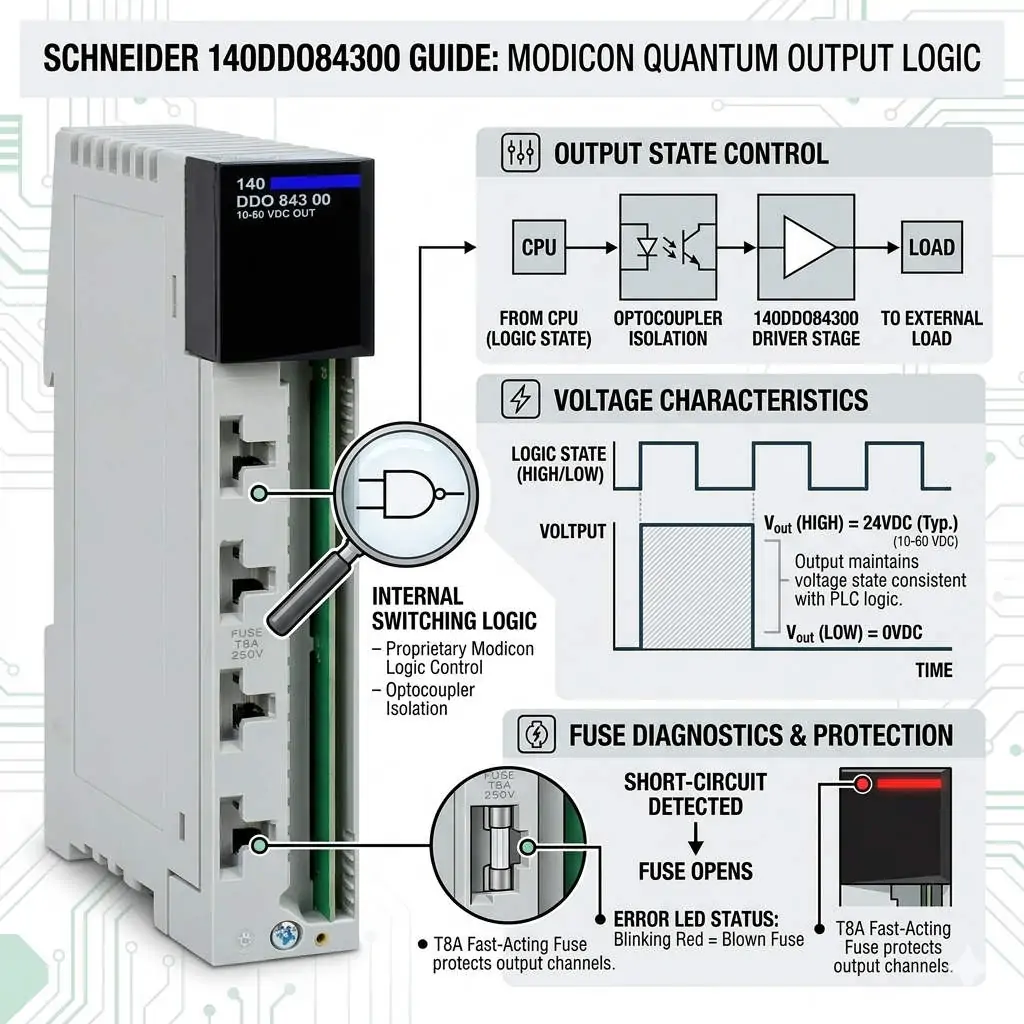
Technical Guide to Schneider Electric 140DDO84300: Optimizing Modicon Quantum Output Reliability
The Operational Role of 140DDO84300 in Discrete Control
The Schneider Electric 140DDO84300 serves as a high-performance 24VDC digital output module within the Modicon Quantum PLC family. Engineers specifically design this module to drive field actuators such as solenoid valves, relays, and indicators. Consequently, it has become a standard in chemical processing and pharmaceutical manufacturing. In these sectors, output stability directly impacts safety and prevents costly batch failures. Reliability is not just an advantage; it is a fundamental requirement for continuous operations.
Analyzing Output Current Capacity and Thermal Management
This module provides a maximum output of 0.5 Amps per channel, with a total module capacity of approximately 4 Amps. While 0.5A is sufficient for most industrial loads, running all channels at full capacity increases internal heat. Therefore, Oiltech Controls Limited suggests maintaining a continuous load of 0.3A per point. This conservative approach extends the hardware lifespan significantly. Moreover, it reduces the risk of thermal tripping during peak summer temperatures in non-conditioned control rooms.
Understanding PNP Source Output and Wiring Compatibility
The 140DDO84300 utilizes a Source (PNP) output logic, meaning the module supplies +24VDC to the load. As a result, the load must be connected to the common 0V ground. This configuration aligns with modern IEC wiring standards preferred in Europe and Asia. However, technicians must verify compatibility when interfacing with legacy Japanese equipment that often uses Sink (NPN) logic. Misidentifying the logic type is a frequent cause of “no output” errors during system commissioning.
Isolation Standards and Interference Mitigation
Industrial automation environments often suffer from high electromagnetic interference (EMC) caused by VFDs and large motors. The 140DDO84300 addresses this through robust group electrical isolation. This design prevents field noise from traveling back to the PLC backplane. Consequently, the system avoids erratic scanning behavior and internal component damage. High-quality isolation is essential for maintaining signal integrity in heavy industrial production lines.
Installation Guide for Harsh Industrial Environments
Maintaining high-density I/O requires proactive installation strategies. Since this model does not include built-in surge suppression for high-inductive loads, external protection is mandatory. We recommend adding flyback diodes for DC loads to prevent back-EMF from damaging the output points. Furthermore, in high-vibration industries like mining, using spring-clamp terminals ensures connections remain secure over time. Regular inspections every three to six months can catch loose wiring before it leads to system downtime.
Strategic Insights from Oiltech Controls Limited
At Oiltech Controls Limited, we observe that many module failures stem from poor thermal planning. Quantum racks are often crowded, leading to heat pockets. Therefore, we advise placing high-power output modules away from the power supply unit. Ensuring at least 20mm of clearance above and below the rack improves natural convection. For environments exceeding 40°C, forced ventilation is a necessary investment to protect your automation assets.
For more technical specifications or to procure genuine Modicon components, visit our dedicated resource center at Oiltech Controls Limited.
Technical Essentials Checklist
- ✓ Load Calculation: Keep long-term current per point under 0.3A for better durability.
- ✓ Logic Verification: Confirm all connected actuators support PNP (Source) input.
- ✓ Protection: Install external RC circuits or diodes on all inductive solenoid valves.
- ✓ Airflow: Maintain clear vertical spacing in the PLC cabinet for heat dissipation.
Frequently Asked Questions (FAQ)
Q1: Can I use the 140DDO84300 to replace a Sink (NPN) module?
No, they are not directly interchangeable. Switching from Sink to Source requires rewiring the common side of all field loads. Attempting a direct swap without rewiring will result in zero current flow to your devices.
Q2: Why do some output points fail while the rest of the module works?
This is typically caused by localized surge damage. If a specific solenoid valve lacks a protective diode, the voltage spike during de-energization eventually destroys that specific channel’s transistor. Always verify your suppression hardware.
Q3: Is this module suitable for safety-critical “Emergency Stop” outputs?
While highly reliable, the 140DDO84300 is a standard digital module. For safety-instrumented functions (SIF), you should use dedicated safety I/O modules or redundant wiring configurations as defined by SIL standards.
Practical Solution Scenario: Packaging Line Optimization
In a high-speed beverage packaging facility, a client experienced intermittent “ghost” resets on their PLC. By analyzing the 140DDO84300 outputs, we discovered that high-speed solenoids were creating noise. After installing external suppression diodes and improving shield grounding, the resets stopped immediately. This case highlights how proper accessory installation is just as important as the module itself.