Troubleshooting the IS200TDBTH6A Rectifier Bridge: A Practical Field Guide
Understanding the Role of the Rectifier Bridge in Control Systems
The diode rectifier bridge on the GE IS200TDBTH6A terminal board is essential for converting AC control power into stable DC voltage. It powers critical circuits within EX2100 and Mark VI excitation systems. When this bridge fails, systems experience intermittent power loss, blown fuses, or total module startup failure. In high-stakes environments like power generation and petrochemical plants, downtime is expensive. Therefore, engineers at Oiltech Controls Limited emphasize that quickly diagnosing a faulty rectifier bridge is vital to maintaining operational continuity and avoiding costly component replacements.
Diagnostic Techniques: Testing Diode Health
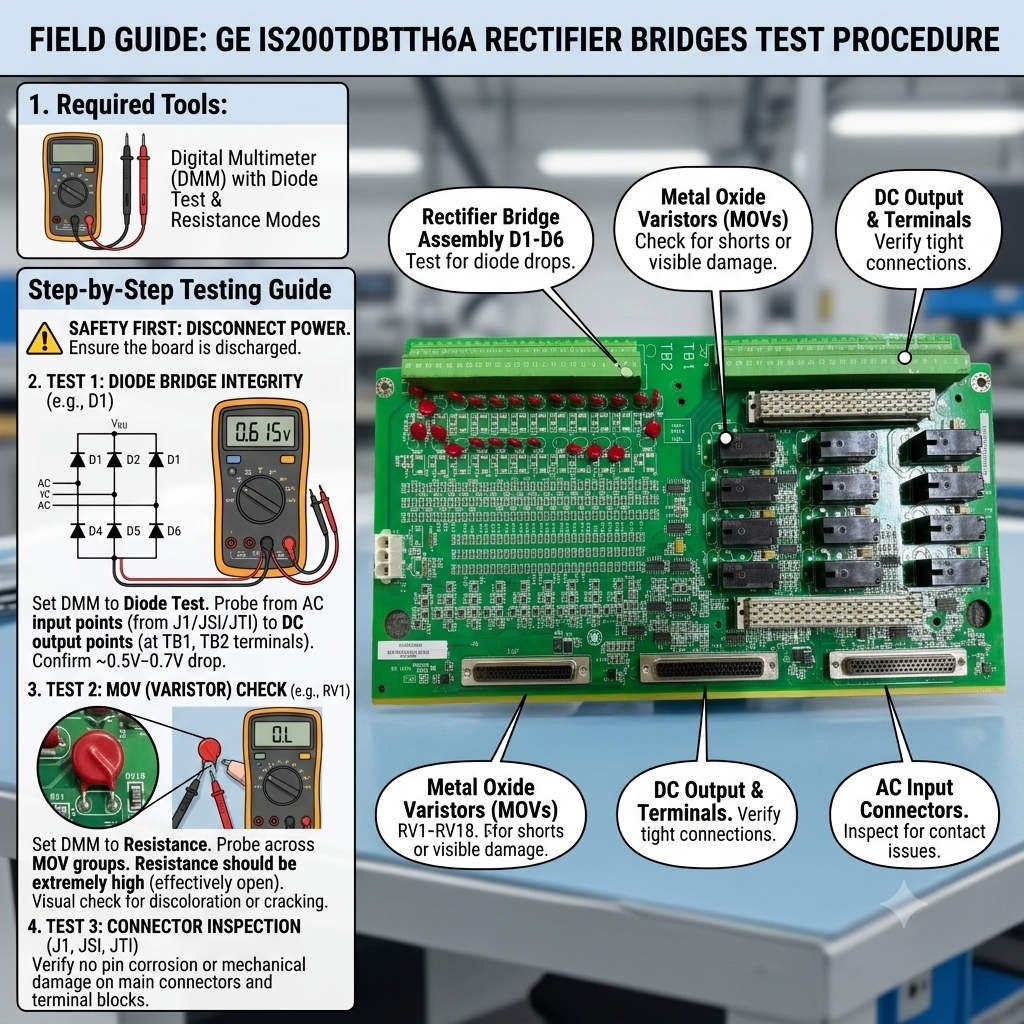
A functional silicon rectifier diode typically shows a forward voltage drop between 0.45 V and 0.75 V when using a multimeter’s diode-test mode. However, values below 0.2 V usually point to an internal short circuit. Conversely, an infinite reading suggests an open diode. Both scenarios cause unstable DC supply levels and unexpected controller resets. During our site visits, we often find that a shorted diode leads to repeated fuse failures immediately upon power-up. Consequently, testing these junctions early in the troubleshooting process saves significant time.
Ensuring Reverse Blocking Integrity
The rectifier bridge must block reverse current effectively. When you measure in reverse polarity, your multimeter should display “OL” or show very high resistance. A diode that leaks in the reverse direction often allows temporary operation but introduces excessive voltage ripple. This ripple stresses power supplies and accelerates the aging of electrolytic capacitors. In several gas turbine installations, we have documented reverse leakage occurring shortly before a total bridge breakdown. We therefore consider preventive diagnosis during scheduled maintenance outages a highly effective strategy for long-term system reliability.
Mitigating Thermal and Electrical Stress
- Perform thorough inspections: Use infrared thermal imaging alongside multimeter tests to identify hotspots.
- Isolate the circuit: Never test components while parallel paths are connected, as this produces misleading data.
- Implement surge protection: In lightning-prone regions, install external surge suppression on the transformer secondary side.
- Verify connections: Before replacing the entire board, disconnect the bridge from the transformer winding to confirm the failure is internal to the board.
Strategic Replacement vs. Repair
Determining whether to repair or replace an IS200TDBTH6A board requires professional judgment. Component-level repair is feasible if only the rectifier bridge has failed and PCB traces remain intact. However, we recommend full replacement if you notice carbonized copper traces or widespread thermal damage. In critical turbine applications, replacing the entire assembly provides superior long-term reliability compared to localized patches. Always ensure the new board matches your system version and wiring requirements precisely, as mechanical compatibility does not guarantee firmware interoperability.
Expert Troubleshooting FAQ
Q: Why do I encounter blown fuses even after checking the rectifier bridge?
A: If the bridge tests normal, look for insulation failures in the wiring downstream or intermittent short circuits in the field excitation cabling. Our experience shows that cable degradation in harsh industrial environments often mimics internal board faults.
Q: Can I use a generic bridge rectifier to repair the IS200TDBTH6A?
A: We strongly advise against using generic parts. The original components are selected for specific thermal and electrical tolerances required by GE excitation systems. Using improper parts often leads to premature failure and potential damage to the control logic.
Q: How often should I perform preventive multimeter testing on these boards?
A: During major outages, include a diode-bridge check as part of your standard preventive maintenance routine. This proactive step helps identify aging components before they trigger an unplanned plant shutdown.
Are you looking to optimize your control system’s reliability? At Oiltech Controls Limited, we specialize in providing high-quality spare parts and technical guidance for GE Mark VI and EX2100 systems. Whether you are planning a migration or need urgent replacements to prevent downtime, our team offers the expertise to keep your operations running smoothly. Visit our website today to explore our full inventory of industrial automation components and support services.