


Why GE Mark VIe IS200TREGH1BDB Safety Circuits Must Use NC Contacts
The “Fail-Safe” Philosophy in Industrial Automation
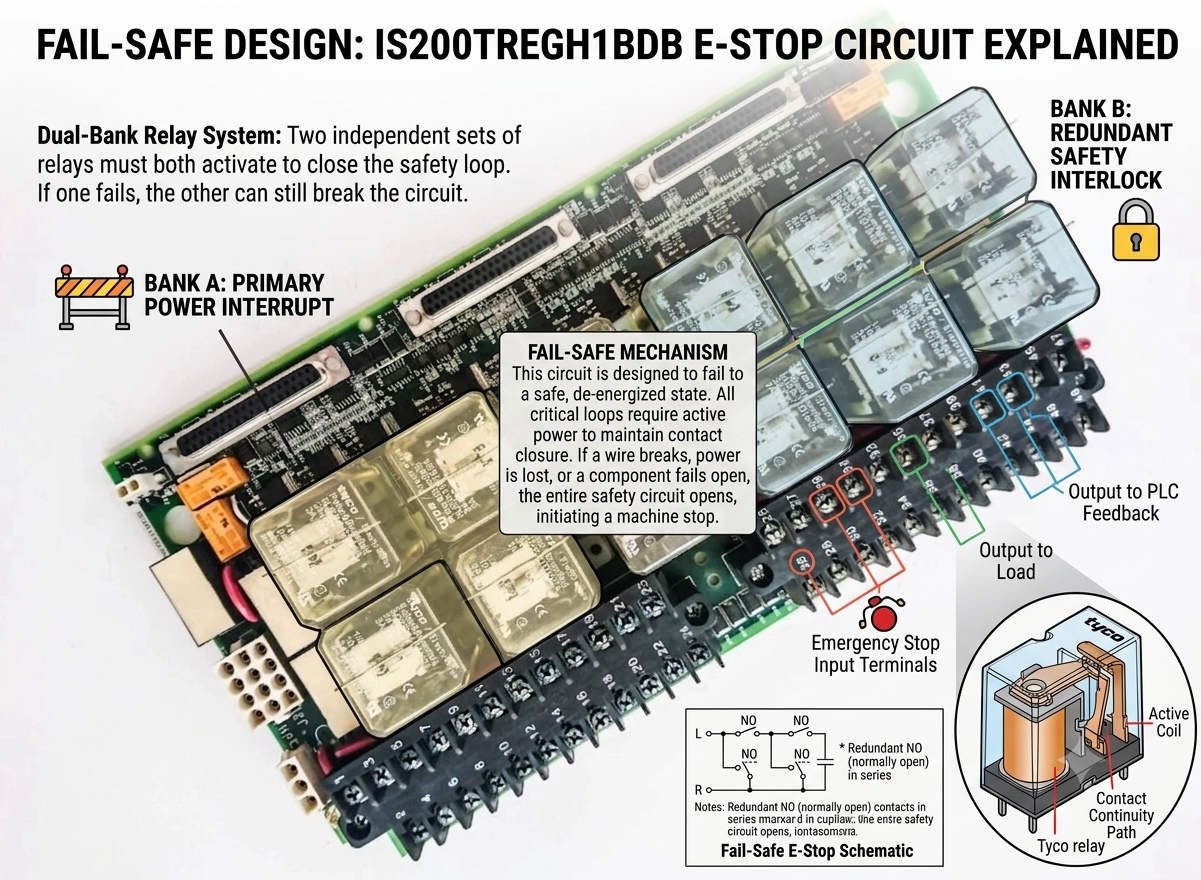
Safety remains the top priority in GE EX2100 and Mark VI/VIe control systems. The IS200TREGH1BDB terminal board manages critical trip signals to keep your assets secure. Engineers often ask why we mandate Normally Closed (NC) contacts for Emergency Stop (E-Stop) buttons. The answer centers on the “fail-safe” principle. If a wire breaks or a connection loosens, the system must interpret this as an emergency. Consequently, an NC circuit creates a continuous loop that detects faults immediately. Without this design, a damaged wire could hide a safety failure, which poses a severe risk in high-stakes environments like power plants.
Enhancing System Reliability Through Fault Detection
Modern factory automation relies on continuous circuit monitoring. An NC configuration keeps current flowing through the loop during normal operation. Therefore, the IS200TREGH1BDB constantly validates the health of the entire safety chain. If a field cable fails or a terminal becomes loose, the controller triggers a protective trip instantly. In contrast, Normally Open (NO) circuits remain silent during wire breaks, leaving operators unaware of the danger until it is too late. Oiltech Controls Limited frequently advises clients that detecting faults before they become emergencies is the hallmark of a resilient control system.
Meeting International Functional Safety Standards
Global standards like IEC 61508 and ISO 13849 drive current safety strategies in DCS and PLC implementations. These regulations emphasize that loss of signal must force equipment into a safe state. By utilizing NC contacts, your IS200TREGH1BDB board inherently complies with these rigorous demands. This approach simplifies safety audits and reduces the risk during system upgrades. Moreover, aligning your hardware with these industry benchmarks ensures long-term operational success for turbine and compressor skids.
Essential Installation and Maintenance Best Practices
- Verify Contact Logic: Always use a multimeter to confirm NC operation before commissioning your E-Stop stations.
- Apply Proper Torque: High-vibration areas like turbine enclosures can loosen connections, so perform regular torque checks on all terminations.
- Use Shielded Cabling: To prevent induced noise in long cable runs, route safety wiring separately from high-power motor cables.
- Utilize Wire Ferrules: Using ferrules on stranded conductors ensures a secure, lasting connection at the terminal board.
Common Troubleshooting & Field Experience (FAQ)
Q: My system keeps tripping intermittently; could it be the NC circuit?
A: Yes. In our experience, intermittent trips in NC loops often result from vibration-induced loose connections or degraded field wiring. Check your terminal torque first before assuming the board has failed.
Q: Can I use NO contacts if I add a software check to monitor the loop?
A: We strongly discourage this. Software checks cannot replicate the instantaneous hardware-level protection provided by a physical NC loop. Always stick to the manufacturer’s fail-safe hardware specifications.
Q: Does the IS200TREGH1BDB require specific firmware for safety validation?
A: Firmware is vital, but the physical wiring integrity is the primary safety layer. Ensure your ControlST configuration matches your physical I/O mapping exactly to avoid synchronization errors.
Are you looking to optimize your control system’s reliability? At Oiltech Controls Limited, we specialize in providing high-quality spare parts and technical guidance for GE Mark VI and Mark VIe systems. Whether you are planning a migration or need urgent replacements to prevent downtime, our team offers the expertise to keep your operations running smoothly. Visit our website today to explore our full inventory of industrial automation components and support services.






%20contacts%20for%20Emergency%20%5B…%5D&media=https://www.oiltechcontrols.com/wp-content/uploads/2026/06/Fail-Safe-Design-IS200TREGH1BDB-E-Stop-Circuit-Explained.jpg)