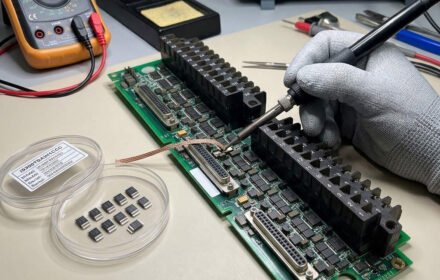
Troubleshooting Honeywell FC-PSU-UNI2450U Smoke and Power Failure Faults
Understanding Safety Manager Power Supply Failure Symptoms
Plant engineers frequently manage critical safety instrumentation within hazardous processing environments. When a Honeywell FC-PSU-UNI2450U power supply module emits smoke immediately after post-overhaul energization, maintenance teams often jump to hasty conclusions. At Oiltech Controls Limited, we emphasize that visible smoke does not automatically confirm a bridge rectifier breakdown or a worn capacitor. Instead, technicians must analyze localized burn marks, protective device trips, and input-side short circuits systematically before replacing hardware.

Evaluating Bridge Rectifier and Inrush Current Hazards
Industrial power distribution relies on robust input rectification stages to convert incoming alternating current into stable direct current. However, a severe short circuit within the primary bridge rectifier frequently triggers immediate protective fuse operation. When power is reapplied hastily after an overhaul, massive inrush currents can destroy vulnerable semiconductor components. Consequently, engineers should inspect MOV surge suppressors and primary switching transistors alongside the rectifier bridge.
Analyzing Electrolytic Capacitor Aging and Dielectric Breakdown
Primary DC bus capacitors endure intense thermal and electrical stress over years of continuous operation in factory automation cabinets. Although aged electrolytic capacitors typically exhibit increased equivalent series resistance and ripple heating, severe dielectric failures can cause hard internal shorts. However, capacitor failure often occurs as a secondary result of another primary component shorting out. Therefore, inspectors must distinguish between initiating faults and collateral thermal damage across the printed circuit board.
Systematic Post-Overhaul Inspection Protocols
Recommissioning complex distributed control systems requires strict adherence to pre-power verification standards to protect expensive hardware investments. To prevent catastrophic component failures and minimize unexpected plant downtime, follow these essential engineering workflows:
- ✅ Verify Input Voltage: Measure supply voltage and frequency precisely to match nameplate specifications before closing supply breakers.
- ⚙️ Isolate Downstream Loads: Disconnect external DC distribution circuits to determine whether power supply faults originate internally or externally.
- 🔧 Inspect Wiring Integrity: Check all terminal connections, retaining clips, and locking plugs for arcing traces and insulation damage.
Author’s Insight: Why Premature Component Blaming Compromises Plant Safety
At Oiltech Controls Limited, our hands-on field commissioning experience across petrochemical and refinery turnarounds shows that technicians frequently misdiagnose post-overhaul smoke incidents. Blaming an electrolytic capacitor blindly without performing component-level isolation tests often masks external wiring errors or load-side short circuits. We strongly advise maintenance engineers to secure damaged units immediately, review revision compatibility notes, and verify load parameters thoroughly before reinstalling replacement power modules.
Frequently Asked Questions (FAQ)
Q: Does immediate smoke near the AC input always mean the bridge rectifier is completely destroyed?
A: Not necessarily. While an input-side short circuit frequently involves the bridge rectifier, similar smoke patterns can originate from failed varistors, primary switching MOSFETs, or damaged input filter components.
Q: Can I safely use a newer Honeywell power supply revision as a direct replacement for an older unit?
A: You must verify hardware revision compatibility carefully. Honeywell system documentation warns that older power supply versions may require specific compatibility components or additional wiring adjustments before upgrading.
Q: What is the best method to isolate an internal power supply fault from an external wiring error?
A: Disconnect all external load connections and test the power supply in an approved isolated test bench environment. If the unit trips protective devices or emits smoke under no load, the fault is internal.
Are you managing Honeywell Safety Manager systems or looking to source verified power supply hardware spares? At Oiltech Controls Limited, we specialize in supplying high-reliability industrial automation equipment and expert technical guidance for complex process control environments. Our team helps you eliminate configuration errors and maintain absolute plant availability. Visit our website today to explore our extensive inventory and connect with our safety system specialists.