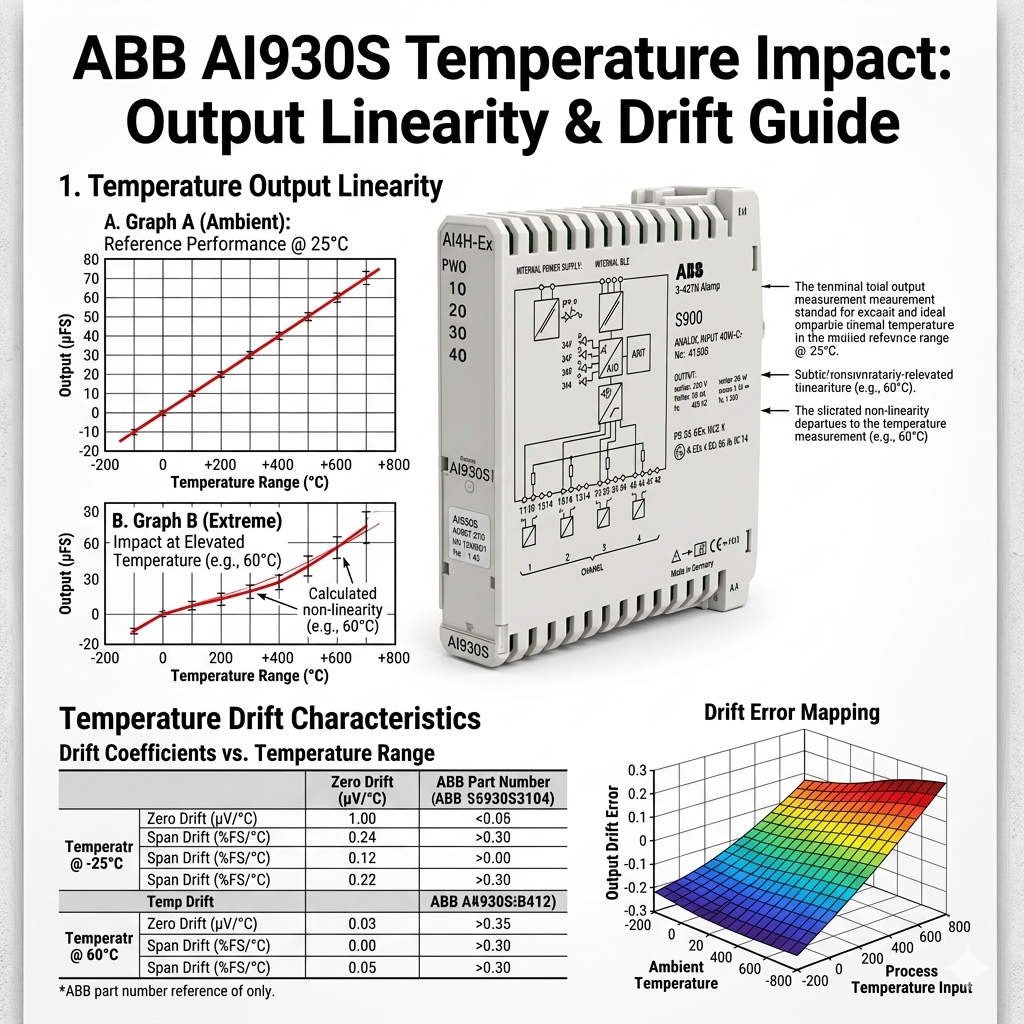
Does Excessive Heat Compromise the Output Linearity of the ABB AI930S?
Thermal Impact on Precision Analog Input Modules
In ABB DCS architectures, signal integrity directly dictates the success of closed-loop control. The ABB AI930S analog input module operates at the heart of critical processes. However, prolonged exposure to high temperatures can degrade output linearity. This issue frequently occurs in refineries and chemical plants where high-density I/O cabinets generate significant heat. Engineers often overlook thermal drift because it manifests as subtle PID oscillations rather than immediate hardware failure.
The Core Role of AI930S in Process Control Accuracy
The primary value of the ABB AI930S lies in its high-accuracy conversion within S800 I/O environments. Maintaining stable analog linearity is vital for calculating flow, pressure, and temperature. For instance, a small 0.5% drift in reactor feedback can lead to massive energy waste via unnecessary steam valve corrections. Oiltech Controls Limited emphasizes that thermal management directly impacts your plant’s bottom line by preserving these fine measurement tolerances.
Understanding Reference Voltage and Thermal Drift
The AI930S utilizes precision semiconductor components to establish a reference voltage for analog-to-digital conversion. Excessive heat alters the junction characteristics of these semiconductors. As a result, the module may experience gain drift and nonlinear responses at the lower ends of the 4–20 mA signal range. You might notice that signal deviations peak during the day and stabilize at night, indicating inadequate cabinet ventilation rather than a faulty field transmitter.
Synergy Between Thermal Stress and Electromagnetic Interference
High temperatures rarely act alone in industrial automation environments. Crowded cabinets often force signal wiring closer to variable frequency drives (VFDs) and high-power cables. Heat increases the sensitivity of analog circuits to electromagnetic interference (EMI). Therefore, the combination of thermal stress and EMI raises the noise floor. This synergy degrades channel consistency and may trigger intermittent diagnostic alarms in your control systems.
Optimizing Cabinet Airflow and Heat Dissipation
Checking if fans are spinning is insufficient for modern factory automation standards. You must verify that air actually moves across the I/O rack. Dust buildup often creates localized “hotspots” that standard sensors fail to detect. We recommend maintaining at least 30mm of spacing above heavily loaded modules. Furthermore, using thermal imaging cameras during peak production loads can reveal hidden heat concentrations before they cause measurement drift.
Power Distribution and Power Quality Management
Aging 24 VDC power supplies often lose their filtering capacity over time. High internal cabinet temperatures amplify the impact of voltage ripples on analog stability. Oiltech Controls Limited suggests using regulated, industrial-grade power supplies to ensure clean energy. Moreover, you should inspect grounding resistance during annual maintenance shutdowns. Proper grounding prevents “floating” signals that frequently mimic the symptoms of thermal linearity degradation.
Strategic Insights from Oiltech Controls Limited
Our experience shows that many “faulty” modules are actually victims of poor environmental design. As industrial automation moves toward higher density, thermal bottlenecks become more common. We believe that proactive cooling and proper wiring separation are more cost-effective than frequent module replacements. Always consider the total thermal load of a cabinet before adding new S800 I/O expansion racks to existing brownfield sites.
For more technical guides and high-quality ABB S800 components, explore the solutions at Oiltech Controls Limited to keep your systems running at peak performance.
Technical Checklist for AI930S Stability
- ✓ Ventilation Check: Maintain 30-50 mm clearance around high-density I/O modules.
- ✓ EMI Separation: Route analog signal cables away from high-current VFD wiring.
- ✓ Thermal Imaging: Inspect cabinets under full load to identify localized hotspots.
- ✓ Termination Integrity: Use ferrules and re-torque terminals to prevent resistance heating.
- ✓ Power Quality: Verify 24VDC ripple levels are within manufacturer specifications.
Frequently Asked Questions (FAQ)
Q1: Can I still use the AI930S if the cabinet exceeds 55°C?
While the module may continue to function, you will likely see a drop in measurement repeatability. At these temperatures, internal hotspots can exceed 70°C, which accelerates component aging and increases calibration frequency. It is better to install active cooling or heat exchangers.
Q2: Is signal drift always a sign of a failing ABB module?
Not necessarily. In many cases, we find that the “drift” is caused by poor shield termination or loose terminal blocks that have expanded due to heat cycles. Always check physical connections and loop resistance before replacing hardware.
Q3: Does firmware version affect how the module handles thermal alarms?
Yes, newer firmware versions often provide more granular diagnostic data regarding internal temperature states. When upgrading your DCS or PLC systems, ensure your CI communication interfaces are compatible with the latest AI930S revisions to receive accurate health status updates.
Application Scenario: Chemical Dosing Accuracy
In a recent chemical batching project, an AI930S module showed a 0.8% deviation in mass flow measurement during the afternoon shift. After moving the module away from a high-heat communication coupler and improving airflow, the linearity returned to within 0.1%. This simple environmental fix saved the client from costly batch rejections and unnecessary hardware purchases.