


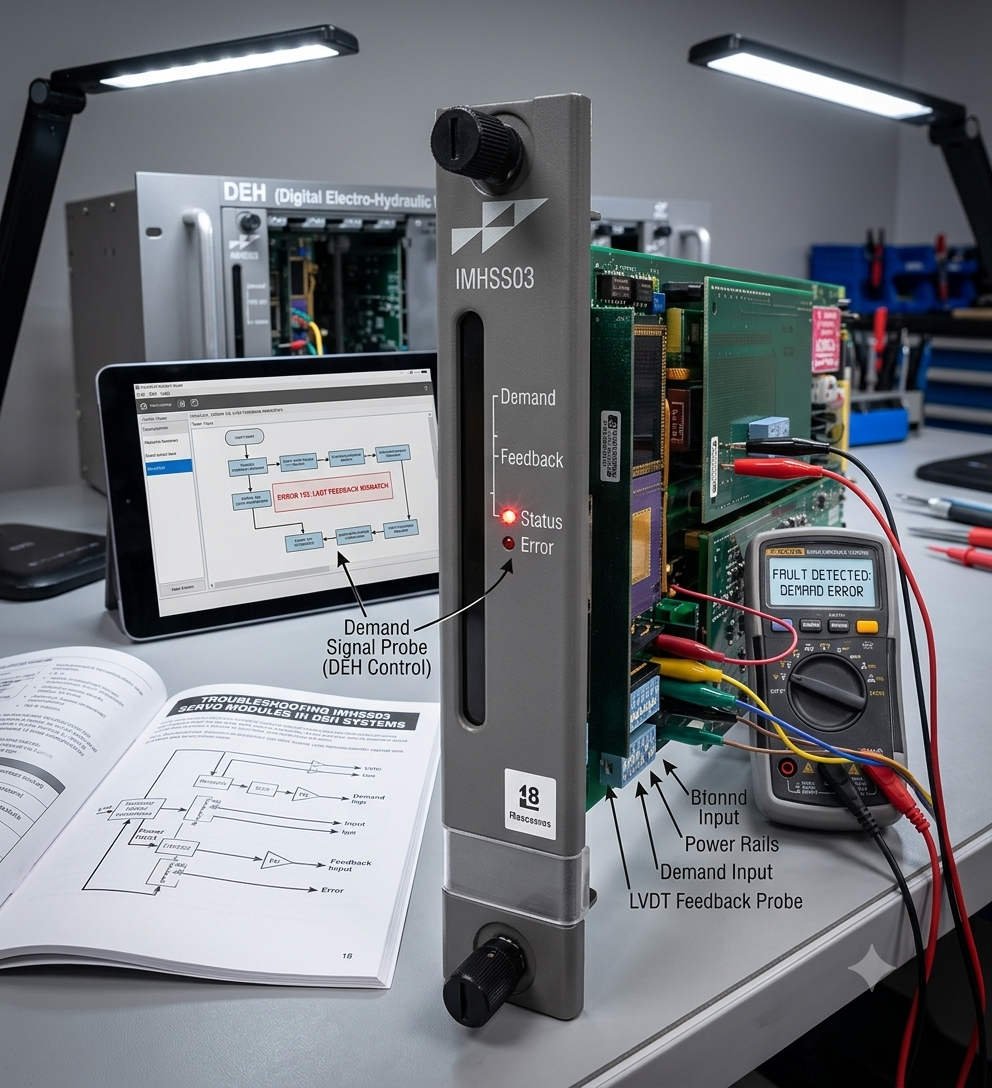
Securing Turbine Control: Bailey INFI-90 IMHSS03 Fail-Safe Mechanisms
The Critical Role of Feedback Reliability in DEH Systems
In Digital Electro-Hydraulic (DEH) control systems for steam turbines, the accuracy of LVDT (Linear Variable Differential Transformer) feedback is paramount. The Bailey INFI-90 IMHSS03 servo control module acts as the heartbeat of this feedback loop. If an LVDT coil burns out or signal integrity fails, the controller must react instantly. At Oiltech Controls Limited, we emphasize that without a robust fail-safe strategy, a feedback error can trigger erratic valve movement or dangerous load fluctuations. Mastering the IMHSS03 fail-safe mechanism is essential for maintaining turbine safety and operational availability.

Advanced Feedback Monitoring and Diagnostic Logic
The IMHSS03 module continuously monitors the excitation circuit and the feedback signal amplitude of your LVDTs. In standard DEH configurations, the module tracks the signal’s continuity and linearity in real-time. If the signal drifts beyond safe limits due to wiring breaks or sensor failure, the module triggers an immediate “Feedback Failure Alarm.” Industrial data indicates that over 30% of servo system anomalies stem from feedback device issues. Therefore, the IMHSS03’s ability to detect these faults within milliseconds is a vital layer of defense against mechanical damage to hydraulic actuators.
Fail-Safe Transition: How the System Maintains Control
When the IMHSS03 detects an LVDT fault, it initiates a precise sequence to prevent the turbine from entering an uncontrolled state:
- ✅ Diagnostic Trigger: The module identifies excitation current errors or signal loss, immediately setting the fault flag.
- ⚙️ Loop Freezing: The controller exits the PID feedback loop to prevent integral windup, ensuring the actuator does not react to “zero feedback” noise.
- 🔧 Fail-Safe Execution: Depending on the turbine configuration, the valve either holds its last position, returns to a safety setpoint, or fully closes to initiate a trip.
Expert Installation and Maintenance Guidance
At Oiltech Controls Limited, we frequently encounter “false positive” feedback alarms caused by external interference rather than hardware failure. To ensure system reliability, we advise the following field practices:
- Measure Excitation: Use an oscilloscope to verify LVDT excitation waveforms during scheduled outages, as multimeters often fail to detect high-frequency noise.
- Ensure Signal Separation: Ensure all feedback cabling remains separated from high-voltage power lines by at least 300mm to prevent common-mode interference.
- Validate Mechanical Alignment: Perform a full-stroke calibration after any mechanical maintenance to verify that the physical valve position matches the electronic setpoint.
Frequently Asked Questions (FAQ)
Q: Does a feedback alarm always indicate that the IMHSS03 module is faulty?
A: No. In our experience, over 70% of feedback alarms are caused by field wiring, loose terminations, or LVDT sensor degradation. Always verify the field instrumentation before replacing the control module.
Q: Can I use the IMHSS03 in redundant LVDT configurations?
A: Yes. The IMHSS03 integrates seamlessly with upper-level control strategies to support voting logic (such as 2oo3), allowing the turbine to continue operating even if a single sensor fails.
Q: What is the primary cause of sudden turbine trip during servo maintenance?
A: Misalignment of the mechanical linkage during sensor replacement is a common cause. Always perform a rigorous valve-position validation check before returning the turbine to service.
Are you looking to ensure the long-term reliability of your Bailey INFI-90 control systems? At Oiltech Controls Limited, we specialize in providing critical spare parts, technical support, and diagnostic guidance for power plant automation. Whether you are addressing an emergency hardware failure or planning a system upgrade, our team is dedicated to your operational success. Visit our website today to explore our expert resources and procurement options.




%20control%20systems%20for%20steam%20turbines,%20the%20accuracy%20of%20LVDT%20(Linear%20Variable%20Differential%20Transformer)%20feedback%20is%20paramount.%20The%20Bailey%20INFI-90%20IMHSS03%20servo%20control%20module%20acts%20as%20the%20heartbeat%20of%20this%20feedback%20loop.%20If%20an%20LVDT%20%5B…%5D&media=https://www.oiltechcontrols.com/wp-content/uploads/2026/06/Troubleshooting-IMHSS03-Servo-Modules-in-DEH-Systems_.jpg)