


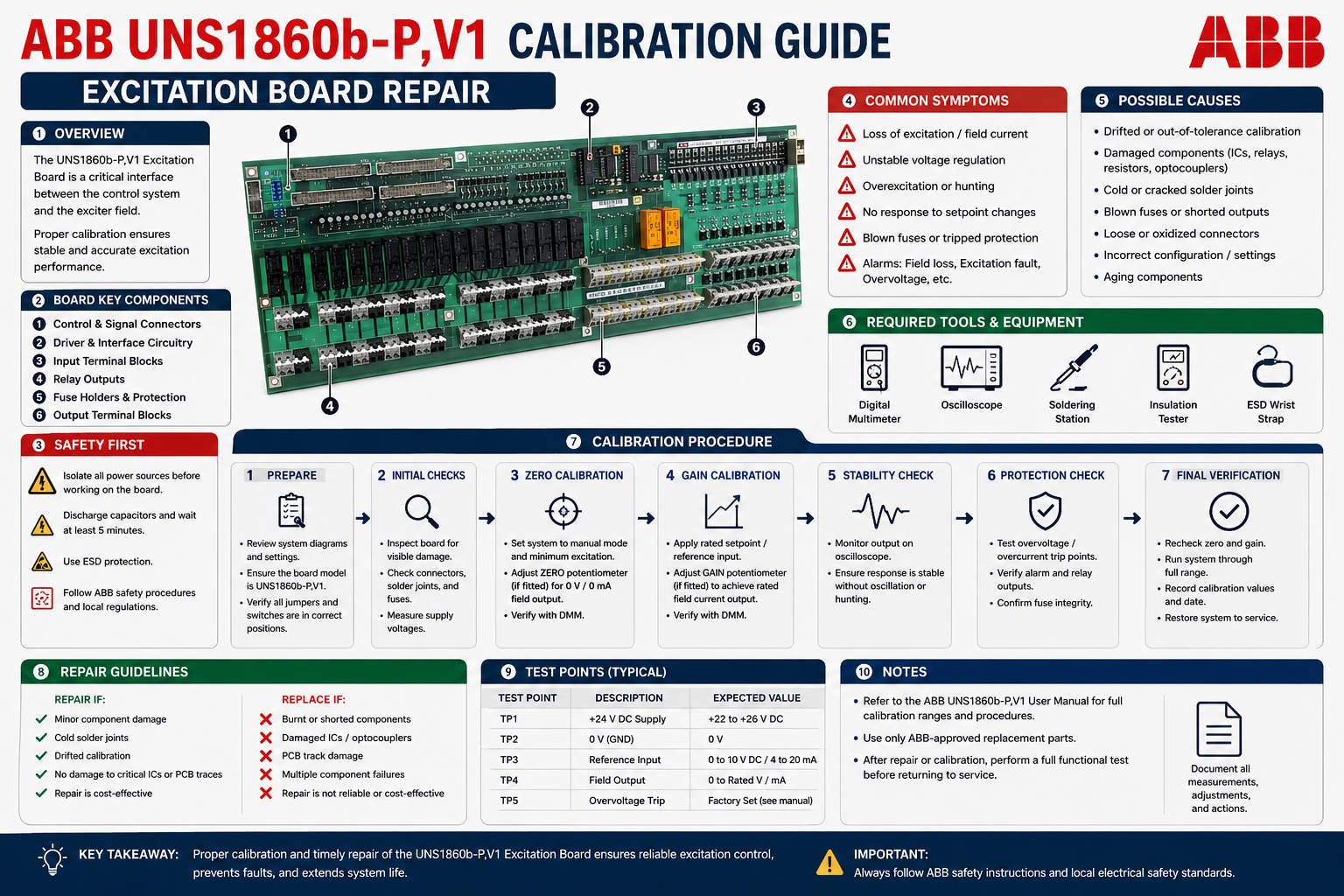
Troubleshooting False PT/CT Wire Break Faults on ABB UNS1860b-P,V1 Excitation Boards
Maximizing Plant Availability with Accurate Excitation Measurement
The ABB UNS1860b-P,V1 (3BHB001336R0001) excitation measurement board provides high-precision signal acquisition in modern control systems. Heavy industries rely heavily on this module to process PT and CT feedback loop signals for turbo-generators. This critical data drives excitation regulation, field forcing capabilities, and vital system protection logic. However, a common issue arises when the module erroneously triggers a PT/CT wire break fault alarm. When field instruments read normal values, internal component drift or calibration errors usually cause the false trip.

How Analog Sampling Drift Induces Phantom Alarms
The UNS1860b-P,V1 board continuously calculates transformer continuity by analyzing signal amplitude ratios and phase angles. Over extended operating cycles, internal analog-to-digital (A/D) converter circuits can experience subtle component variations. Consequently, engineers often observe intermittent alarms during severe generator load fluctuations. The fault message may disappear temporarily after power cycling the module. Before condemning the hardware, technicians must inspect physical wiring terminals, oxidation buildup, and grounding shield continuity.
Thermal Stress Challenges in Factory Automation Environments
Excitation cubicles located near steam turbines or massive compressor systems frequently endure sustained temperatures exceeding 45°C. According to industrial automation research, prolonged thermal exposure accelerates the aging of precision onboard resistors. This thermal stress shifts the diagnostic sensitivity thresholds for undervoltage detection and transformer loss. Therefore, replacing expensive field instruments before checking board calibration represents an inefficient maintenance approach. Periodic calibration verification during annual outages helps plants avoid unnecessary hardware procurement.
Ensuring Compatibility Across System Legacy Migrations
Plants often integrate this measurement board into legacy ABB UNITROL platforms or custom DCS architectures. During maintenance turnarounds, matching the precise hardware revision with the existing AVR firmware parameter set is crucial. Different production series may utilize distinct analog scaling coefficients that do not transfer automatically. Ignoring these engineering parameters can cause reactive power instability or immediate protective misoperation. Technicians must document existing calibration values and operating snapshots before initiating a board replacement.
A Structured Remediation Protocol for Field Technicians
When field multimeters prove that the transformer secondary circuits are healthy, execute a structured repair procedure. First, test the stability of the analog power supply rails directly on the circuit board. Unstable voltage rails introduce signal ripple that corrupts the wire break logic. Second, perform channel balancing using an isolated precision AC signal injector. Finally, calibrate the specific channel gain offsets through the factory service software menu. Never attempt adjustments while the generator experiences active load cycling.
Mitigating Physical Vibrations and High Voltage Surges
High-vibration settings, such as cement plants and compressor stations, often loosen heavy screw-terminal connections. While circuits may appear closed during static plant shutdowns, dynamic operation creates transient contact resistance. To prevent this, maintenance teams should implement spring-clamp terminal retrofits during scheduled outages. Furthermore, installing external secondary-side surge suppressors protects the delicate analog front-end from switching transients. This practice reduces long-term component degradation across your factory automation assets.
Strategic Procurement Guidance from Oiltech Controls Limited
At Oiltech Controls Limited, we advise engineering teams to evaluate board conditions thoroughly before purchasing replacements. Calibration successfully resolves the vast majority of gradual analog drift symptoms where components show no thermal discoloration. However, if multiple channels exhibit erratic fluctuations simultaneously, immediate board replacement becomes mandatory. For high-consequence power generation processes, keeping a pre-calibrated spare board in stock minimizes costly emergency downtime.
For certified replacement hardware, technical configuration assistance, and expert procurement support, visit Oiltech Controls Limited to keep your control systems running efficiently.
Essential Calibration Checklist
- ✓ Verify Reference Voltages: Confirm power rail stability within specified tolerances before software calibration.
- ✓ Isolate Signal Injectors: Use only floating, calibrated AC signal sources to prevent ground loop interference.
- ✓ Backup Database Parameters: Save existing EEPROM register configurations prior to applying new offset values.
- ✓ Inspect Physical Barriers: Ensure internal cabinet temperature remain below critical thresholds to prevent future drift.
Frequently Asked Questions
Q1: Why does a wire break fault manifest only after the generator reaches high output levels?
This pattern indicates that thermal dissipation within the cabinet or minor terminal loose connections interact with load vibrations. As current rises, localized heat increases contact resistance, causing the board to read a false imbalance.
Q2: Can we swap an older revision board with a new V1 variant directly?
Not without verification. Even though the physical footprint matches, firmware scaling coefficients differ between revisions. You must update your controller configuration file to prevent persistent diagnostic conflicts.
Q3: Is it safe to bypass the PT/CT wire break protection logic temporarily during troubleshooting?
We highly discourage bypassing this function while online. If an actual transformer failure occurs while the protection is disabled, the regulatory system may over-excite the machine, damaging the generator rotor.
Application Scenario: Chemical Plant Compressor Optimization
A petrochemical facility faced recurring AVR alarms that caused safety shutdowns on a critical synthesis gas compressor. While external instrumentation tests showed zero defects, the board continuously reported secondary loss. Engineers from Oiltech Controls Limited recommended an onsite recalibration of the zero-offset thresholds. The optimization corrected a 3% analog measurement drift caused by ambient cabinet heat. Following the service, the compressor achieved uninterrupted operation through the subsequent production cycle.





%20excitation%20measurement%20board%20provides%20high-precision%20signal%20acquisition%20in%20modern%20control%20systems.%20Heavy%20industries%20rely%20heavily%20on%20this%20module%20to%20process%20PT%20and%20CT%20feedback%20loop%20signals%20for%20turbo-generators.%20This%20critical%20data%20drives%20excitation%20%5B…%5D&media=https://www.oiltechcontrols.com/wp-content/uploads/2026/05/ABB-UNS1860b-PV1-Calibration-Guide-Excitation-Board-Repair-1.jpg)