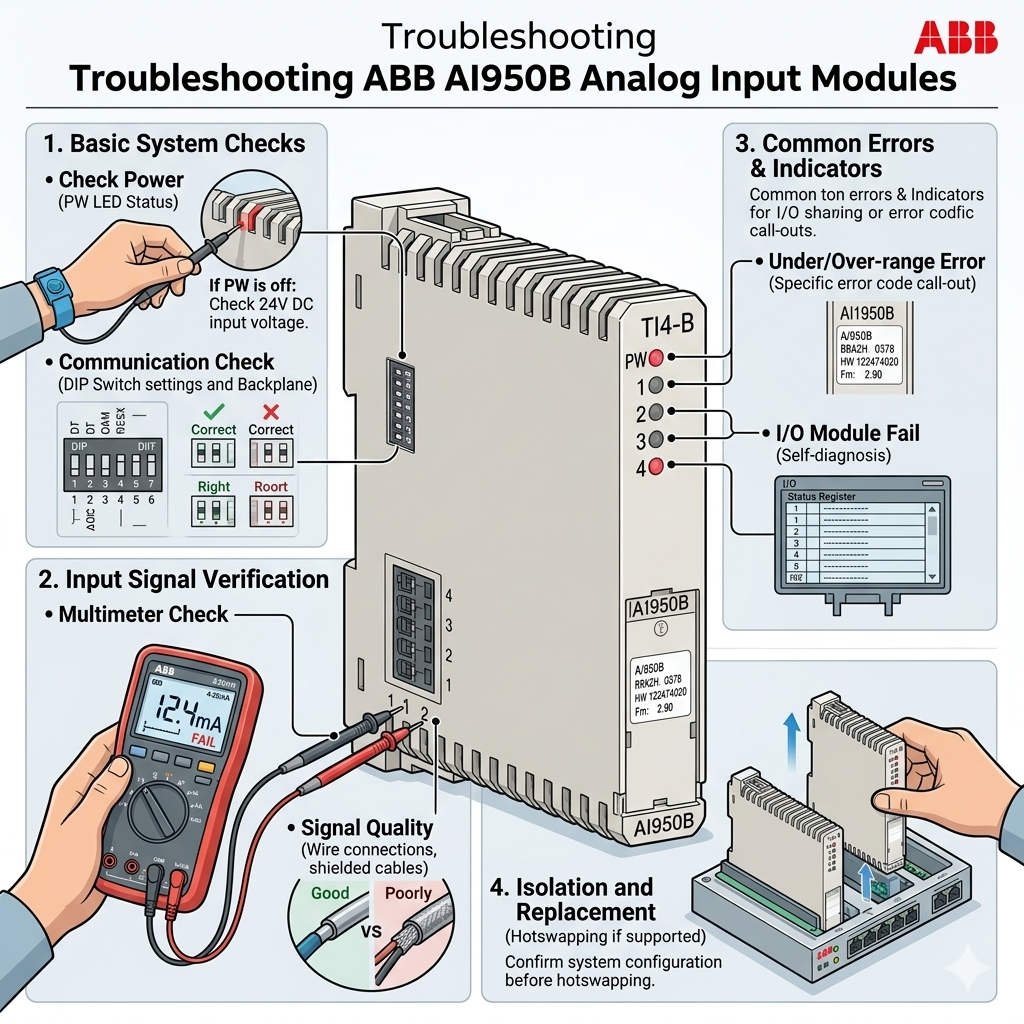
Troubleshooting the ABB AI950B: A Guide to Short-Circuit Protection and Reset Recovery
The Role of ABB AI950B in Industrial Automation Reliability
The ABB AI950B analog input module serves as a critical interface in continuous-process industries. High-stakes environments like petrochemical plants and power generation facilities rely on this module for stable DCS signal acquisition. Its primary strength lies in its ability to isolate faulty channels during short-circuit events. This isolation protects the backplane bus and connected field instruments from catastrophic damage. Consequently, maintaining this module correctly ensures long-term control systems availability and safety.

Understanding Short-Circuit Protection Logic and Latching
The AI950B features sophisticated current-limiting protection on its input circuitry. When the module detects an abnormal current spike, it enters a protective state to prevent hardware failure. However, many field engineers forget that this protection often remains “latched” after the fault is cleared. Even if you repair the field wiring, the 4-20 mA signal may remain frozen or display a “FAULT” status. Therefore, technicians must perform a manual reinitialization to restore the data flow to the PLC or controller.
Ensuring Post-Reset Signal Stability in Harsh Environments
Restoring power to a channel is only the first step in successful maintenance. In chemical refineries, grounding issues often cause intermittent signal fluctuations following a short circuit. Moreover, sharing a common ground among multiple transmitters or terminating shields at both ends can induce noise. To ensure factory automation stability, engineers should verify loop resistance and shield continuity immediately after a reset. This proactive approach prevents “nuisance trips” that frustrate operations personnel.
Environmental Factors and Cabinet Reliability Standards
High-density DCS cabinets frequently suffer from thermal buildup, which can affect electronic protection sensitivity. At Oiltech Controls Limited, our field experience suggests that many “module faults” actually stem from external environmental stressors. Condensation in junction boxes, loose terminal screws, or corroded connections often mimic hardware failures. For offshore platforms or high-vibration sites, we strongly recommend periodic torque inspections of all terminal blocks to maintain electrical integrity.
Step-by-Step Manual Reset Procedure
Follow this professional sequence to recover an AI950B channel safely:
- ✓ Isolate the Loop: Disconnect the affected field loop to prevent further surges.
- ✓ Electrical Verification: Use a multimeter to confirm the short circuit is completely removed.
- ✓ Check Impedance: Verify that loop resistance falls within the specified operating range.
- ✓ Soft Reset: Execute a disable/enable command from the ABB DCS engineering workstation.
- ✓ Power Cycle: If the diagnostic latch persists, perform a controlled power cycle of the specific I/O rack.
Strategic Maintenance for High-Vibration and Surge-Prone Areas
In environments like turbine halls or lightning-prone regions, standard wiring often fails. We recommend the following technical standards:
- Wiring Termination: Always use ferrule-terminated wires rather than bare conductors to resist vibration.
- Surge Suppression: Install external DIN-rail surge protectors if the module lacks built-in lightning protection.
- Hot-Swap Safety: Always verify controller redundancy and process permissives before attempting a hot-swap replacement.
Expert Commentary from Oiltech Controls Limited
At Oiltech Controls Limited, we emphasize that the AI950B is a remarkably robust piece of hardware. However, a “reset-first” mentality without investigating the root cause is a common mistake in industrial automation. If a channel trips repeatedly, the issue is almost always found in the field wiring or the loop power distribution. Understanding the diagnostic heartbeat of your ABB system is the best way to extend the lifespan of your I/O infrastructure.
For high-quality ABB components and expert technical support for your control systems, visit Oiltech Controls Limited to explore our comprehensive solutions.
Frequently Asked Questions (FAQ)
Q1: Does the AI950B support “Automatic Recovery” after a short circuit is fixed?
Usually, no. Most ABB AI950B firmware versions require a soft reset via the DCS software or a physical re-seating of the module to clear the diagnostic latch. This prevents the system from cycling power into a potentially dangerous fault repeatedly.
Q2: When should I choose replacement over a simple reset?
You should consider replacement if a channel consistently trips under a verified 20mA load or if the module generates internal “Over-Temperature” alarms. In our experience, if multiple channels fail simultaneously, the issue likely resides in the backplane or the 24VDC power supply rather than the module itself.
Q3: Is the AI950B compatible with legacy ABB I/O racks?
Compatibility is highly dependent on your specific firmware revision and controller generation. Before procurement, always verify your system’s engineering database version to ensure the new module is recognized by the existing software templates.
Application Scenario: Offshore Platform Maintenance
On an offshore gas platform, salt-air corrosion often causes high-resistance shorts in junction boxes. Maintenance teams using the AI950B were able to identify failing loops via DCS alarms before the corrosion led to a total system shutdown. By following the “Verification Before Reset” protocol, they reduced spare part consumption by 40% over two years.