How to Avoid Costly Installation Errors with the ABB 5SHY3545L0009 Power Module
Critical Role of High-Power Semiconductors in Heavy Industry
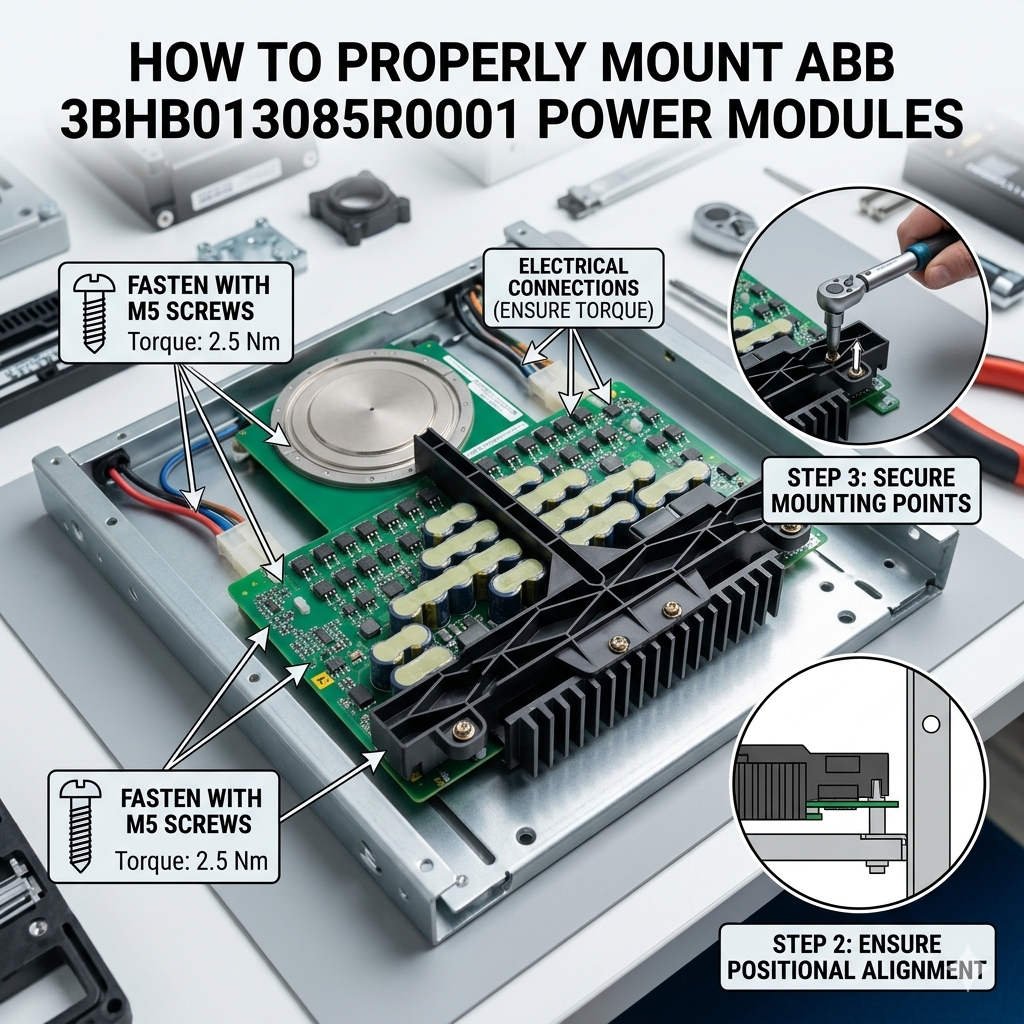
The ABB 5SHY3545L0009 / 3BHB013085R0001 power semiconductor module anchors high-capacity drive systems and medium-voltage converters. Heavy industries like mining, petrochemical processing, and steel rolling mills rely on these components to maintain continuous factory automation. However, improper mechanical mounting represents a primary cause of premature power module failure in the field. Technicians must focus on uniform clamping force and exact thermal compound application during replacement to ensure plant uptime.

Why Precise Clamping Force Governs Thermal Contact Stability
Clamping mechanisms do more than secure the module physically; they form an integral part of the thermal circuit. In distributed control systems (DCS) and drive maintenance, uneven torque distribution often triggers mysterious overtemperature alarms. Technicians must distribute pressure evenly across the entire heatsink interface, keeping bolt torque deviation within ±5%. Moreover, following a strict cross-pattern tightening sequence prevents substrate warping and subsequent junction overheating under heavy load conditions.
The Destructive Impact of Excessive Thermal Compound
Many maintenance teams mistakenly apply an overly thick layer of thermal paste during installation. In reality, thermal grease only fills microscopic air gaps between the baseplate and the heatsink surface. Excessive paste acts as a thermal insulator rather than a conductor, which rapidly increases thermal resistance. Therefore, engineers must apply a thin, uniform film and completely remove old compound to avoid localized hot spots and potential insulation contamination.
Surface Integrity Standards for Older Converter Cabinets
Before mounting the 5SHY3545L0009 module, technicians should inspect the heatsink surface for oxidation, scratches, or residual hardened paste. Even minor surface defects significantly reduce heat transfer efficiency in demanding factory automation environments. Consequently, cleaning the interface with non-residue industrial solvents is mandatory. For older ABB cabinets operating beyond a decade, refurbishing or flattening the corroded heatsink surface is vital to prevent immediate post-commissioning failures.
Comprehensive Testing and Cooling System Verification
Replacing a damaged semiconductor module provides only a temporary fix if the underlying cooling infrastructure has degraded. Maintenance personnel must verify fan airflow volume, liquid circulation status, and cabinet filter cleanliness before energizing the equipment. In addition, checking the integrity of temperature sensor feedback prevents false metrics. Addressing the entire cooling loop ensures long-term operational reliability and protects your financial investment in replacement hardware.
Expert Recommendations from Oiltech Controls Limited
At Oiltech Controls Limited, we frequently observe that hurried turnaround schedules lead to skipped steps during power stage retrofits. We strongly advise against manual estimation of bolt tightness; always use a calibrated torque wrench. Furthermore, direct module substitution in older legacy drives requires caution. Subtle differences in gate driver matching or snubber circuit parameters can trigger nuisance protection trips. Pre-installation audits save thousands in emergency shutdown costs.
For certified ABB semiconductor modules and specialized engineering support, visit Oiltech Controls Limited to keep your medium-voltage drives operating at peak efficiency.
Field Maintenance Technical Checklist
- ✓ Calibrated Torque Wrench: Always tighten bolts incrementally using multiple passes.
- ✓ Fresh Compound Only: Never mix old and new grease; clean both surfaces thoroughly.
- ✓ Surface Flatness Check: Inspect the heatsink using a straightedge to ensure zero burrs.
- ✓ Gate Driver Audit: Confirm firmware thresholds match the current revision of the replacement module.
Frequently Asked Questions
Q1: Why does a module fail within weeks if the initial startup parameters look normal?
This delay usually points to latent mechanical stress from uneven torque or over-tightening during installation. The resulting micro-cracks in the internal ceramic substrate expand progressively under cyclic thermal loading, eventually causing a catastrophic gate short circuit after production resumes.
Q2: Can standard industrial silicone grease be substituted for factory-specified paste?
No, high-power converters require compound with specific dielectric properties and high thermal conductivity. Standard grease often separates or pumps out under severe thermal cycling, which leaves air pockets that cause localized thermal runaway.
Q3: How can procurement teams verify backward compatibility before placing an order?
Do not rely solely on basic voltage and current ratings listed on the datasheet. You must cross-reference the full specific part number suffix with the original drive build documentation to ensure physical mounting dimensions and gate insulation tolerances align perfectly.
Industrial Automation Solution Scenario
A mining facility operating a high-power hoist drive experienced repeated overtemperature trips after changing a phase module. Engineers from Oiltech Controls Limited audited the installation and discovered severe pitting on the legacy heatsink interface. After resurfacing the metal block, applying a calibrated cross-torque sequence, and renewing the thermal paste layer, the drive successfully returned to full load capacity without further temperature anomalies.