Bently Nevada 3300 XL Proximity Probe Fault Diagnosis — Target Size, Magnetic Interference and Cross-Talk Troubleshooting

My Bently Nevada 3300 XL probe is reading noisy or drifting. What do I check first?
Start with target size — the single most common cause of false low output. The 11 mm 3300 XL probe needs a minimum 30.5 mm (1.2 in) diameter flat metallic target face. If your shaft shoulder or thrust collar is smaller than that, output drops by 15–30% and becomes non-linear. Then check for 60/50 Hz magnetic field interference from nearby transformers or induction motors.
Fault diagnosis decision tree
Problem: noisy or drifting output
├─ 1. Is output linear? → Test 3-point calibration
│   └─ Non-linear → Target too small / wrong material
├─ 2. Is there 50/60 Hz ripple? → Scope the proximitor output
│   └─ Yes → Cable run near AC power / bad shield termination
├─ 3. Is radial pair reading 2–5 μm phantom vibration?
│   └─ Yes → Cross talk / shaft too small (< 152 mm for 11 mm)
├─ 4. Is zero drifting > 1 μm/month?
│   └─ Yes → Probe tip temperature cycling / moisture in connector
└─ 5. Is output saturation (> +18 V or < -30 V)?
    └─ Cable open or short circuit
1. Target size — check the diameter
| Probe | Minimum target diameter | Notes |
|---|---|---|
| 11 mm | 30.5 mm (1.2 in) | Flat face needed; chamfered edges lose signal |
| 8 mm | 20 mm | Smaller target acceptable |
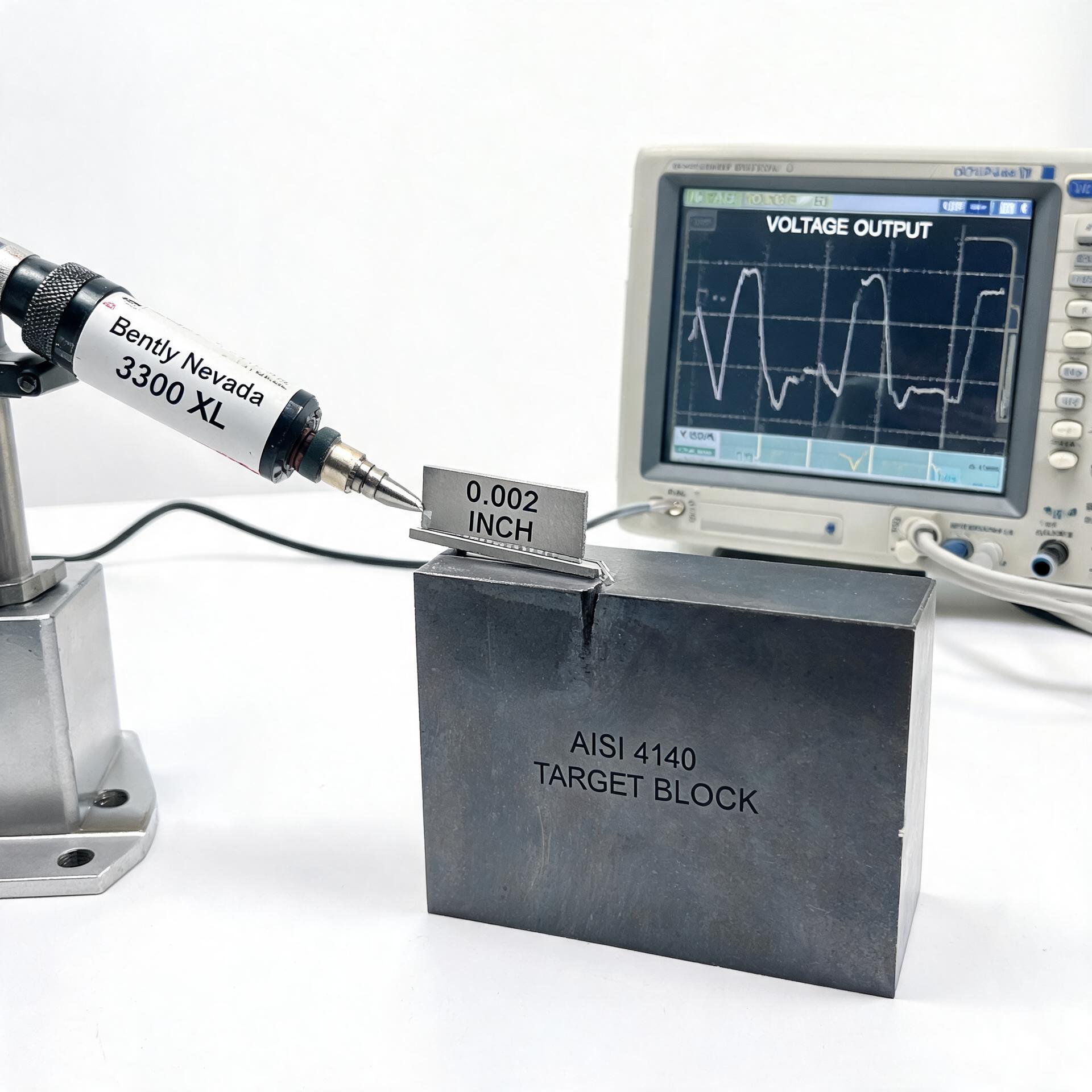
Test: place a flat 40 mm diameter 4140 steel block in front of the probe. If output jumps by more than 10%, your shaft shoulder is too small. Fix: weld or machine a larger collar onto the shaft.
2. Target material — steel vs stainless vs Inconel
The 3300 XL is calibrated at factory against AISI 4140 steel. Different alloys give different output per mm:
| Target material | Output per mm vs 4140 steel |
|---|---|
| AISI 4140 steel | 3.94 V/mm (reference) |
| AISI 1018 steel | 3.86 V/mm (-2%) |
| AISI 410 stainless | 3.70 V/mm (-6%) |
| AISI 304 stainless | 3.55 V/mm (-10%) |
| Inconel 625 | 3.15 V/mm (-20%) |
Test: field-calibrate with your actual shaft material. If you are on Inconel and expecting 3.94 V/mm, every axial reading is 20% too low.
3. 50/60 Hz magnetic interference
Symptom: output has 50 or 60 Hz ripple on an oscilloscope trace, but DC level reads correct. Causes:
– Cable run within 300 mm of AC power cable
– Cable run parallel to induction motor leads
– Proximitor rack mounted near power transformers (> 100 kVA)
Fix: move cable, install shielded metal raceway, or mount a ferrite ring around the cable near the proximitor.
4. Cross-talk between probe pairs
Symptom: X and Y radial probes on the same shaft both read correlated vibration at the same frequency that neither is actually seeing. Root cause: shaft diameter is too small relative to probe diameter.
| Probe | Minimum shaft diameter |
|---|---|
| 11 mm | 152 mm (6 in) |
| 8 mm | 100 mm (4 in) |
If your shaft is smaller, swap to 8 mm probes.
5. Zero drift — connector moisture
If zero drifts ±0.5 mm over a week, the ClickLoc connector is leaking moisture into the center conductor. Common when:
– You skipped the tip protector (DD=01 variant) on a wet turbine
– FluidLoc seal was not properly engaged (DD=02 only, not DD=11)
– Connector was left loose and lube oil migrated in
Fix: disconnect, clean contact surfaces with isopropanol, re-seat with 0.565 N·m finger-tight torque.
6. Frequency response roll-off
Symptom: high order harmonics (above 6 kHz) missing from vibration spectrum. Causes:
– Total field wiring > 305 m
– Cable shield not grounded at proximitor end only (ground loops)
– Using non-Baker Hughes cable (wrong impedance)
7. Probe tip wear
After 3–5 years the PPS tip (11 mm) or ceramic tip (ETR) can wear from continuous temperature cycling. Symptoms: output drift + reduced frequency response. Fix: replace probe cable assembly — the tip is not field-repairable.
Quick field diagnostic toolkit
| Tool | What it tests |
|---|---|
| Digital multimeter | DC output from proximitor |
| Oscilloscope | AC ripple, 50/60 Hz pickup, cross-talk |
| Feeler gauge stack + 4140 block | Target size, linearity |
| Ohmmeter | Cable open/short |
| Infrared thermometer | Probe temperature cycling |
Related guides
- 7200 to 3300 XL upgrade — recalibration after install
- 11 mm vs 8 mm — target size minimums
- 3300 XL part number ordering guide
1. Can I use an oscilloscope to test a 3300 XL probe in the field?
Yes — tap into the proximitor output (not the probe cable directly). The proximitor outputs -17 to -26 Vdc with the DC output you measure with a multimeter. Any AC ripple over 10 mV peak-peak on that line is interference or cross-talk.
2. My target is smaller than 30.5 mm. Is the probe broken?
No, the probe is working correctly — it just cannot read linearly on that small a target. Baker Hughes publishes the 30.5 mm minimum explicitly in Datasheet 146256 §9. Fix: machine a larger collar, or switch to the 8 mm probe (20 mm minimum target).