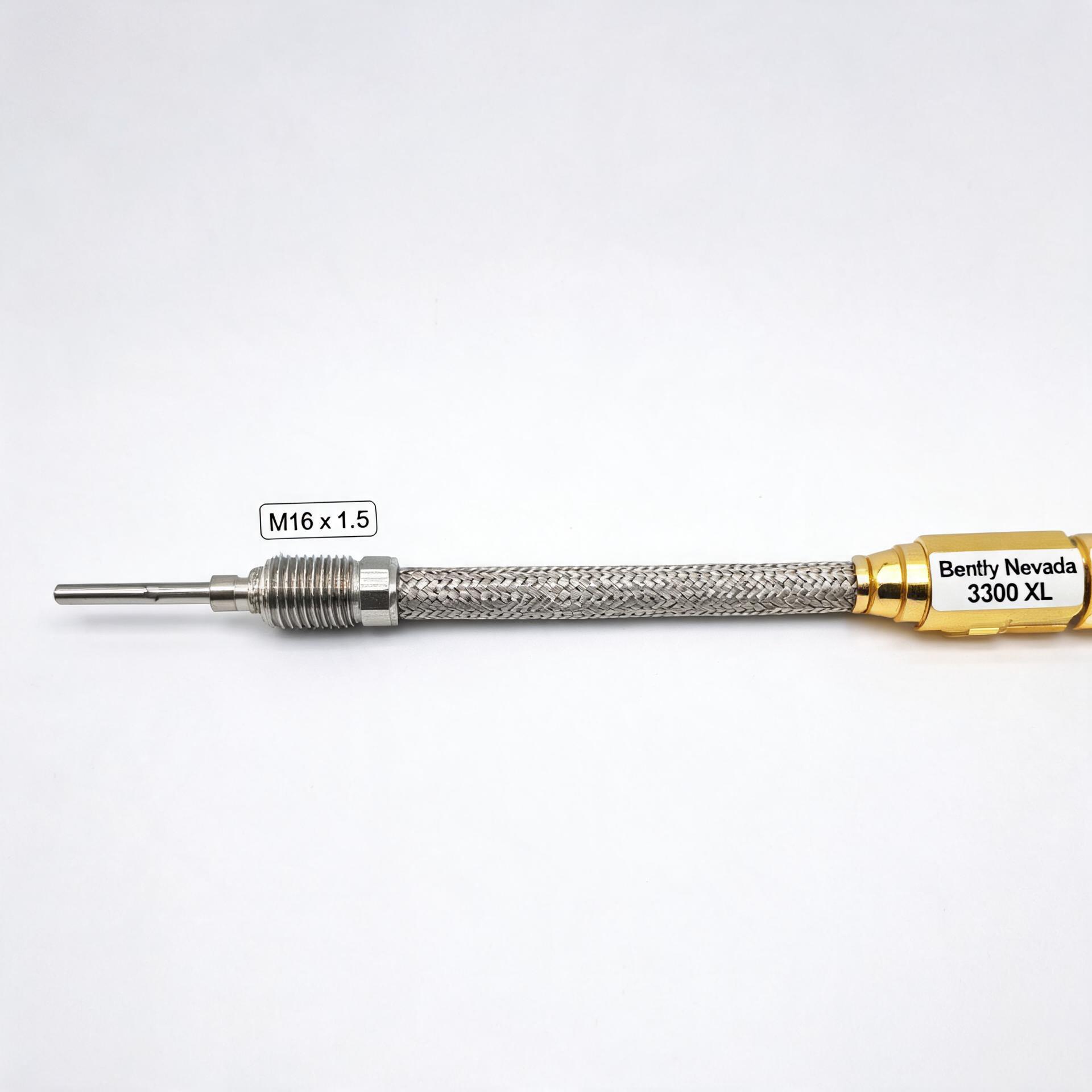
Bently Nevada 330709-000-050-10-02-00 — Armored M16 × 1.5 Proximity Probe, 50 m Cable Installation Guide

How do I install the Bently Nevada 330709 armored M16 × 1.5 proximity probe with 50 m cable?
Install it into an M16 × 1.5 6H threaded housing, torque to 21.1 N·m recommended / max 63.3 N·m, then terminate the AISI 302 armor braid at both the probe (mechanical) and proximitor (electrical) ends. The 50 m 75 Ω triaxial cable with FEP outer jacket is factory-fitted — do not cut it unless absolutely necessary.
330709-000-050-10-02-00 — the armored member of the family
| Feature | Value | Notes |
|---|---|---|
| Thread | M16 × 1.5 6H | Larger than M14, used on heavy metric housings |
| Cable length | 50 m | Longest standard length from factory |
| Armor | Yes — AISI 302 braid + FEP jacket | Adds 100 g; IP67 rated |
| Probe mass | 170 g | Heavier because of braid termination |
| Frequency | 0–8 kHz | Same as all 11 mm family |
| Linear range | 4.0 mm (160 mil) | Optional Extended DSL 5.0 mm |
| Temp | -52°C → +177°C | Probe only; cable rated same |
Step 1 — M16 × 1.5 housing machining
- Drill: 14.64 mm (for class 6H metric tap)
- Tolerances: 6H internal thread
- Full engagement: ≥ 12 mm (more meat on M16 than M14)
- Datum shoulder: 20.00 mm diameter, flatness ≤ 0.02 mm
- Torque: 21.1 N·m recommended, max 63.3 N·m
Step 2 — Thread the probe
- Clean threaded bore with dry air — no cutting fluid residue.
- Probe in finger tight only until shoulder seats.
- Back out 1/4 turn — this is your working zero gap.
- Install locknut. Torque to 21.1 N·m with calibrated wrench.
- Jam nut finger tight, back 1/16 turn.
Step 3 — Armor cable support every 500 mm
Armored cable is stiffer than unarmored and supports its own weight in vertical runs, but must be supported every 500 mm in horizontal runs. Use:
- Stainless steel cable clamps, not plastic ties
- Minimum bend radius 150 mm (critical — armor braid cracks below this)
- Do not squeeze the FEP outer jacket with undersized clamps
Step 4 — Armor termination rules
Armor braid has two distinct roles:
– Probe end: mechanical strain relief. Terminate armor braid into the probe body — do not leave it exposed.
– Proximitor end: EMI shield. Terminate armor braid to a clean ground lug at the proximitor rack only. Do not ground armor at both ends — ground loop current will flow through the braid and corrupt radial vibration readings.
Why 50 m cable is important
The 330709-000-050 ships with 50 m because heavy metric turbines (Siemens F-Class, Alstom GT24) are commonly deployed with the monitoring rack 35–48 m from the bearing housing. You have 2–15 m of slack for raceway routing without splicing.
Comparison to 330703-000-040 (M14 non-armored)
| 330703 (M14, no armor) | 330709 (M16, armored) | |
|---|---|---|
| Thread | M14 × 1.5 | M16 × 1.5 |
| Cable | 40 m unarmored | 50 m armored |
| Weight | 70 g probe | 170 g probe |
| Protection | Indoor / protected | IP67 / outdoor / chemical |
| Bending | Flexible | Rigid — 150 mm min radius |
| Price | 1× | 1.6× |
When you absolutely need armor
Specify armored 330709 when:
– Probe is mounted outdoors, unprotected from rain/snow
– Cable runs through chemical plant areas with HCl, H₂SO₄ or aromatic solvents (FEP jacket resistant)
– Vibration environment exceeds 10 g RMS at 1 kHz — unarmored cable will fatigue
– You have had prior unarmored cable failures in this area
Related guides
- 3300 XL part number ordering guide
- 330703 M14 × 1.5 field wiring
- 7200 to 3300 XL upgrade guide
- Thread selection tree
1. Can I run armored cable and unarmored extension cable together?
Yes, Baker Hughes 3300 XL armored and unarmored cables use the same 75 Ω triaxial core. You splice with the factory crimp connector only. The armor braid terminates at the splice — you do not splice armor to armor. Ground both braids at proximitor end only.
2. Is the 50 m cable factory-fitted or field-installable?
Factory-fitted. The armor braid is crimped onto the probe connector at Baker Hughes. You cannot replace the armor in the field — if it is damaged, return the entire probe/cable assembly for service.