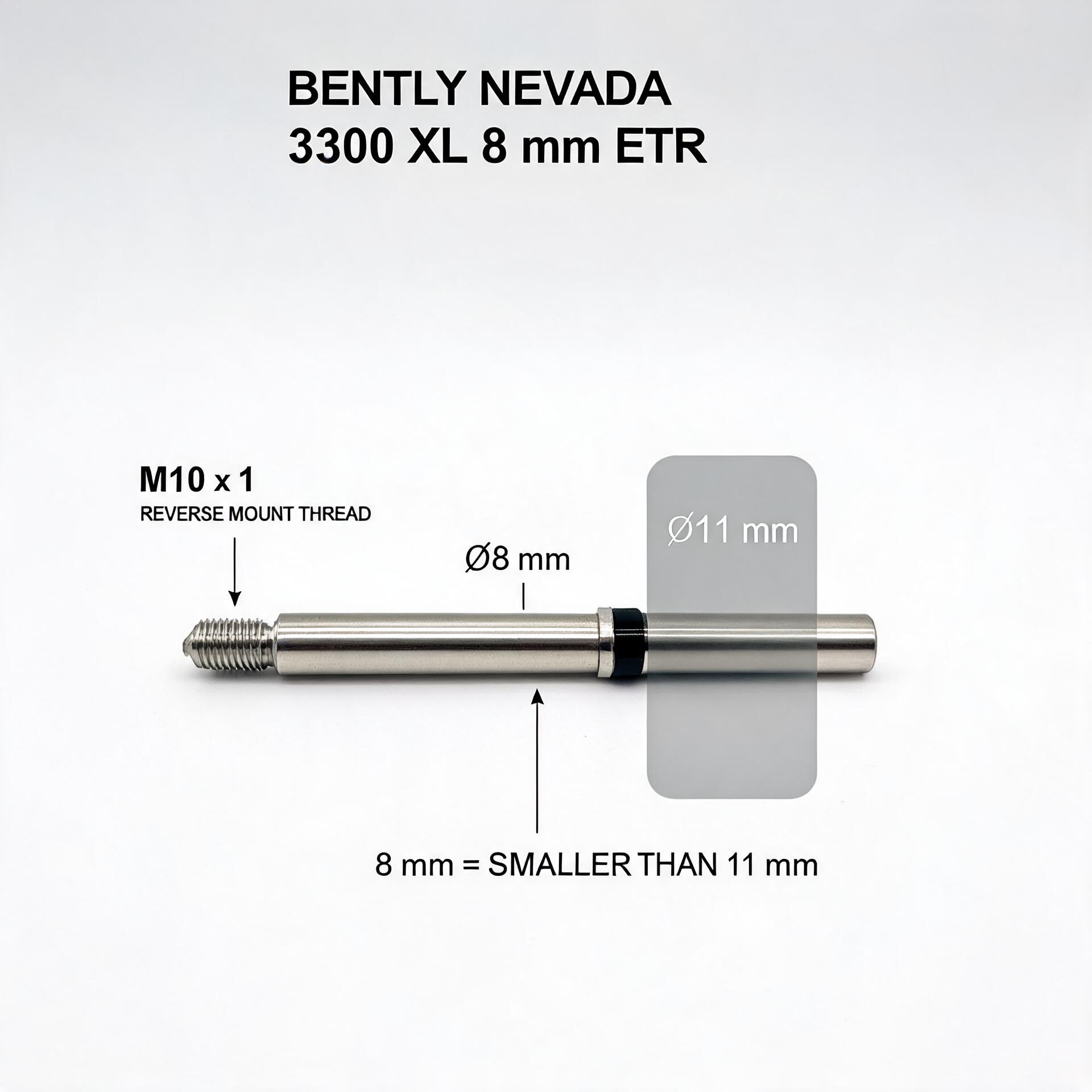
Bently Nevada 3300 XL 11 mm vs 8 mm Proximity Probe — When Longer Linear Range Actually Matters

Should I use an 11 mm or 8 mm Bently Nevada 3300 XL proximity probe?
Use the 11 mm probe for thrust position measurement (needs 4.0 mm linear range) and any radial vibration on shafts larger than 100 mm diameter. Use the 8 mm probe only on small shafts (< 100 mm) and when you need the ETR extended temperature range up to +232°C. Never use the 8 mm probe for thrust — it only has 2.0 mm linear range.
Core comparison table
| Spec | 11 mm probe | 8 mm probe |
|---|---|---|
| Diameter | 11 mm | 8 mm |
| Linear range | 4.0 mm (160 mil) | 2.0 mm (80 mil) |
| Output sensitivity | 3.94 V/mm | 3.94 V/mm |
| Frequency response | 0–8 kHz | 0–8 kHz |
| Temp range (standard) | -52°C → +177°C | -52°C → +177°C |
| Temp range (ETR) | not available | -35°C → +232°C |
| Minimum target dia | 30.5 mm | 20 mm |
| Minimum shaft dia | 152 mm (6 in) | 100 mm (4 in) |
| Minimum target gap | 0.25 mm | 0.15 mm |
| Cable weight (20 m) | 1.1 kg | 1.1 kg |
Linear range is the non-negotiable difference
The 11 mm probe reads linearly across 4.0 mm (160 mil). That means you can set zero at 2.0 mm and have ±2.0 mm of working range to monitor axial thrust position during turbine startup, load changes and shutdown. The 8 mm probe only has 2.0 mm linear range — half the working room.
Real example — GE Frame 7E thrust collar: nominal running position is 1.5 mm, alarm at 3.0 mm, trip at 3.5 mm. That 2.0 mm safety margin exactly matches the 11 mm linear range ceiling. An 8 mm probe would trip against its 2.0 mm limit at 3.5 mm — not enough.
Target size — why 11 mm wants bigger targets
Inductive proximity probes need a minimum flat metallic target to produce a stable linear response. The 11 mm probe needs a 30.5 mm (1.2 in) diameter flat target face. If your target (shaft shoulder, thrust collar) is smaller than that, you will have:
– Output reduced by 15–30%
– Non-linear response outside ±0.5 mm of center
– Temperature drift as the magnetic fringe fields change
The 8 mm probe only needs 20 mm minimum target — handy on small centrifugal compressor shafts where you don’t have room for a 30 mm collar.
Shaft diameter — cross talk prevention
Proximity probes produce a magnetic field that extends outward roughly 1× the probe diameter. If you mount two 11 mm probes (X and Y radial pair) on a shaft smaller than 152 mm (6 in) center-to-center, cross-talk can cause phantom vibration readings of 2–5 μm. The 8 mm probe lets you run pairs on 100 mm (4 in) shafts without cross-talk.
ETR temperature — only 8 mm has it
The only 3300 XL probe with Extended Temperature Range (up to +232°C) is the 8 mm ETR (prefix 3301xx). The 11 mm family caps at +177°C. If you need probes in:
– Gas turbine exhaust casings (+200°C wall)
– Cryogenic air separation (-35°C)
– Refinery heater tubes (+210°C process side)
… the 8 mm ETR is the only choice.
Thread family availability
| 11 mm | 8 mm | |
|---|---|---|
| 1/2-20 UNF | ✅ 330701 | ❌ |
| 5/8-18 UNF | ✅ 330707 | ❌ |
| M14 × 1.5 | ✅ 330703 | ❌ |
| M16 × 1.5 | ✅ 330709 | ❌ |
| M10 × 1 LH reverse | ❌ | ✅ 330103 |
Decision tree
- Are you measuring axial thrust position? → 11 mm mandatory (need 3–4 mm range).
- Is your bearing housing wall hotter than +177°C? → 8 mm ETR only.
- Is your shaft smaller than 152 mm? → 8 mm to avoid cross-talk.
- Is your target face smaller than 30.5 mm? → 8 mm.
- Otherwise → 11 mm standard (cheaper, more robust, more thread options).
Related guides
- 330103 ETR 8 mm M10 cn variant specs
- 3300 XL fault diagnosis — target size and magnetic interference
- 7200 to 3300 XL upgrade guide
1. Can I mix 11 mm and 8 mm probes on the same 3500 rack?
Yes. Each 3500 proximitor channel reads one probe independently — the rack does not care about diameter. You must configure each channel’s sensitivity (3.94 V/mm for both) in the 3500 configuration software. The only gotcha: ETR probes need the temperature compensation model loaded into the channel firmware.
2. Why can’t an 8 mm probe read thrust position?
Thrust position requires 3–4 mm working range to cover startup, full load and shutdown. The 8 mm probe only has 2.0 mm linear range. If thrust moves past 2.0 mm from zero, output enters saturation and your alarm setpoints become meaningless.