Bently Nevada 330103-04-09-10-02-cn — ETR 8 mm Extended Temperature Range Proximity Probe, M10 × 1 Reverse Mount Thread, China cn Approval

What makes the 330103-04-09-10-02-cn different from other 3300 XL probes?
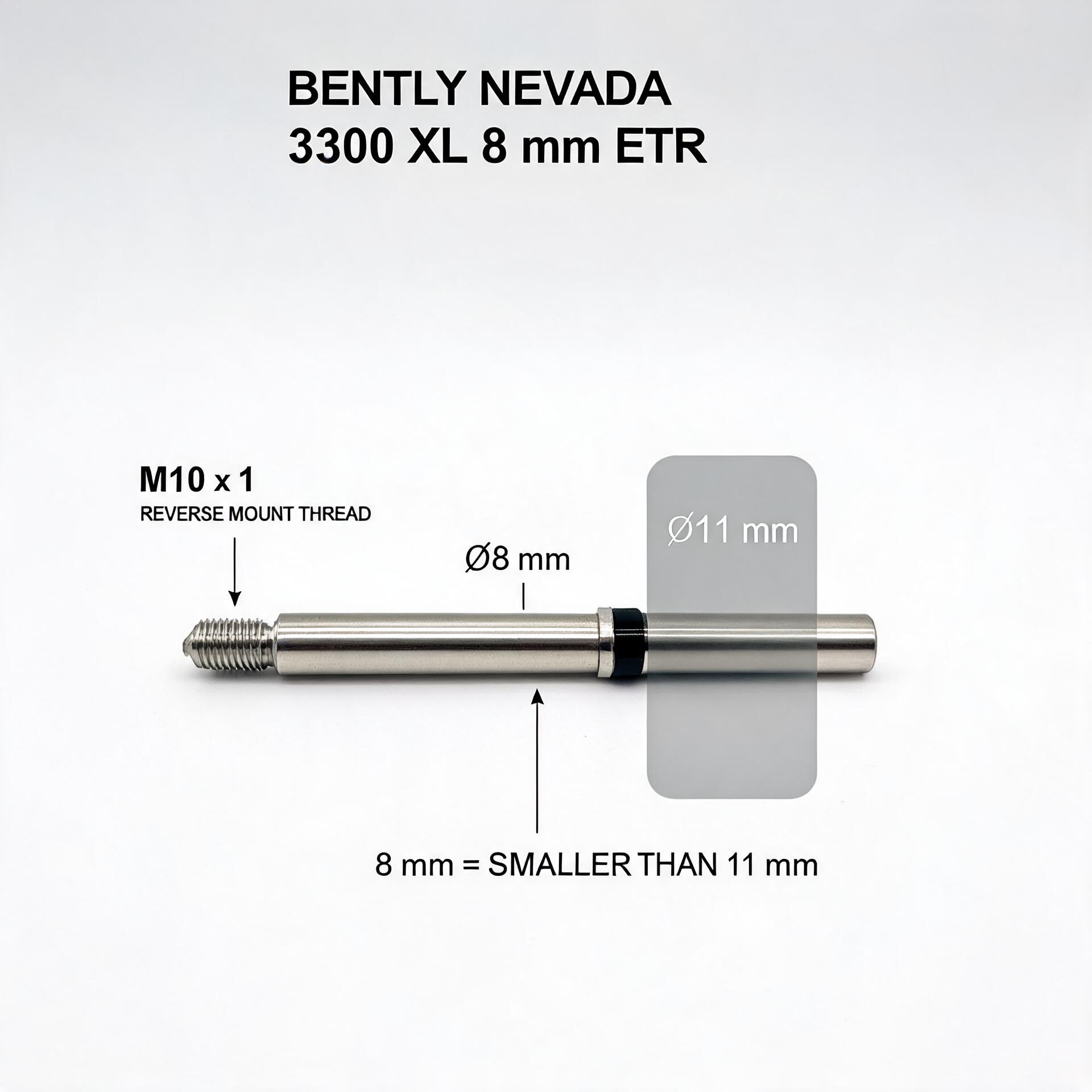
Three things: it is the only 8 mm diameter ETR (Extended Temperature Range) probe in the 3300 XL family, it uses a reversed M10 × 1 thread for through-bore mounting on small Chinese bearing housings, and the cn suffix is Baker Hughes’ market-specific approval for China NMPA regulated sites. Temperature range is -35°C → +232°C, 55°C hotter than the standard 11 mm probe.
Decode 330103-04-09-10-02-cn block by block
| Block | Code | Meaning |
|---|---|---|
| Prefix | 330103 | 8 mm diameter ETR probe (not 11 mm) |
| AAA | 04 | Unthreaded body 4 mm |
| BBB | 09 | Cable length 9 m |
| CC | 10 | No armor |
| DD | 02 | ClickLoc + protector |
| EE | cn | China NMPA market approval |
ETR — Extended Temperature Range — why it matters
Standard 3300 XL 11 mm probes cap at +177°C. The ETR version (prefix 3301xx) uses a ceramic-tip induction coil instead of PPS, pushing the upper limit to +232°C. This matters on:
- Gas turbine exhaust casings where radiated heat from the combustor wall hits 200°C
- Steam turbine high-pressure sections where superheated steam casing walls can reach 210°C
- Cryogenic air separation units where probes run at -35°C without performance loss
Linear range drops slightly to 2.0 mm (80 mil) on the 8 mm ETR — smaller than the 4.0 mm on 11 mm probes. Do not use ETR probes for thrust position measurement (needs 3–4 mm range); use them for radial vibration only.
M10 × 1 reverse mount thread
330103 uses a reversed M10 × 1 thread, not the standard metric thread. This lets you feed the probe through a small-diameter bearing housing from the back side, capture it from the outside with a retaining nut — ideal for retrofitting older Chinese-built small centrifuges where the front face has no thread access.
Machining spec:
– Through-hole: 12 mm diameter
– Nut thread: M10 × 1 left-hand (LH)
– Retaining nut torque: 10 N·m (finger tight + 1/4 turn with wrench)
China cn approval — why you need it
EE = cn means the probe has been submitted to China NMPA (National Medical Products Administration, formerly CFDA) for industrial instrumentation registration. If your site is in Mainland China and your inspection bureau requires NMPA-listed safety components, this is the correct part number. If you order 330103-04-09-10-02-00 instead, customs will not clear it.
9 m cable — short for a reason
Small centrifugal compressors in China are typically built on skids where the bearing housing is within 5–7 m of the monitoring box. The 9 m cable has 2–4 m of slack for dressing. No need for the 20–50 m cables used on large frame turbines.
All 330103 part number variants
| Part number | Thread | Cable | Armor | Approval |
|---|---|---|---|---|
| 330103-04-09-10-02-00 | M10 × 1 LH | 9 m | No | Zone 2 Ex nA |
| 330103-04-09-10-02-cn | M10 × 1 LH | 9 m | No | China cn |
| 330103-04-09-10-02-02 | M10 × 1 LH | 9 m | No | Zone 0 Ex ia |
ETR 8 mm vs standard 11 mm — which to pick
| 11 mm standard | 8 mm ETR | |
|---|---|---|
| Linear range | 4.0 mm (160 mil) | 2.0 mm (80 mil) |
| Frequency | 0–8 kHz | 0–8 kHz |
| Temp upper | +177°C | +232°C |
| Temp lower | -52°C | -35°C |
| Min target dia | 30.5 mm | 20 mm |
| Shaft min dia | 152 mm | 100 mm |
| Application | Thrust + radial | Radial only |
| Country | Universal | China cn specific |
Related guides
- 3300 XL 11 mm vs 8 mm probe — when to use smaller diameter
- 3300 XL part number ordering guide
- Thread selection tree
1. Can I use a standard 11 mm probe where I would normally use a 330103 ETR?
No. The 11 mm standard has a temperature limit of +177°C. If your bearing housing wall reaches +200°C you will drift zero or burn out the PPS tip. Use ETR probes for all bearing housings that have exposed metal near combustors or exhaust sections.
2. Is the cn approval more expensive?
The cn-approved variant is price-equivalent to the standard Zone 2 approved 330103. The lead time is slightly longer (4–6 weeks vs 2–4 weeks) because Baker Hughes handles separate documentation and customs pre-clearance for China shipments.