Bently Nevada Proximity Probe Thread Selection — 1/2-20 UNF vs 5/8-18 UNF vs M14 × 1.5 vs M16 × 1.5 vs M10 × 1 Decision Tree

How do I pick the right thread form for my Bently Nevada 3300 XL proximity probe?
Start with your bearing housing material region of origin, then your existing thread if you are retrofitting, then shaft and frame size. 1/2-20 UNF is the most universal choice for most industrial turbines and compressors; 5/8-18 UNF for heavy North American frames; M14 × 1.5 and M16 × 1.5 for European metric frames; M10 × 1 for small Chinese machines and ETR probes.
Quick reference — all 5 thread families side by side
| Thread | Probe family | Region | Housing type | Torque rec | Max |
|---|---|---|---|---|---|
| 1/2-20 UNF | 330701 | Global N.Am. | Most turbines/compressors | 45.2 N·m | 63.3 N·m |
| 5/8-18 UNF | 330707 | North America | Heavy frames > 1500 kW | 45.2 N·m | 63.3 N·m |
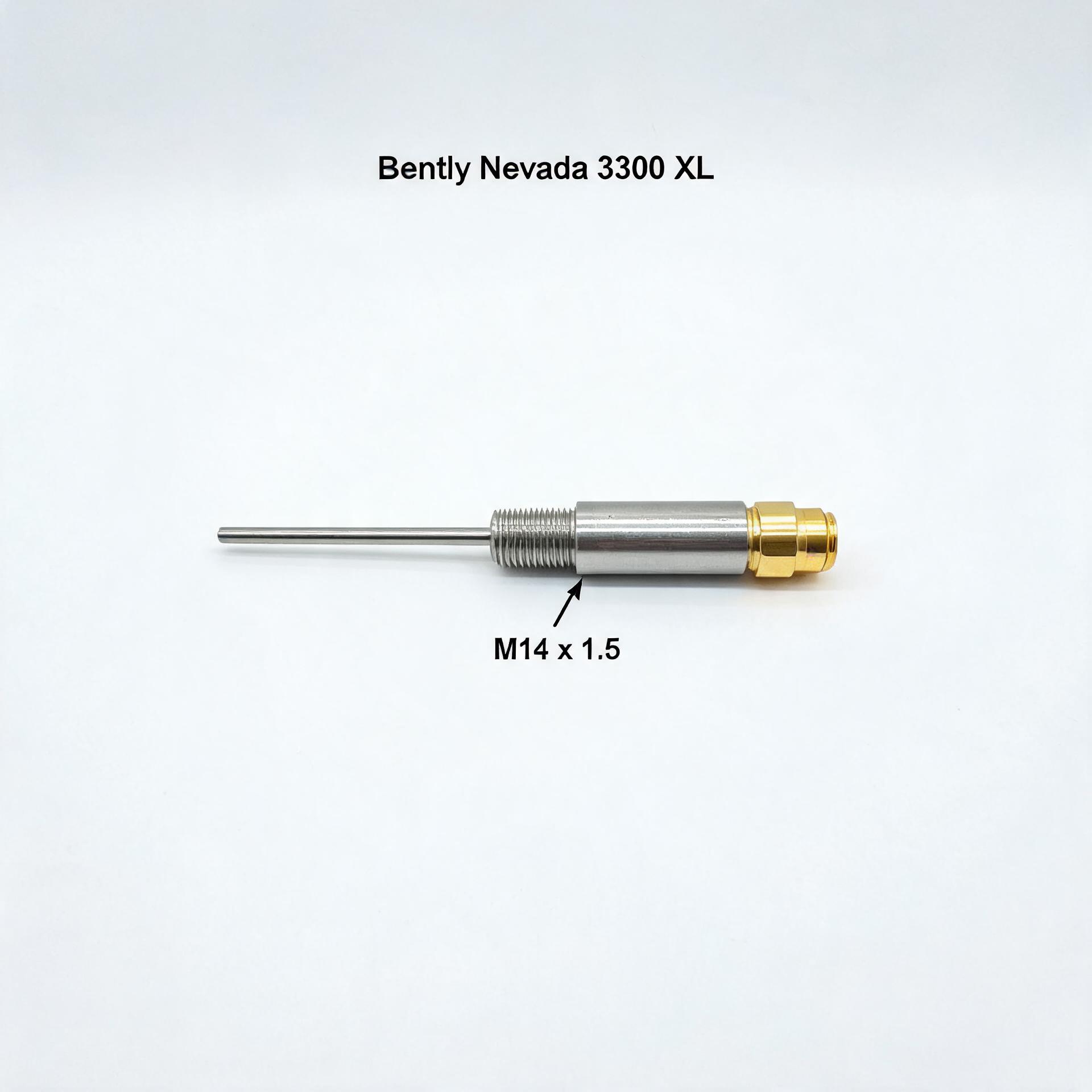
| M14 × 1.5 | 330703 | Europe, SI | Metric medium frames | 21.1 N·m | 63.3 N·m |
| M16 × 1.5 | 330709 | Europe, SI | Heavy metric frames; armor optional | 21.1 N·m | 63.3 N·m |
| M10 × 1 LH | 330103 | China, SI | Small centrifuges, ETR only | 10 N·m | 30 N·m |
Thread by machine country
| Machine builder | Typical thread |
|---|---|
| GE Vernova (Frame 5/6/7/9) | 1/2-20 UNF, heavy frames 5/8-18 UNF |
| Siemens Energy (F-Class, H-Class) | M14 × 1.5 (medium), M16 × 1.5 (heavy) |
| Alstom GT24/GT26 | M16 × 1.5 |
| Mitsubishi Power M501G/M701G | 1/2-20 UNF |
| Shanghai Electric / Chinese small machines | M10 × 1 LH |
| Atlas Copco / Ingersoll Rand compressors | 1/2-20 UNF |
| Howden compressors | 1/2-20 UNF or M14 |
Decision tree — walk through these 5 questions
Q1. Are you retrofitting an existing 7200 / 3300 XL installation?
    YES → Match existing thread form (DO NOT change)
    NO → Q2

Q2. Is your bearing housing machined to imperial or metric?
    Imperial → Q3
    Metric → Q4
    Not sure → measure pitch with thread gauge

Q3. Imperial — 1/2-20 or 5/8-18?
    Shaft < 152 mm OR frame < 1500 kW → 1/2-20 UNF
    Shaft ≥ 152 mm AND frame ≥ 1500 kW → 5/8-18 UNF

Q4. Metric — M14 or M16?
    Frame up to 25 MW → M14 × 1.5
    Frame 25 MW to 80 MW → M16 × 1.5
    Frame > 80 MW AND need armor → M16 × 1.5 armored 330709
    Small centrifuge or ETR → M10 × 1 LH (330103)

Q5. Do you need Extended Temperature Range?
    YES (housing wall > +177°C) → 8 mm ETR (330103, M10 × 1 LH or standard 8 mm)
    NO → proceed with the thread you picked above
Torque values — do not guess, use a wrench
| Thread | Recommended | Maximum | Notes |
|---|---|---|---|
| 1/2-20 UNF | 45.2 N·m (33.4 lbf·ft) | 63.3 N·m | Calibrated torque wrench required |
| 5/8-18 UNF | 45.2 N·m (33.4 lbf·ft) | 63.3 N·m | Same as 1/2-20 UNF |
| M14 × 1.5 | 21.1 N·m (15.6 lbf·ft) | 63.3 N·m | Lower because smaller bolt diameter |
| M16 × 1.5 | 21.1 N·m (15.6 lbf·ft) | 63.3 N·m | Same as M14 |
| M10 × 1 LH | 10 N·m (7.4 lbf·ft) | 30 N·m | Left-hand thread; reverse mounting |
Armor only available on M16 — 330709 unique
The only 3300 XL probe that ships with factory armor is 330709 (M16 × 1.5). If you need an armored probe in an imperial housing or an M14 housing, you can field-fit an after-market armor jacket but this is not Baker Hughes-certified. Always specify M16 + CC=20 if armor is part of your requirement.
ETR temperature and thread are linked
If you need Extended Temperature Range (+232°C), you must buy 8 mm diameter and the only thread option in 8 mm is M10 × 1 LH (330103). The 11 mm probes do not have ETR option. This means:
– ETR → M10 × 1 LH only
– M10 × 1 LH → ETR 8 mm only
– Standard 11 mm → any of the other 4 threads
Imperial vs Metric — what’s the real difference
Functionally nothing. Once installed, every 3300 XL probe reads 3.94 V/mm, 0–8 kHz, -52°C to +177°C. The only difference is the machining on your housing. You can swap a 1/2-20 UNF probe for an M14 probe on the same 3500 rack — you just need to re-machine the housing bore.
Top 3 mistakes to avoid
- Cross-threading — never force a wrong thread. You destroy the housing and risk unrepairable axial drift.
- Over-torquing — 63.3 N·m maximum. PPS tip cracks at 65 N·m.
- Wrong datum shoulder — every thread calibrates from a specific shoulder diameter. If your shoulder does not match the Baker Hughes drawing, your axial reading is offset from day one.
Related guides
- 330701 1/2-20 UNF cable length variants
- 330707 5/8-18 UNF torque installation
- 330703 M14 × 1.5 field wiring
- 330709 armored M16 × 1.5 install
- 3300 XL part number ordering guide
1. Can I tap an M14 bore to 1/2-20 UNF?
Technically yes but Baker Hughes does not recommend it — the minor diameter difference (11.5 mm drill vs 12.64 mm M14 drill) means you are cutting into the existing thread roots. The housing wall thickness will be reduced and cross-talk risk increases. Better to weld the old bore and machine new.
2. Why does M16 ship armored but not the other threads?
Baker Hughes targets heavy industrial installations (80 MW+ frames, outdoor skids, chemical plants) for the armored option, and these frames universally use M16. The 1/2-20 UNF and M14 probes are more often used indoors where armor is unnecessary. After-market armor jackets exist but void the ATEX approval.