


Choosing Between 10/100Base-T and 100Base-FX for Bently Nevada 3500/22M Communication
Maximizing Data Reliability in Machinery Protection Systems
Selecting the correct port type for the Bently Nevada 3500/22M Transient Data Interface (TDI) is a critical engineering decision. In the demanding environments of power generation and petrochemical plants, stable communication between vibration monitors and control networks is essential. Therefore, understanding the functional differences between copper (10/100Base-T) and fiber (100Base-FX) ensures your machinery protection data remains uninterrupted. At Oiltech Controls Limited, we emphasize that this choice directly prevents costly communication drops during critical machine startup phases.
Distance Capabilities and Network Infrastructure Planning
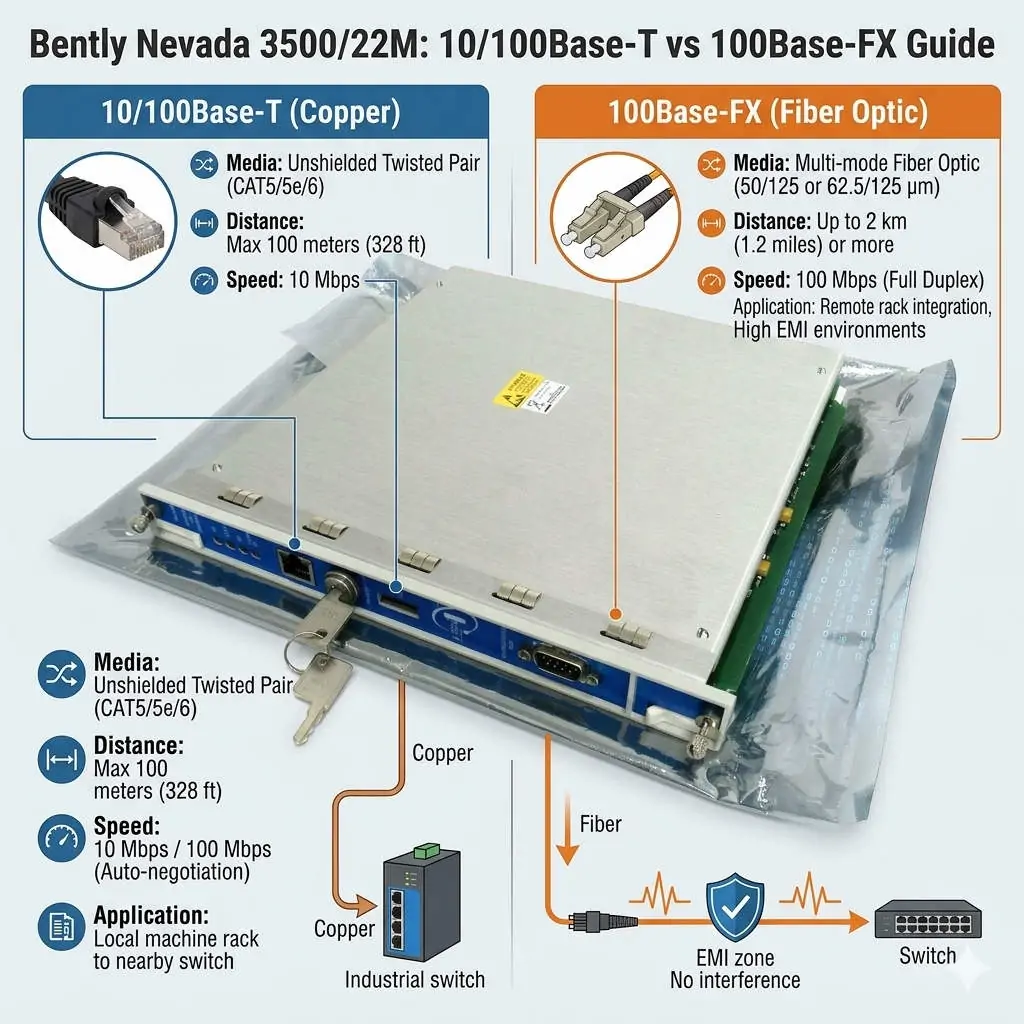
Distance represents the primary physical constraint when designing your network topology. Standard 10/100Base-T copper Ethernet utilizes twisted-pair cables (Cat5e or Cat6) and faces a strict 100-meter limit. Conversely, 100Base-FX fiber optic ports support distances ranging from 2 kilometers to over 20 kilometers using single-mode fiber. For large-scale refineries where the DCS (Distributed Control System) is far from the compressor shack, fiber eliminates the need for intermediate switches. As a result, you reduce potential points of failure and streamline your system maintenance.
Overcoming Electromagnetic Interference (EMI) in High-Voltage Areas
Industrial settings often subject communication links to significant electromagnetic noise. Copper Ethernet is inherently vulnerable to EMI, ground loops, and electrical surges. However, fiber optics transmit data via light pulses, making 100Base-FX completely immune to electrical interference. In our field experience at Oiltech Controls Limited, we have seen numerous copper links fail during turbine generator startups due to induced noise. Switching to fiber resolved these issues instantly, providing a stabilized link for critical machinery protection.
Integration Flexibility and Future-Proofing Control Systems
The 10/100Base-T port offers maximum compatibility with standard industrial Ethernet infrastructure and existing switches. This makes it an ideal choice for localized racks or cost-sensitive projects. However, for greenfield projects or critical asset monitoring, 100Base-FX provides a more robust, future-proof architecture. Although fiber requires specialized switches or media converters, it aligns more closely with modern IEC industrial network design standards. Consequently, investing in fiber today often reduces the total cost of ownership by preventing future signal integrity issues.
Professional Installation and Field Maintenance Standards
Maintaining high signal integrity requires strict adherence to installation protocols. For copper installations, always utilize Shielded Twisted Pair (STP) cables and ensure proper grounding to prevent intermittent communication alarms. When working with 100Base-FX, connector cleanliness is paramount. Even microscopic dust on an LC or SC connector can cause significant signal attenuation. Therefore, we recommend using high-quality dust caps and professional fiber cleaning kits during every commissioning phase.
Engineering Recommendations from Oiltech Controls Limited
We believe that the decision should prioritize the criticality of the monitored asset. If your 3500/22M module is protecting a primary steam turbine or a major compressor train, the 100Base-FX port is the superior choice for long-term reliability. For smaller, non-critical localized monitoring, copper provides sufficient performance at a lower price point. At Oiltech Controls Limited, we help our clients optimize these configurations to ensure maximum machine uptime.
For expert technical guidance on Bently Nevada systems and high-performance vibration monitoring hardware, visit our full resource center at Oiltech Controls Limited.
Technical Essentials Checklist
- ✓ Distance Audit: Use fiber if the run between the rack and switch exceeds 100 meters.
- ✓ EMI Assessment: Choose 100Base-FX in environments with large VFDs or high-voltage motors.
- ✓ Shielding Protocol: Ensure STP cables are used for copper ports in all industrial automation applications.
- ✓ Fiber Hygiene: Clean all fiber ferrules before insertion to prevent link instability.
Frequently Asked Questions (FAQ)
Q1: Can I use a media converter to switch from copper to fiber for a 3500/22M rack?
Yes, you can use industrial-grade media converters. However, at Oiltech Controls Limited, we recommend choosing the native 100Base-FX module variant whenever possible to reduce hardware complexity and minimize latency in your machinery protection loop.
Q2: Does the fiber port (100Base-FX) require specific fiber types?
The 3500/22M generally supports multi-mode fiber for standard plant distances (up to 2km). If your run is longer, ensure your switch and SFP modules match the fiber wavelength (typically 1300nm for 100Base-FX) to ensure signal synchronization.
Q3: Why does my copper Ethernet link keep dropping despite being under 100 meters?
This is often caused by ground potential differences between the rack and the network switch. In industrial automation, ground loops can induce current in the shield of the Ethernet cable. If this occurs, switching to fiber is the safest solution, as it provides complete electrical isolation.
Application Scenario: Power Plant Turbine Protection
In a large power generation facility, several Bently Nevada 3500 racks were installed 300 meters away from the main control room. Initially, copper links were proposed with repeaters. However, due to the high EMI from the generators, the engineers opted for the 100Base-FX variant. This choice eliminated the need for mid-span hardware and guaranteed that vibration data remained crystal clear during the high-load operations of the plant.






%20is%20a%20critical%20engineering%20decision.%20In%20the%20demanding%20environments%20of%20power%20generation%20and%20petrochemical%20plants,%20stable%20communication%20between%20vibration%20monitors%20and%20control%20networks%20is%20%5B…%5D&media=https://www.oiltechcontrols.com/wp-content/uploads/2026/04/Bently-Nevada-3500-22M-10-100Base-T-vs-100Base-FX-Guide.webp)