Troubleshooting the Schneider 140DDO84300 External Fault: A Maintenance Guide
The Role of Schneider 140DDO84300 in Modicon Quantum Systems
The 140DDO84300 stands as a high-density discrete output module essential for reliable actuation in Modicon Quantum architectures. In industrial automation, these modules act as the final interface between the control logic and field devices. Therefore, understanding its diagnostic alarms, specifically the “External Fault,” is critical for maintaining system uptime. This module plays a vital role in factory automation by pinpointing whether a failure stems from the field wiring or the internal hardware.
Understanding Output Channel Protection and Diagnostics
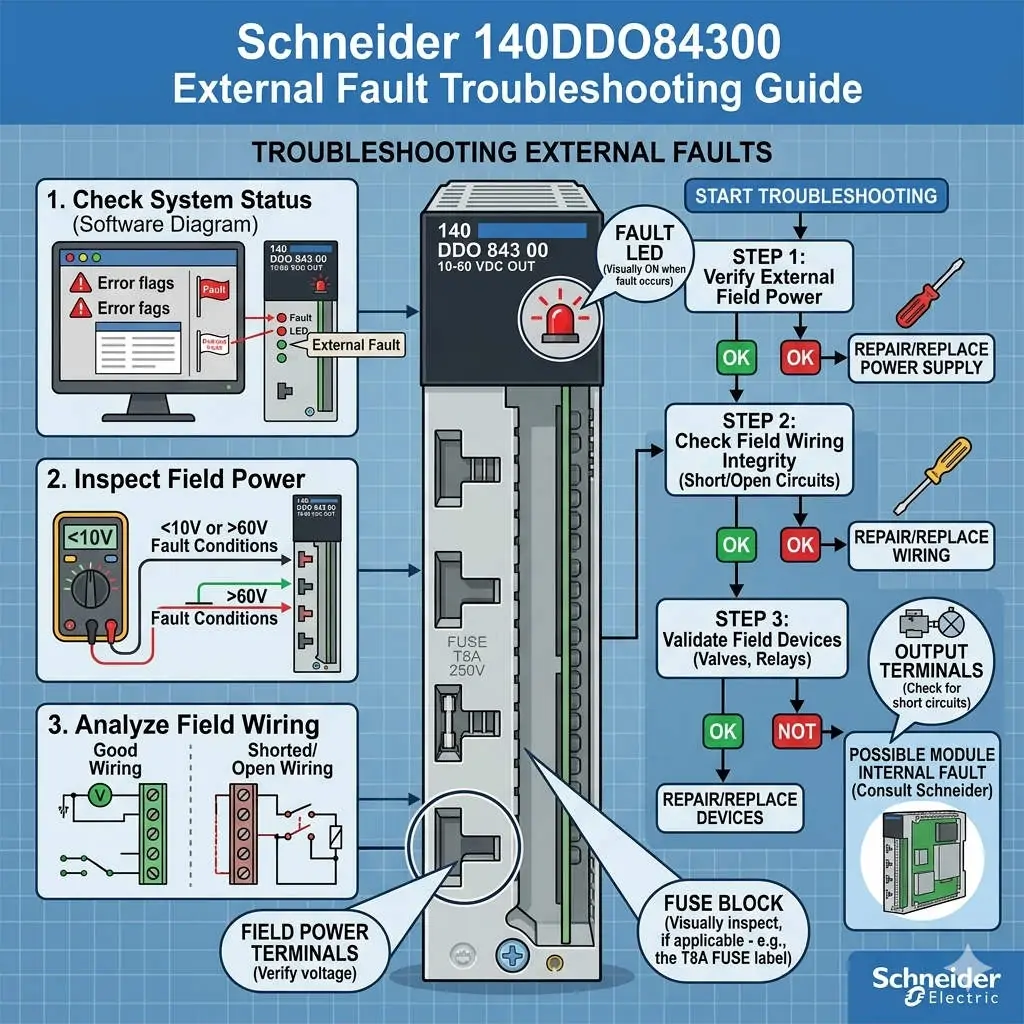
Schneider engineers built the 140DDO84300 with per-channel monitoring to detect short circuits, overcurrent, and field voltage loss. However, an “External Fault” alarm rarely indicates a module failure. Instead, it serves as a protective warning for field-side electrical anomalies. For instance, a shorted solenoid valve or an incorrectly polarized relay coil often triggers this diagnostic state. Based on technical reports from Oiltech Controls Limited, over 80% of these alarms originate from the field environment rather than the I/O card itself.
Voltage Limits and Inductive Load Management
This module operates within a strict 24V DC range, with specific limits on current per channel and total module capacity. If a connected load exceeds these ratings or exhibits high inrush current, the module triggers an intermittent fault. This is common with aging contactors or solenoid valves that lack proper suppression. Consequently, using inductive loads without adequate flyback protection can lead to transistor degradation over time, causing false diagnostic triggers during control systems operations.
Strategic Field Troubleshooting and Maintenance
When you encounter an “External Fault,” we recommend a systematic isolation approach before attempting hardware replacement. First, disconnect the load from the suspect channel and reset the fault. If the alarm disappears, the issue resides in the field wiring or the device. Moreover, the diagnostic granularity of the 140DDO84300 allows you to distinguish between a single-channel failure and a total module power loss. This capability significantly reduces the Mean Time to Repair (MTTR) in complex DCS environments.
Expert Advice from Oiltech Controls Limited
At Oiltech Controls Limited, we emphasize that the 140DDO84300 is a highly resilient component. We often see technicians replace modules prematurely, only for the fault to reappear on the new unit. To avoid unnecessary costs, always verify your flyback diodes and RC snubbers at the load side. In high-vibration sectors like oil and gas, ensure you use ferrules and torque your terminals correctly. Proper installation hygiene is the most effective way to eliminate intermittent “External Faults.”
For more technical insights and to explore our extensive inventory of Modicon Quantum modules, please visit Oiltech Controls Limited today.
Technical Summary and Best Practices
- ✓ Load Isolation: Always test the module with a known-good load before assuming internal damage.
- ✓ Inductive Protection: Install diodes or snubbers as close to the field load as possible.
- ✓ Wiring Integrity: Use spring clamps or ferrules to prevent vibration-induced signal loss.
- ✓ Diagnostic Analysis: Group-level faults usually point to power supply issues, while single-channel faults point to specific loads.
Frequently Asked Questions (FAQ)
Q1: Why does the External Fault alarm persist after I fixed the wiring?
Most Modicon Quantum modules require a manual reset through the PLC software or a power cycle of the field voltage to clear the latching fault state. Always ensure the system is “acknowledged” after repairs are complete.
Q2: Can I use the 140DDO84300 to drive high-power contactors directly?
While it can drive many coils, check the “inrush current” specification. If the contactor pulls more current than the per-channel rating during startup, the module will interpret it as a short circuit and trigger a fault to protect itself.
Q3: Is there a way to suppress “External Fault” for non-critical channels?
Fault detection is usually a global hardware feature for this module. Rather than suppressing it, we recommend using interposing relays for unstable loads. This isolates the sensitive module electronics from harsh field conditions.
Solution Scenario: Chemical Plant Actuator Control
In a recent chemical processing facility, multiple “External Fault” alarms occurred during valve cycling. The maintenance team initially suspected the 140DDO84300 module. However, upon inspection by Oiltech Controls Limited, it was discovered that missing flyback diodes on the actuators were creating voltage spikes. By installing proper suppression, the plant eliminated the alarms and extended the lifespan of their I/O hardware.