Understanding Residual Voltage in Schneider Quantum 140DAO84210 Discrete Output Modules
Core Value of the 140DAO84210 in Industrial Automation
The 140DAO84210 discrete output module provides reliable digital control within Schneider Quantum PLC systems. It excels in continuous-process industries like chemical and pharmaceutical manufacturing. This module ensures deterministic switching behavior and maintains electrical isolation between field devices and control logic. However, engineers often observe “residual voltage” even without a logic command. This characteristic is usually a predictable electrical trait rather than a hardware defect.
Technical Insights into Leakage Current and Voltage Behavior
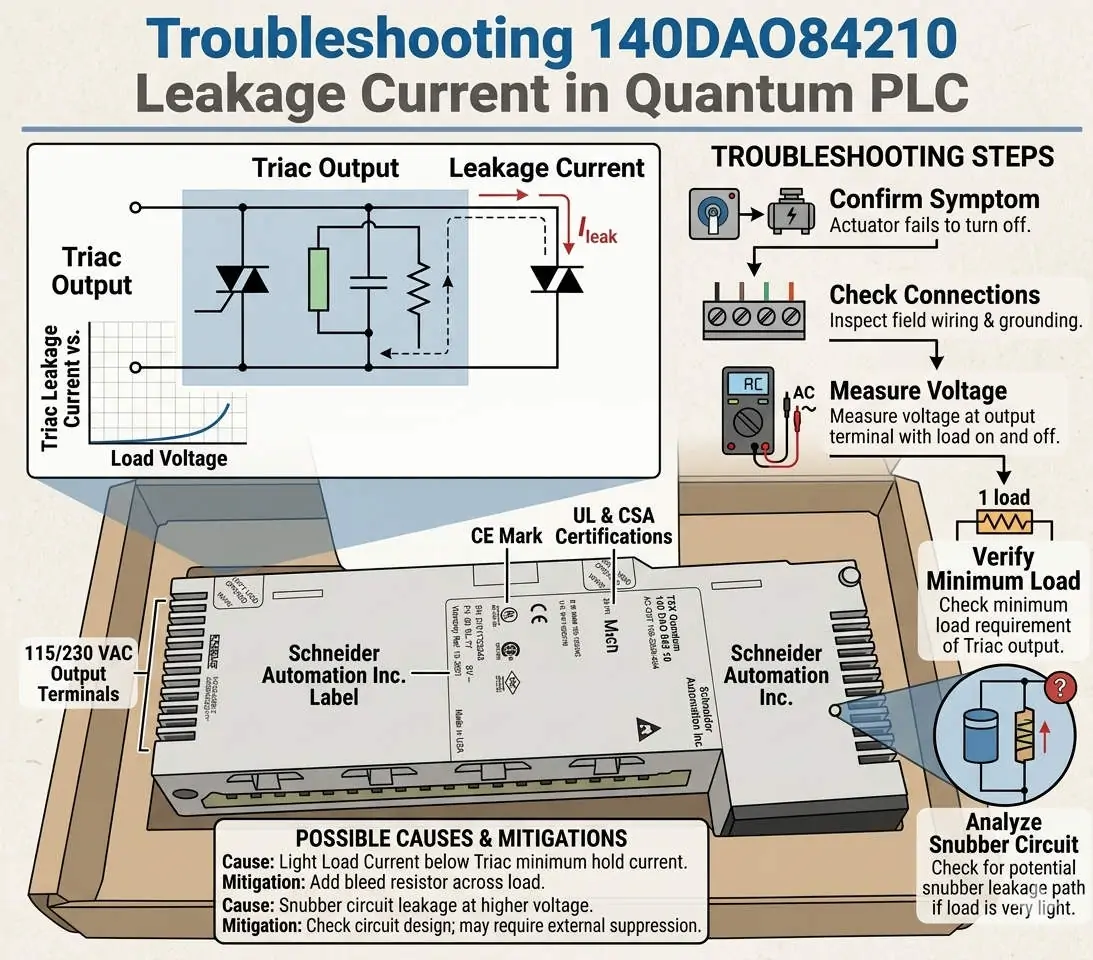
Like many transistor-based modules, the 140DAO84210 exhibits off-state leakage current. Even when inactive, a small current flows through internal protection circuits or semiconductor junctions. High-impedance loads, such as LED relays, may interpret this leakage as a weak signal. Consequently, this can cause “ghost activation” in sensitive instrumentation. During commissioning, multimeters may detect 5–30V, but this voltage collapses under a real load.
Solid-State vs. Relay Output Performance
The 140DAO84210 utilizes solid-state transistor outputs rather than mechanical relays. This design offers faster switching and a longer lifecycle since there is no mechanical wear. However, unlike relays, solid-state outputs lack true galvanic disconnection when turned off. Therefore, if your application requires zero leakage for safety interlocks, you should consider a relay output module instead of a transistor-based unit.
Internal Protection and Surge Suppression Standards
To comply with IEC 61131-2 standards, this module integrates RC snubber circuits and transient suppression. These components protect the output from inductive spikes caused by contactors or solenoids. While these circuits enhance reliability in harsh industrial environments, they are also the primary source of residual voltage. This effect is especially noticeable when using high-impedance DC measurement tools.
Installation and Maintenance Best Practices
If downstream devices trigger falsely due to leakage, install a bleeder resistor (10k–47kΩ) across the load. This provides a discharge path to eliminate floating voltage. Moreover, avoid connecting transistor outputs directly to high-impedance PLC input cards. Using interposing relays ensures proper signal isolation and removes ambiguity. Finally, implement single-point grounding to prevent induced voltage from amplifying perceived leakage issues.
Expert Perspective from Oiltech Controls Limited
At Oiltech Controls Limited, we believe understanding semiconductor behavior is vital for modern plant maintenance. Residual voltage in the 140DAO84210 is a design characteristic, not a failure. While newer platforms like the Modicon M580 offer lower leakage, the Quantum series remains a robust workhorse for existing infrastructure. Proper load design and isolation will resolve most field issues without expensive hardware replacements.
For more technical guides and high-performance Schneider Electric components, visit our catalog at Oiltech Controls Limited to optimize your control system today.
Technical Guidelines for Maintenance
- ✓ Test Under Load: Always measure voltage with the load connected to avoid false floating readings.
- ✓ Isolation Strategy: Use interposing relays for low-power signaling to ensure a true “off” state.
- ✓ Suppression: Verify that external inductive loads have dedicated surge suppression to protect module longevity.
- ✓ Grounding: Maintain single-point grounding to minimize noise interference in petrochemical environments.
Frequently Asked Questions (FAQ)
Q1: If I see 24V on an inactive output, is my 140DAO84210 module faulty?
Not necessarily. If you are measuring with a high-impedance multimeter and no load is connected, you are likely seeing ghost voltage from the internal snubber circuit. Connect the actual field device and check if the voltage drops to near-zero before considering a replacement.
Q2: Why do my small LED pilot lights stay dimly lit when the PLC output is off?
This occurs because the off-state leakage current of the transistor is enough to power the low-current LED. Adding a bleeder resistor in parallel with the light will shunt the leakage current to ground and turn the LED off completely.
Q3: Is it possible to swap this transistor module for a relay module to stop leakage?
Yes, but you must check the power requirements and switching frequency. While relays solve leakage issues, they have a finite mechanical life. If your process requires frequent switching (multiple times per minute), stay with the 140DAO84210 and use an external isolation method instead.
Application Scenario: Chemical Dosing Control
In a recent pharmaceutical project, a 140DAO84210 was used to trigger small solenoid valves. The valves remained partially energized due to leakage current. By implementing 10kΩ bleeder resistors at the terminal block, the engineering team eliminated the residual voltage. As a result, the system achieved precise dosing control without changing the PLC hardware or control logic.