ABB XV C724 BE101 vs. XVC724BE102 Compatibility: Interchanging and Firmware Requirements
Evaluating Core Hardware Roles in ABB Excitation Control Systems
The ABB XV C724 series serves as a critical communication processing interface within complex control systems and turbine excitation architectures. This hardware handles deterministic data exchange between the central processing units, remote I/O sections, and the primary system bus. For heavy critical facilities, maintaining a reliable system bus communication link directly influences power generation stability and overall system trip protection reliability.
Analyzing the Main Differences Between BE101 and BE102 Revisions
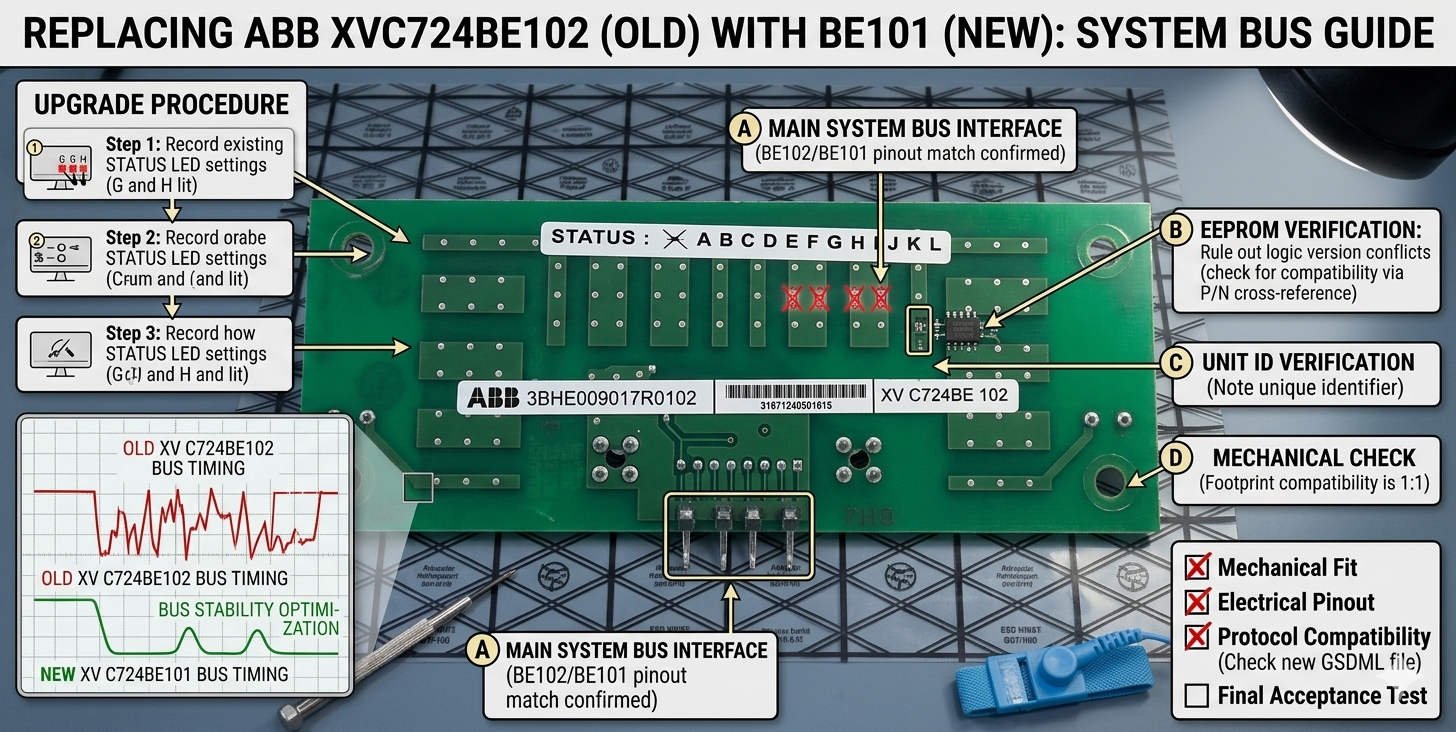
ABB introduced the newer XV C724 BE101 (3BHE009017R0101) module to improve long-term hardware availability and enhance signal protection. Compared to the older XVC724BE102 (3BHE009017R0102) variant, the BE101 design features modern component layouts. Moreover, the manufacturer updated the newer module to handle severe electrical environments more effectively. Consequently, the BE101 provides superior electromagnetic compatibility (EMC) and better thermal resilience during prolonged, high-load industrial operations.
Determining Real-World Interchangeability and System Bus Constraints
Engineers often assume that identical form factors mean immediate plug-and-play installation. However, the XV C724 BE101 and BE102 are not fully interchangeable without careful evaluation. The system bus relies heavily on specific firmware object mapping and precise communication timing parameters. Therefore, swapping a BE102 board for a BE101 in a legacy DCS or UNITROL environment may cause intermittent node drops or synchronization errors.
Understanding System Bus Firmware Upgrade Requirements
Does the newer BE101 board require a system bus firmware upgrade? The answer depends entirely on your current controller CPU generation and the existing software lifecycle release. If your controller software package predates the release of the BE101 hardware, you must perform a firmware update. Skipping this step often causes communication watchdog alarms or a complete failure of the redundant controller switchover mechanism.
Mitigating Noise and Grounding Issues in High-Power Plants
High-power environments with large variable frequency drives (VFDs) generate significant electrical noise. While the BE101 offers improved noise immunity, poor field installation practices can still degrade high-speed bus signals. Engineers must implement low-impedance grounding and verify that shield terminations occur at a single designated point. As a result, proper cable isolation prevents circulating currents from causing sporadic communication resets.
Operational Guidance and Best Practices from Oiltech Controls Limited
At Oiltech Controls Limited, field experience shows that firmware dependencies pose a greater risk than mechanical fit during module changeovers. We recommend reviewing the official ABB hardware compatibility matrix during the early planning stages of your turnaround. Furthermore, maintenance teams must monitor bus error counters for several hours after startup to catch latent timing mismatches. Taking these steps prevents unexpected platform trips and protects production revenue.
To secure authentic ABB excitation parts and access deep technical diagnostics for your system, explore the engineering inventory at Oiltech Controls Limited today.
Essential Field Verification Checklist
- ✓ Software Audit: Document the exact system firmware revision before removing any hardware components.
- ✓ Impedance Testing: Verify the grounding path integrity to eliminate high-frequency electrical noise interferences.
- ✓ Redundancy Validation: Test the automatic processor switchover sequence in a controlled environment post-installation.
- ✓ Thermal Scan: Check cabinet airflow to maximize the operating lifecycle of the newly installed modules.
Frequently Asked Questions
Q1: Why did my controller report a watchdog timeout after installing the newer board?
This issue usually points to a firmware handshake mismatch between the module and the main CPU. The controller expects specific object definitions that the older communication stack does not support. Updating the node definition files usually resolves this error.
Q2: Is it safe to execute a hot-swap operation when changing a BE102 to a BE101?
No, we strongly advise against hot-swapping these modules during live process operations unless your specific system release explicitly approves it. A firmware mismatch can disrupt the active system bus, causing an immediate control system trip.
Q3: How do aging cabinet components impact the communication stability of legacy boards?
Older boards suffer from dried-out electrolytic capacitors and thermal stress after years of continuous usage. This degradation increases susceptibility to electrical noise, leading to unexplained checksum errors that disappear after a system cold start.
Application Solution Scenario: Turbine Excitation Retrofit
An industrial power plant experienced sporadic communication losses on their UNITROL excitation system after replacing an aging XVC724BE102 board. Technicians initially suspected a physical cable defect. However, an engineering assessment revealed that the system controller was running an obsolete 2012 firmware block. After flashing the system bus firmware to a compatible revision, the new XV C724 BE101 module initialized correctly, establishing stable data mapping and eliminating all redundant synchronization lag.